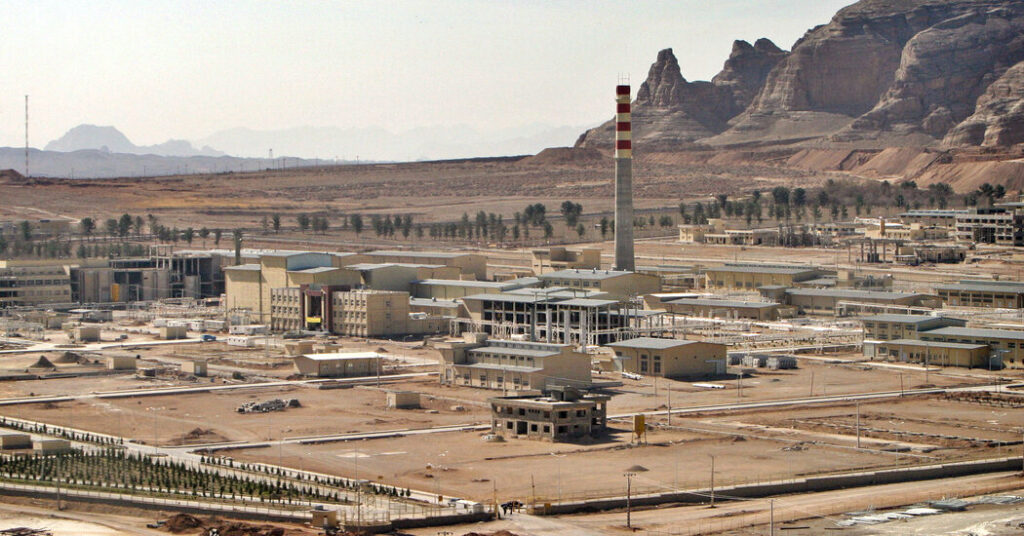
A critical nuclear target in Iran appears to have been spared so far during four days of bombing by the United States and Israel. It is near Isfahan, an ancient city south of Tehran, and is believed to be the site where Iran harbors a batch of uranium sufficient to make nine or 10 atomic bombs.
“It would seem to be the safest place in the republic,” Robert E. Kelley, a former inspector for the United Nations agency that monitors Iran’s nuclear sites along with hundreds of others around the globe, said in reference to the Islamic republic of Iran. “It’s amazing.”
President Trump has made repeated vows to ensure that Iran can never obtain a nuclear weapon. And during the 12-day campaign last June against Iran, Israel and the United States smashed the site at Isfahan. The nuclear base’s main purpose was to convert uranium ore into a gas that could be enriched into nuclear fuel.
Now, nuclear experts suspect that the mountains near the industrial site harbor a complex of tunnels where Iran keeps its batch of enriched uranium that, if further purified, would be sufficient to make nine or 10 atomic bombs.
In a report last week, the United Nations agency that monitors Iran’s nuclear sites, the International Atomic Energy Agency, pointed to the tunnel complex at Isfahan as the likely storage site for Iran’s cache of near-bomb-grade uranium.
Some analysts theorize that Isfahan has been left alone as American and Israeli forces focus on destroying Iran’s air defenses, its military command posts and its hidden batteries of missiles and drones.
Experts watching the campaign — and citing Secretary of State Marco Rubio’s remarks Monday in which he said “the hardest hits are yet to come” — predict that a new wave of American and Israeli attacks in coming days and weeks will focus more directly on Iran’s nuclear sites.
In his remarks, Mr. Rubio said Iran had built up a deadly conventional arsenal as a means of protecting its wide array of nuclear sites.
“What they are trying to do, and have been trying to do for a very long time, is build a conventional weapons capability as a shield,” Mr. Rubio said. “Meaning there will come a point where they have so many conventional missiles, so many drones and can inflict so much damage that no one can do anything about their nuclear program.”
David Albright, president of the Institute for Science and International Security, a nonprofit in Washington, said he expected many strikes on Isfahan in the coming days.
“It will be strange if they don’t hit it” by next week, Mr. Albright said. “If they don’t, they can’t make the argument that they’re preventing Iran from getting the bomb.”
Another theory is that Isfahan has been left alone because an intense bombing of the tunnel complex could make it difficult or impossible for the United States to account for the nuclear material. Still another posits that Washington is holding out hope that Tehran might give it up as part of a negotiated end to the war.
While Isfahan has not been hit, ordnance on Sunday hit Natanz, where Iran had enriched uranium into a form that could fuel nuclear reactors or atom bombs. Mr. Albright’s analysis of satellite imagery showed that the strikes had demolished the entrances to the underground cavern that held centrifuges for uranium enrichment.
The Isfahan site is a giant industrial complex that is mostly out in the open, which makes it vulnerable to satellite surveillance and attack.
The tunnel complex lies nearby, under a mountain, and analysts of satellite images have labeled its three visible entrances as north, middle and south. While damage to the tunnel entrances was visible in June last year, analysts have no knowledge of the degree of damage inside the complex, if any.
Rafael Grossi, director general of the International Atomic Energy Agency, told reporters on Monday that his analysts judged that most of Iran’s highly enriched uranium remained buried deep beneath Isfahan and had not been bombed in the current conflict, or last June.
In a January analysis of the tunnel complex, Mr. Albright of the science institute said he observed increased activity at the northern entrance, including the coming and going of many vehicles. While acknowledging the unknowns, he and his colleagues assessed that it was plausible that Iran had been “moving assets inside the tunnel rather than out.”
Another concern is that Iran, just before the onset of the 12-day war last June, announced that it would, in secret, open a new uranium enrichment site. That site is now thought to be within the Isfahan tunnel complex.
On Friday, just before the current war started, the I.A.E.A. said it had no knowledge of the precise location of the new site, or whether it was operational.
Since Iran first declared the new facility last year, the report added, “it is a matter of increasing concern that Iran has never provided the Agency with access.”
William J. Broad has reported on science at The Times since 1983. He is based in New York.
The post An Iranian Nuclear Site Avoids New Airstrikes, for Now appeared first on New York Times.