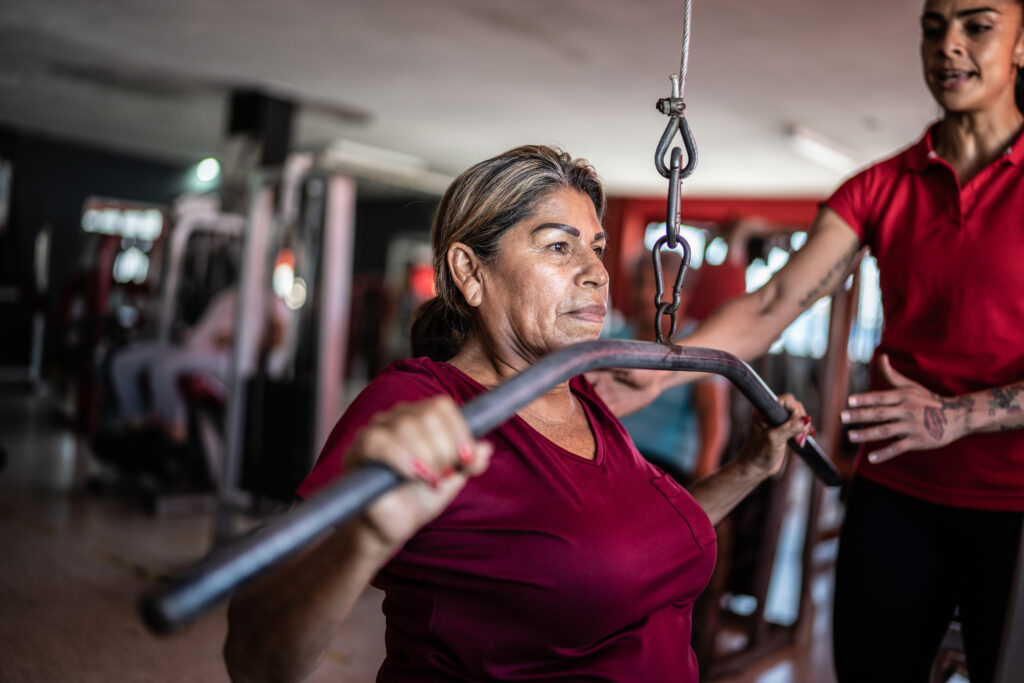
To live long, be strong.
That’s the poetic implication of a new study of longevity and mortality in a large group of women aged 63 to 99.
In the study, published in February in JAMA Network Open, researchers checked the women’s health, fitness, grip strength and lifespans. By analyzing that data, they hoped to tease out the importance of muscular strength for healthy aging.
The results “were a bit of a surprise,” said Michael J. Lamonte, lead author of the study and a professor of epidemiology and healthy aging at the University of Buffalo in New York. Strength turned out to be a key — and singular — contributor to longer lives, he said, reducing the risk for early death by a third or more, even when the researchers took into account people’s aerobic fitness, health, age and exercise habits.
The study used simple DIY tests of strength, so it has practical takeaways about how to measure and augment our own. But it also raises broader, almost philosophical questions about the extent to which we’ve undervalued muscles as a driver of successful aging, especially in women.
Problems with past science
Plenty of existing science shows that strength contributes to improved longevity. A 2024 Nature study, for instance, of almost 10,000 men and women found that weak grip strength equated to an increased risk of early death. Similarly, a 2016 review of past research concluded that muscular weakness reliably predicted upcoming concerns with “cognition, mobility, functional status and mortality.”
But most of this research had a scientific shortcoming: It couldn’t distinguish between the benefits of being strong and those of being active and fit. Strength may have been contributing to longer lives primarily by enabling people to move more and improve endurance. In that case, it could be the extra exercise and aerobic fitness that improved people’s longevity, not strength, per se.
So, for the new study, the researchers set out to home in on and isolate the effects of strength, to the extent they could. They turned to data from a subset of 5,472 women who had joined the large-scale Women’s Health Initiative.
These women had worn an activity tracker for a week, to objectively measure how much they moved around. They’d also completed a timed-walk test of their aerobic fitness (assessing how long it took to walk 8 feet), multiple medical exams, lifestyle questionnaires and two checks of their current strength. One measured their grip strength with a dynamometer (a hand-held device you squeeze as hard as possible), the other their lower-body strength with the 5-times-sit-to-stand test, during which they rose from a chair and sat again five times as fast as possible.
Did stronger women live longer?
The researchers also checked death registries for about eight years after people joined the study. More than a third of the women died during that time.
Then the scientists cross-checked strength and mortality, to see if stronger women lived longer. Unsurprisingly, they did. The scientists then refined their analysis, controlling for people’s health, bodily inflammation markers, smoking history, age, ethnicity, other general lifestyle factors and any history of falls or use of a cane or similar mobility device, to see if stronger women still lived longer, despite those other issues. They did.
They also removed data for any women who’d died within the first five years of the study, since they might have been weak because of illness, which would have skewed the results.
Finally, the scientists also controlled for the women’s aerobic fitness and daily physical activity, including whether they met the experts’ recommendation of 150 minutes per week of moderate exercise and how many hours each day they spent sitting. If the relationship between strength and longevity still held, the results would tell us that strength, by itself, was associated with longevity.
And again, the results held.
In effect, the findings showed that if two women had similar fitness and exercise habits — “which, in these women, was mostly walking,” LaMonte said — the woman whose muscles were stronger would typically live longer.
How to check your strength
The study convincingly underscores that “having sufficient strength, in itself, is an independent factor in health and longevity,” said Brad Schoenfeld, an exercise scientist at CUNY Lehman College in the Bronx, New York, and expert in the science of resistance trainingwho wasn’t involved in the new study.
Encouragingly, the strength involved was hardly Herculean. The grip strength of the strongest women in the study averaged about 24 kilograms or 53 pounds, according to their dynamometer readings, a little below average for women of all ages, while the fastest 5-times-sit-to-stand times were around 11 seconds.
You can check your own grip strength with a dynamometer, available online or at many gyms, or, more informally, by seeing how long you can hang from a pull-up bar, a move known as a dead hang. Most experts agree that healthy men and women under 40 should generally be able to hold that position for a minute or more, while people between 40 and 50 should aim to dead hang for at least 30 seconds, and those past age 60, should try for a minimum of 10 seconds.
You can also assess your 5-times-sit-to-stand speed easily with a chair and a stopwatch. Sit down, fold your arms over your chest and rise and sit as fast as you can five times.
The study’s limitations
The study, which was a snapshot of one point in the volunteers’ lives, can’t show causation, meaning it doesn’t prove that strength causes us to live longer, only that strength and lifespan are closely linked. It focused, too, exclusively on women, although LaMonte thinks “it’s likely” the results would hold true for older men, as well as younger people. The researchers also didn’t measure the women’s muscle mass, only their strength.
Even with those caveats, the study’s main lesson remains compelling. “Strength should be considered” alongside aerobic exercise as essential for longevity, LaMonte said. Strength training and endurance exercise, like walking or jogging, have distinct physiological effects, he said, prompting differing changes to our muscles and cells. Together, these effects probably offer our best chance of prolonged health and greater longevity. So, he said, “do both.”
Do you have a fitness question? Email [email protected] and we may answer your question in a future column.
The post Being stronger means you’re likely to live longer, new study finds appeared first on Washington Post.