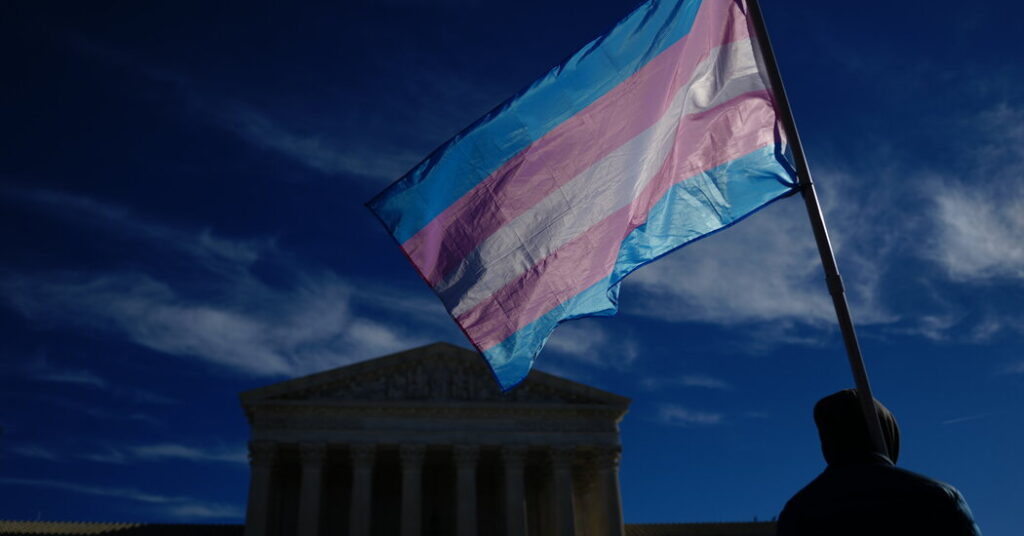
The Supreme Court on Monday sided with a group of religious parents, temporarily blocking California from using policies that generally bar public-school teachers from outing transgender students to their parents.
A group of Christian teachers and parents asked the justices to intervene on an emergency basis, contending that the state had adopted a policy that requires public schools to hide students’ transgender status from their own parents and to facilitate their transition, even over their parents’ objections.
California’s attorney general, Rob Bonta, countered that the challengers had misconstrued state law and policy. He told the court in a filing that California’s policies did not prohibit the disclosure of information about students’ gender identities, and in some cases required disclosure when there was a risk of serious harm to the student.
But for many students, he wrote, “the consequences of compelling the disclosure of confidential information about their gender identity would be irreversible.”
In its order on Monday, the court’s conservative majority granted the emergency request of the parents with religious objections, saying they were likely to succeed in their legal challenge to California’s policies. As a result, the justices said the rules could not remain in place while litigation continued.
The parents have “sincere religious beliefs about sex and gender, and they feel a religious obligation to raise their children in accordance with those beliefs,” according to the unsigned order. California’s policies, the majority added, “violate those beliefs” and impose a burden on the parents’ religious rights.
In addition, the majority said that a broader set of parents beyond those with religious objections have a separate right to “not be shut out of participation in decisions regarding their children’s mental health” and that the state’s policies most likely violate their rights to direct the upbringing of their children.
The court’s three liberal justices dissented. Justice Elena Kagan criticized her conservative colleagues for being hasty, essentially prejudging a significant issue on an emergency basis and without full briefing or oral arguments. The court also acted before the appeals court had formally resolved the matter.
“The court is impatient: It already knows what it thinks, and insists on getting everything over quickly,” Justice Kagan wrote. She adding that the majority could not claim “that thought and care are not needed” in a case involving thorny legal questions.
“If nothing else, this court owes it to a sovereign state to avoid throwing over its policies in a slapdash way,” she wrote.
Three of the justices in the majority pushed back on the dissent, insisting the temporary order is “not a sign of the court’s ‘impatience.’”
Instead, they wrote, the order reflects the risk of harm if parents are excluded from “participating in consequential decisions about their children’s health and well-being.” The concurrence was written by Justice Amy Coney Barrett, who was joined by Chief Justice John G. Roberts Jr. and Justice Brett M. Kavanaugh.
The case involves the rights of parents to information about their public-school children and the privacy interests of students. The order comes as the justices have for weeks been considering at a series of private conferences whether to review similar claims in cases from Massachusetts and Florida.
At issue in those cases is the question of whether a school district violates parents’ rights when it encourages students to transition to a different gender or assists in that process without the parents’ knowledge. The justices have not yet announced whether they will hear the cases.
The court has turned away other related cases, but several conservative justices expressed an interest in considering the issue.
The court is already immersed this term in litigation involving gender identity and transgender rights. The justices are weighing the constitutionality of state laws banning transgender athletes from participating on girls’ and women’s sports teams.
They are also considering the case of a Christian therapist who challenged a Colorado law barring the practice of so-called conversion therapy for gay and transgender minors.
In the California schools matter, parents and teachers sued in 2024, challenging a set of state laws and policies that they said violated their rights to free speech and the free exercise of religion. Monday’s order grants relief only to parents, but the effect of the ruling is to block the state’s policies while the case plays out in the lower courts.
The policies, the opponents said in court filings, violate the due process rights of parents by requiring teachers to get the consent of students before disclosing their transgender status or that they have begun to use pronouns at school that do not match their birth certificates.
Specifically, the challengers took issue with the attorney general’s 2025 “State of Pride” report published on a government website. It tells students: “You have the right to disclose — or not disclose — your gender identity on your own terms, regardless of your age.” The document continues: “Your school, whether public or private, doesn’t have the right to ‘out’ you as L.G.B.T.Q.+ to anyone without your permission, including your parents.”
Two parents involved in the case said that they were not told for months that their middle-school-age daughter was being identified as male at school, and that they learned about it only after she attempted suicide, court filings show.
There is deep disagreement over what the California Constitution and state law actually require. In January 2025 the Legislature passed a law prohibiting policies that require school employees to disclose the sexual orientation or gender identity of students without their consent.
In court filings, the attorney general’s office has taken the position that policies requiring disclosure — rather than allowing it at times — are a form of sex discrimination because school employees would be required to notify parents when a student identifies as transgender, but not when a student identifies as cisgender. Instead, the state backs policies that encourage students to inform their parents and provide counseling and support for those discussions.
In December, a Federal District Court judge in Southern California barred state school officials from keeping information from parents and from abiding by a student’s request to be addressed by a particular name or pronouns over the objection of a parent.
The judge, Roger T. Benitez, relied in part on a Supreme Court decision last year in the case Mahmoud v. Taylor in holding that parents have the right to be told before a school socially transitions their child and to opt out of the process. In last year’s case, the court sided with religious parents who wanted to withdraw their young children from class sessions with L.G.B.T.Q.-themed story books.
The judge in California acknowledged the state’s interest in protecting vulnerable children from harassment and discrimination, but said the state’s “parental exclusion policies” were harmful to parents, teachers and the children.
A three-judge panel of the U.S. Court of Appeals for the Ninth Circuit put Judge Benitez’s order on hold, finding it overly broad because it covered every parent of millions of students and every public-school employee. The panel said the judge misread the state’s policy, which “does not categorically forbid disclosure of information about students’ gender identities.”
Ann E. Marimow covers the Supreme Court for The Times from Washington.
The post Supreme Court Sides With Religious Parents, Blocking California’s Trans Student Policy appeared first on New York Times.