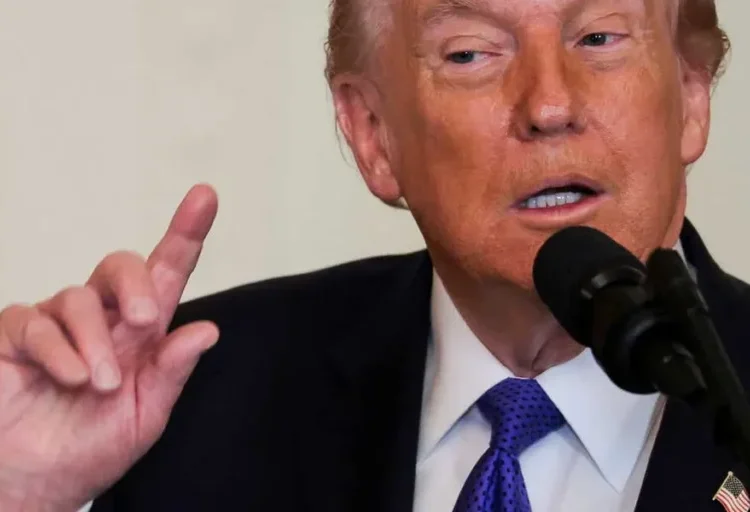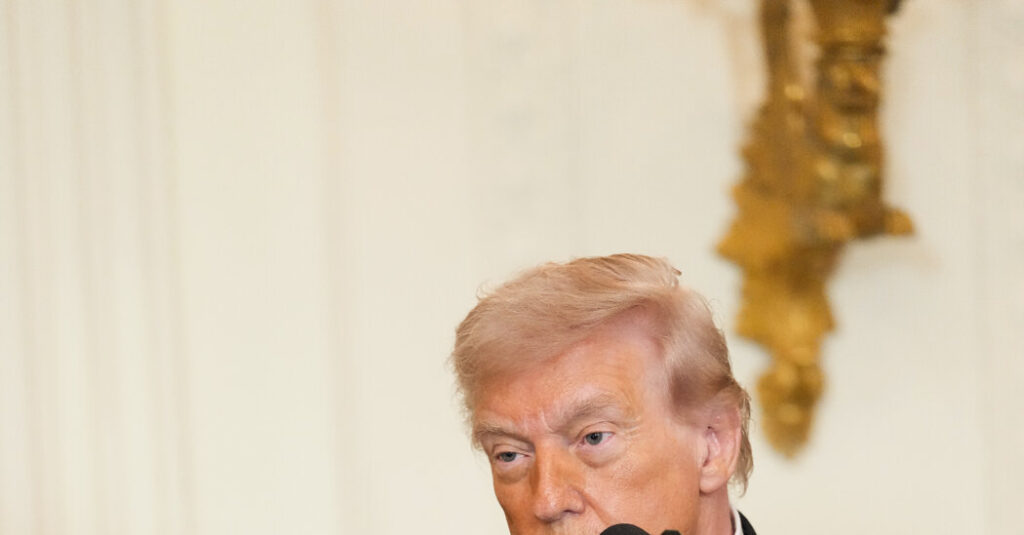
Shortly before noon on Monday, the public got its first good look at the commander in chief since he took the country to war with Iran.
He’d been mostly out of sight all weekend, monitoring the combat from a makeshift situation room at Mar-a-Lago in Florida. He did post two videos of himself talking about the war on social media, and he took plenty of phone calls from reporters. But now he was back before the cameras of the White House press corps, hosting a Medal of Honor ceremony for military veterans of past wars in the East Room.
The president who showed up to work Monday morning was a president at war. How might he act?
Not so different from how he normally acts, it turns out.
“Let me provide a brief update on Operation Epic Fury,” he began. He spent the next five minutes offering vague projections of a timeline (“whatever the time is, it’s OK, whatever it takes”) and condemnations of the Iranian regime (“sick” and “sinister”) before abruptly switching to an entirely different but all too familiar topic: White House décor.
“I picked those drapes in my first term,” he said, turning away from the teleprompters to admire curtains in the room. “I always like gold.” This led him to talk about “the most beautiful ballroom anywhere in the world” that he was building. He did his routine about how his wife is getting fed up with all the construction noise. There was some light chuckling from the military veterans and Pentagon officials in the room.
The president praised his administration for its handling of the southern border. He criticized Barack Obama. He joked about awarding himself a Medal of Honor.
It was unusual how usual he was acting.
In the past 48 hours, six U.S. service members had died, three American fighter jets were shot down in friendly fire over Kuwait, oil prices spiked, and some of the administration’s most unquestioning supporters had become restive. Only 21 percent of the public liked the idea of the United States initiating an attack on Iran. Here, now, in the East Room, the president could offer a proper explanation as to what he was doing and why.
But he spent more time talking about the first lady and the ballroom than about the service members who died since Operation Epic Fury began.
Presidents typically address the nation within 24 hours after launching a military campaign. In this case, Mr. Trump didn’t make much of an effort to prepare the public for war with Iran — he barely touched on it during last week’s State of the Union address — and he wasn’t doing much to explain it now. The new war was allotted five minutes of his time, tacked on to remarks he was making about the old wars.
There was something discordant about using this event for that purpose. The audience in the East Room was made up mostly of military men and women , people who’d fought in Vietnam and Afghanistan. Mr. Trump received a medical exemption from the military — bone spurs — for Vietnam and has condemned the war in Afghanistan as needlessly long and misbegotten. And yet, moments before speaking to this crowd, he told a reporter from the New York Post that he has no hesitation about sending troops to fight against Iran.
“I don’t have the yips with respect to boots on the ground,” he told the Post, “like every president says, ‘There will be no boots on the ground.’ I don’t say it.”
One of the men being honored Monday was a platoon leader in Vietnam who saved dozens of U.S. troops despite being wounded by an enemy sniper. Another award was being given posthumously to a soldier who was killed in Afghanistan after an insurgent’s suicide vest detonated. A flag with 13 white stars set against a blue backdrop was propped up on Mr. Trump’s right side. He told the room he expected the war in Iran to last “four to five weeks, but we have capability to go far longer than that.”
He spotted Republican Senators Tom Cotton and Bill Hagerty in the room. “You guys were great on television this weekend,” Mr. Trump said. “Can’t have a better representative, both of you, thank you very much.”
There was one thing in particular that Mr. Trump had heard in news coverage of the war that was bothering him Monday .
“Somebody said today, they said, ‘Oh the president wants to do it really quickly, after that he’ll get bored,’” Mr. Trump said. “I don’t get bored. There’s nothing boring about this. Do you agree with that, Pete?”
Defense Secretary Pete Hegseth — Mr. Trump had changed the job title to “Secretary of War” earlier this year — was also there in the room.
“There’s nothing boring about it,” Mr. Trump said to Mr. Hegseth, Mr. Caine and all the members of the military gathered before him.
“I never get bored,” he added.
He took no questions.
Shawn McCreesh is a White House reporter for The Times covering the Trump administration.
The post In First Appearance Since Taking the Country to War, Trump Is Business as Usual appeared first on New York Times.