There is a lot happening, and it’s happening fast.
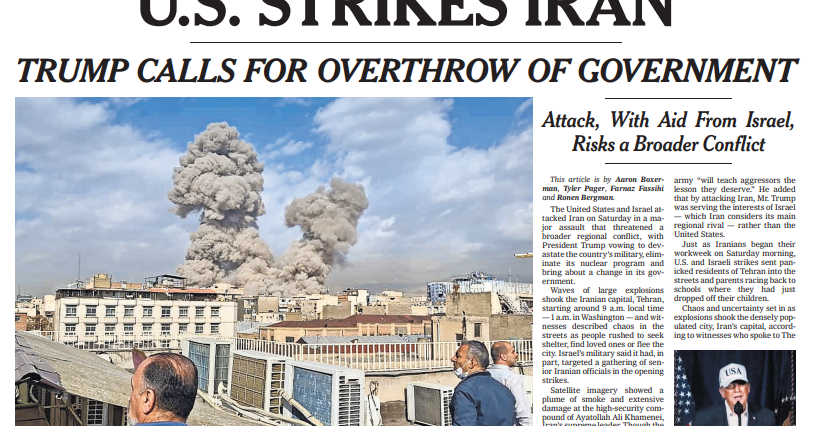
On Feb. 28, the United States and Israel launched joint attacks on Iran. A day later, Iran announced that Ayatollah Ali Khamenei, the nation’s supreme leader for almost 37 years, had been killed.
In Iran, the death of the supreme leader is a watershed moment in the 47-year existence of the Islamic Republic, and raises the prospect of a power vacuum in an already turbulent region. The scenes that followed — throngs of Iranians taking to the streets to celebrate, others turning out to grieve — signal a deep uncertainty about what comes next.
Whether you already understand some of this context, or whether it’s all new for you, we hope what we offer here — a menu of links to free New York Times maps, videos, articles, photos, podcasts and opinion pieces — can help.
We invite you to first listen to the podcast below to get the big picture. Then you can explore any aspect of this complex topic that you want to know more about by clicking the link embedded in each question.
Then, we hope you’ll use our open-ended prompts at the bottom of this post to tell us about your reactions and ask additional questions, whatever they may be.
Note: The links in this piece all go to recent news articles unless otherwise noted. You can keep up with all the developments as they happen via Times Live Updates.
Get the big picture in one quick podcast:
Listen to the Headlines podcast, March 2 edition. You can also read the transcript.
Understand more about what just happened:
Why did the United States and Israel attack Iran?
Why did President Trump pick this moment to begin what our national security correspondent, David E. Sanger, called, in the video below, a war of choice? What went on behind the scenes of Mr. Trump’s decision?
How did the attack unfold? What do these maps show about where the United States, Israel and Iran have struck?
Who has been killed in this war so far?
What can these photographs tell you about what has happened, the aftermath and the reactions?
Learn some background that can help this news make sense:
Where is Iran on a world map?
Why is the Persian Gulf so critical to the global economy?
How has Iran projected its military power across a large swath of the Middle East?
What can this obituary of Ayatollah Ali Khamenei tell you about the hard-line cleric and his government?
What was everyday life in Iran like under Ayatollah Khamenei? For example, what does this 2022 article tell you about the role of women in the country?
How have young people in Iran been breaking taboos and changing social mores?
Why were Iranians protesting their government in recent months?
What happened after the Iranian government brutally killed thousands of those protesters?
What do you know about the Iranian Revolution of 1979 and how it continues to shape the country today? (This article is from 2019.)
What do you know about Iranian culture? (For instance, more than 300 million people in Iran and beyond will celebrate the ancient holiday of Nowruz this month.)
Consider the possible implications of this war:
What is the Trump administration’s plan? How have the official statements about that plan conflicted with one another?
What might the plan mean for American troops?
Has Mr. Trump violated the Constitution by starting a war without congressional authorization?
How has Iran retaliated? What else might it do?
What do experts say may be the geopolitical effects of this war?
How could these events affect the world economy?
Find out how people are reacting around the world and across political lines:
Who is still in charge in Iran, and what have these leaders said?
How have Iranians at home reacted? What about those who live abroad?
What do Israeli citizens think?
How do American citizens feel?
What have world leaders said? For example, what does this war mean for America’s European allies?
How have Democrats and Republicans in the United States reacted?
What can you learn from the range of perspectives published on the Times Opinion page? Here is a selection:
-
Times Editorial Board: Trump’s Attack on Iran Is Reckless
-
Amir Ahmadi Arian: The Outlook Is Grim for a Freer Iran
-
Thomas L. Friedman: How to Think About Trump’s War With Iran
-
Ben Rhodes: Trump May Come to Regret This
-
Bret Stephens: Trump and Netanyahu Are Doing the Free World a Favor
-
David French: War and Peace Cannot Be Left to One Man — Especially Not This Man
Now that you have some context, tell us …
-
How do you make sense of fast-moving news like this? Besides the Times articles linked in this post, what are your sources for the news? Why do you trust them?
-
What is your reaction to what is happening, based on what you understand right now?
-
What questions do you have?
-
Does this news matter to you? Does it affect you or a community you care about? Why do you think it is such a big story worldwide?
-
If you had to sum up what has happened since Feb. 28 for an 8-year-old, what would you say?
-
What do you think may happen as a result of this war? What are your hopes and fears?
Students 13 and older in the United States and Britain, and 16 and older elsewhere, are invited to comment. All comments are moderated by the Learning Network staff, but please keep in mind that once your comment is accepted, it will be made public and may appear in print.
Find more Student Opinion questions here. Teachers, check out this guide to learn how you can incorporate these prompts into your classroom.
Katherine Schulten has been an editor at The Times’s Learning Network since 2006. She spent 19 years as a high school English teacher and a literacy consultant in New York City public schools.
The post The War in Iran: A Place for Student Questions and Reactions appeared first on New York Times.