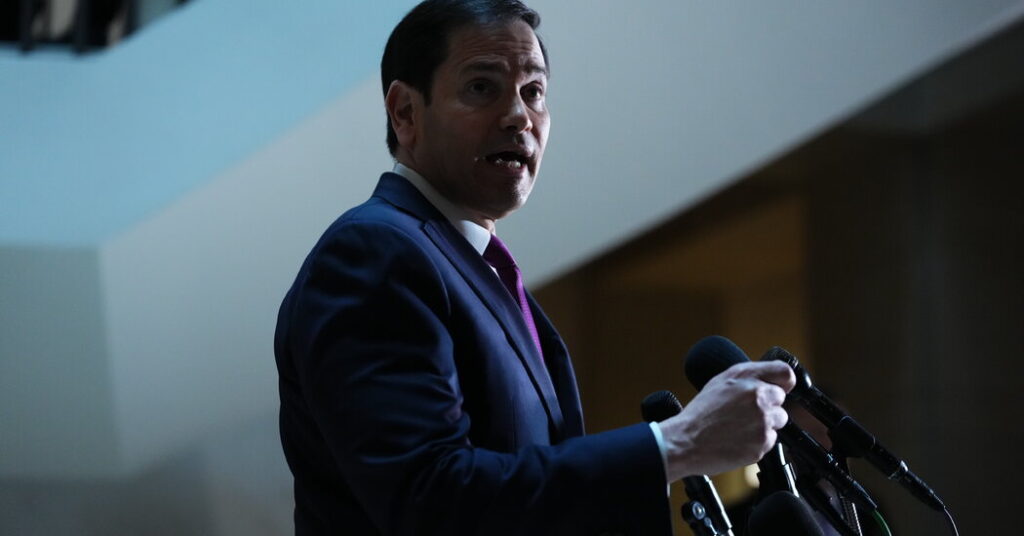
Secretary of State Marco Rubio warned that “the hardest hits are yet to come from the U.S. military” in the offensive against Iran, as he gave conflicting rationales for the attack underway as both a pre-emptive strike and a response to an immediate threat.
Speaking to reporters on Capitol Hill on Monday, Mr. Rubio signaled plans for an escalation of the U.S.-Israeli military operation. The “next phase will be even more punishing on Iran than it is right now,” he declared.
Mr. Rubio, who was about to head into a closed-door meeting with senior lawmakers who had expressed skepticism about the administration’s justification for attacking Iran, offered a muddled message, saying the strikes were a response to an “imminent threat” but then describing the campaign as a pre-emptive and based on the assumption that Iran would strike at the United States once Israel began bombing the country.
“The imminent threat was that we knew that if Iran was attacked, and we believed they would be attacked, that they would immediately come after us, and we were not going to sit there and absorb a blow before we responded,” Mr. Rubio said. “We went proactively in a defensive way to prevent them from inflicting higher damage.”
He went on to lay out military objectives that had nothing to do with immediate danger to the United States and appeared rooted instead in a longer-term mission of weakening Iran’s long-range missiles to degrade its ability to shield its nuclear program.
“The purpose of this is to destroy that missile capability,” he said, reaching beyond the administration’s initial explanation that the operation was meant to stop Iran from developing a nuclear weapon.
“What they are trying to do and have been trying to do for a very long time is build a conventional weapons capability as a shield where they can hide behind,” Mr. Rubio said. “Meaning there will come a point where they have so many conventional missiles, so many drones and can inflict so much damage that no one can do anything about their nuclear program.”
His comments reframed the U.S. participation in the strikes as being far beyond a response to a specific, time-sensitive threat, which a president has broad unilateral authority to respond to. That raised more questions about Congress’s role, a question that the House and Senate are set to weigh in on this week in a pair of votes seeking to limit President Trump’s power to continue using force against Iran.
Mr. Rubio’s remarks also contradicted the administration’s previous emphasis on the possibility that Iran could soon launch missiles capable of reaching the continental United States, an argument he made last week ahead of the strikes, even though American officials told reporters that U.S. intelligence agencies had no evidence Iran was on such a path.
Robert Jimison covers Congress for The Times, with a focus on defense issues and foreign policy.
The post Rubio Warns ‘Hardest Hits’ on Iran Lie Ahead and Offers Conflicting Rationales appeared first on New York Times.