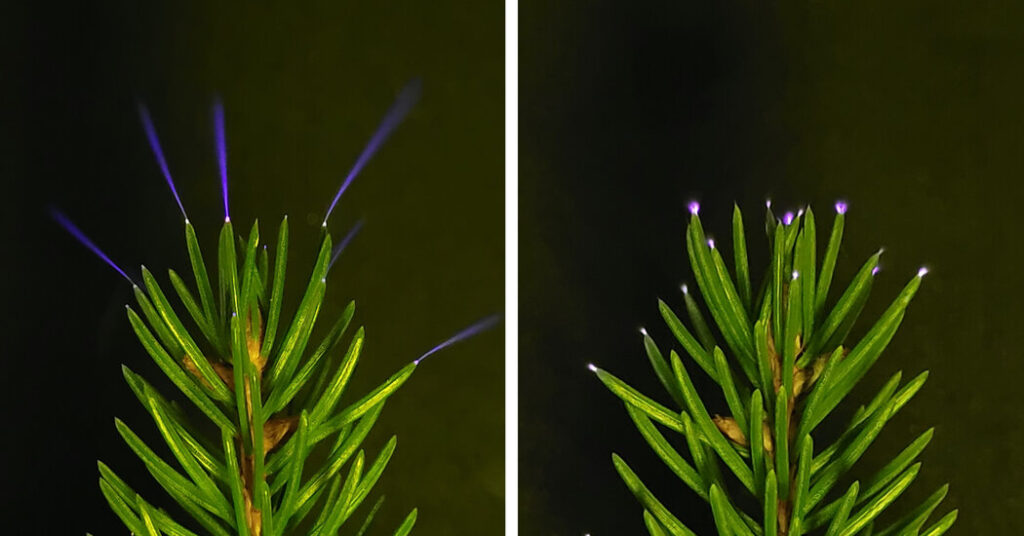
When lightning strikes in a thunderstorm, people occasionally report seeing eerie violet light coming from the tips of ship masts, church spires and even animal horns. This ghostly phenomenon is rarely seen and was once believed to be a good omen. It is nicknamed St. Elmo’s Fire.
However, a study published last month in Geophysical Research Letters says this violet glow may be pretty common if you know how to look for it. In fact, during thunderstorms, St. Elmo’s Fire may light up entire forest canopies in a faint, flickering purple hue.
In the treetops, this phenomenon is nearly impossible to see with the naked eye. But in just the right conditions, “it would look like a whole bunch of fireflies or a really cool light show,” said Patrick McFarland, a meteorologist at Pennsylvania State University and an author of the study.
Through lab experiments, and a summer spent chasing storms in a modified minivan, Mr. McFarland and his colleagues were able to capture photos and videos of weak electrical discharges, known as coronae, appearing on the very tips of trees during thunderstorms.
St. Elmo’s Fire occurs when a strong electric field concentrates around a sharp point, ionizing the surrounding air molecules and creating plasma with a blue or violet glow. Scientists have long wondered if the tips of trees might become a focal point for the eerie emanations.
Determined to find out, Mr. McFarland and his colleagues took a branch from a campus spruce tree and exposed it to strong electric fields in their lab. “And sure enough, it glowed,” he said. Indeed, the waxy tips of the spruce’s needles became adorned with glowing balls of purple light.
While the glow could be photographed in the lab in a pitch-black room, seeing it in the wild was going to be tricky.
Not only would they need supersensitive imaging equipment, but they had to find a way to wield it in a thunderstorm. But like most of life’s problems, this one could be solved with a 2013 Toyota Sienna that carried “all kinds of instruments,” Mr. McFarland said.
“We had to remove a seat to put the telescope in, and then we cut a 12‑inch hole in the roof,” he explained. “Totally killed the resale value of the car.”
It also carries an electric field detector, a Faraday cage and a roof-mounted periscope connected to an ultraviolet camera. The team piled in and spent much of the summer of 2024 chasing storms up and down the East Coast.
Although they couldn’t see much during the storms, they were astonished when they returned to the lab and analyzed the footage and found out how common St. Elmo’s Fire was.
“Every single tree that we looked at under a thunderstorm had very similar amounts or frequencies of this corona glow,” he said.
The team didn’t just see one leaf or needle tip glow; they saw hundreds. The implication is that forests are constantly illuminated in bursts of violet-blue light that last up to three seconds and often leap from leaf to leaf. Our eyes are simply unable to see them.
Richard Zare, a chemistry professor at Stanford University who was not involved with the study, said the discovery had implications for understanding how lightning and trees combine to generate ozone and nitrogen oxides in the atmosphere.
“It might be very important,” he said.
According to Loïc D’Orangeville, a forest ecologist at Laval University in Quebec who was not involved in the study, such compounds, in high concentrations, can be harmful to trees. Though he suspects that the trees have evolved to adapt to those compounds, Dr. D’Orangeville said additional research could study how St. Elmo’s Fire affects trees.
“There are around 1,800 thunderstorms occurring at any given moment on Earth,” he said. “So that’s quite a significant amount of those coronas occurring at all times.”
Dr. D’Orangeville said the best part of the study was learning something new about forests.
“As an ecologist, I think it’s neat to discover something new that’s going on with the trees that I had absolutely no clue existed,” he said.
The post Your Closest Forest Gets Lit Up by a Hidden Purple Glow appeared first on New York Times.