BEIT SHEMESH, Israel — Even before U.S. and Israeli warplanes struck Iranian targets, officials in Washington and Jerusalem were bracing for retaliation. They had gamed out missile salvos, cyberattacks, proxy strikes on U.S. bases and Israeli cities. What few seemed prepared for was the speed — and the geographic sprawl — of the blowback: some 300 million civilians, across more than a dozen nations, suddenly under the umbrella of an escalating war.
By Monday, less than 72 hours after the first strikes, the conflict had ricocheted well beyond the original targets in Iran, Israel and Iraq. Missiles and drones streaked toward capitals around the Persian Gulf. Hotels and apartment buildings in the United Arab Emirates were hit. Israel bombed Hezbollah positions in Lebanon. Militias aligned with Tehran claimed strikes from the Mediterranean to the Red seas.
In Cyprus, explosions sounded at a British base Sunday, marking the first European country to be hit. Sirens wailed in Nicosia on Monday.
“The regional spillover is already happening,” said Shira Efron, a Tel Aviv-based fellow at Rand, the security think tank. “This started as a semi-surgical campaign targeting leadership and military assets. Already it’s spinning almost out of control.”
The cascade began shortly after dawn Saturday, when Israeli aircraft — backed by U.S. intelligence, aerial refueling and naval support — struck what officials described as Iranian command-and-control facilities and missile infrastructure, as well as Iran’s supreme leader, Ali Khamenei.
As the Israeli-American attacks continue, Iran’s response has spread like wildfire, burying civilians in a debris field stretching across the Middle East and spreading death and trauma well beyond military targets.
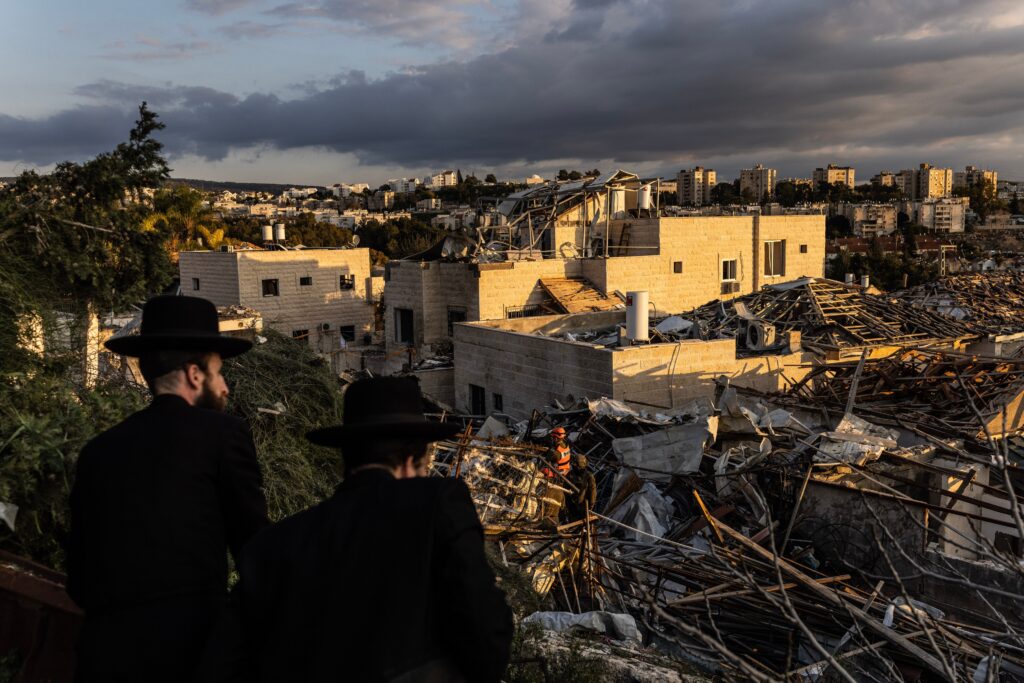
In Beit Shemesh, a small city west of Jerusalem, Mazalika Amrani, 61, came to consciousness Sunday afternoon in the bomb shelter where she had been waiting out an air raid with her neighbors. Slowly, she realized that the suffocating mass on top of her was a pair of those neighbors, two of the nine people killed when an Iranian missile vaporized the building above.
“Everybody next to me died,” Amrani said in tears Monday, wearing borrowed pajamas, as volunteers rushed to clear some of the most dangerous rubble from streets strewn with twisted metal and broken bricks. “My neighbors died, the children died. It is a nightmare. Why, why, why can’t there be peace and not war?”
Amani’s destroyed shelter was beneath a synagogue. In Lebanon, a priest described sheltering terrified migrant workers from Israeli attacks against Hezbollah strongholds south of Beirut.
“We turned the church again into a shelter,” said Robert Gemayel of the Jesuit Refugee Service. “It seems like it’s going to escalate more.” In Lebanon, at least 31 people were killed and 149 were injured, according to the Ministry of Health.
In the United Arab Emirates, explosions rocked hotel and residential complexes around Abu Dhabi and Dubai. A high-rise in Bahrain was in flames Monday morning. Drones even struck a port in Oman — long a quiet intermediary between Washington and Tehran — an attack Iranian officials blamed on a targeting mistake.
By pulling gulf monarchies and even Europe — Cyprus is a European Union member — into the blast radius, Tehran signaled that no one can remain a bystander and no target is off-limits.
“What makes this escalation particularly alarming is that the Iranian strikes were not limited to military installations, despite Tehran’s claims,” Khalid Al-Jaber, executive director of the Middle East Council on Global Affairs, wrote in an Atlantic Council analysis Sunday. “They affected airports, critical infrastructure, hotels, and residential areas — spaces where civilians live, work, and travel.”
At least 555 people were killed in Iran, according to the Red Crescent there. There were reports of at least 10 dead in Israel, three killed in the UAE, two in Iraq and one each in Bahrain, Kuwait and Oman, and more injured in those countries as well as in Qatar. The Washington Post could not independently verify the tallies.
Four U.S. soldiers have been killed so far, the Pentagon said, and three U.S. F-15E Strike Eagles were downed by friendly fire over Kuwait with the six crew ejecting safely.
Diplomats said they fear the expansion could mark a pivot to something far more volatile.
“This is the gulf states’ worst nightmare,” Efron said. “They feared this outcome the most, and made extraordinary efforts to mediate and prevent a war. They pledged that their territory would not be used as part of the U.S. campaign. None of that helped them.”
Perversely, Iran may have forced the reluctant gulf states more firmly into President Donald Trump’s camp than they ever wanted.
Analysts in the region were already picking up signals that some of the countries were prepared to make their territory available to the Americans. That could open up new tactical land and sea routes for U.S. attacks but pull the countries further from the nonaligned role they sought.
“The confrontation is forcing the UAE much closer to the U.S. and Israeli position than it wants to be,” Eric Alter, dean of the Anwar Gargash Diplomatic Academy in Abu Dhabi, wrote in the Atlantic Council roundup. “On the one hand, the UAE remains a security partner of the United States,” Alter said. “It quietly aligns with Israel on many regional concerns, especially regarding Iran’s missile program and its network of regional militias. On the other hand, the UAE has heavily invested in building a more stable relationship with Tehran. Trade has grown, diplomatic ties have been renewed, and both sides have been working to prevent escalation in the Gulf.”
A 53-year-old businesswoman in Dubai, who spoke on the condition of anonymity because of fears for her safety, said that hotels had been hit by Iran’s retaliatory strikes, a serious blow to the country’s crucial tourism industry.
“The doors and windows in my house are constantly vibrating and they keep hitting us,” the businesswoman said. “They are hitting Dubai as much as Israel.” She added: “Since the afternoon I’ve been hearing horrific sounds. … When you look up in the sky, you see these lights in the sky and they are not stars. They are fixed in the sky.”
The gulf states host critical energy infrastructure and U.S. military assets. Any sustained barrage risks oil shocks, maritime chokepoints and broader economic fallout. The Strait of Hormuz — through which roughly a fifth of the world’s oil supply flows — looms over every calculation. Will the Straits of Hormuz close completely? Will oil markets tank? Will U.S. military casualties climb into double digits?
“No one has any idea how this ends,” Efron said.
Mohamad El Chamaa and Suzy Haidamous in Beirut, Lior Soroka in Tel Aviv and Susannah George in Washington contributed.
The post Threat from Iran conflict spreads across Middle East in 72 hours appeared first on Washington Post.