President Emmanuel Macron said Monday that France would expand its nuclear arsenal and deepen cooperation with European neighbors to deter attacks, a landmark shift in its nuclear doctrine that reflects how an aggressive Russia and a retreating United States are redrawing the security contours in Europe.
Mr. Macron’s speech, delivered on a day when the war with Iran threatened to spiral into a regionwide conflict, illustrated France’s willingness to take on a new role in a dangerous world. But the timing was also a reminder of Europe’s limitations after decades of sheltering under America’s nuclear umbrella.
“What I want more than anything, as you will have understood, is for Europeans to regain control of their own destiny,” Mr. Macron declared, as he laid out what he called a strategy of “forward deterrence.”
France will work more closely on nuclear security with Britain, western Europe’s other nuclear-armed country, as well as with Germany and six other countries: Poland, the Netherlands, Belgium, Greece, Sweden, and Denmark. This will include joint exercises between France’s nuclear forces and the conventional forces of these countries, and temporarily moving nuclear warheads outside France.
“This is the most significant overhaul of French nuclear policy in 30 years,” said Bruno Tertrais, deputy director of the Foundation for Strategic Research, a research organization in Paris. He said it would not replace the existing American-led NATO nuclear umbrella, but could act as a “backstop.”
Alexander K. Bollfrass, head of strategy, technology and arms control at the International Institute for Strategic Studies in Berlin, called it a “meaningful step in deterrence for Europe by Europeans.” But he added, “It’s also clear that Macron is not proposing to solve the problem of uncertainty over American extended deterrence.”
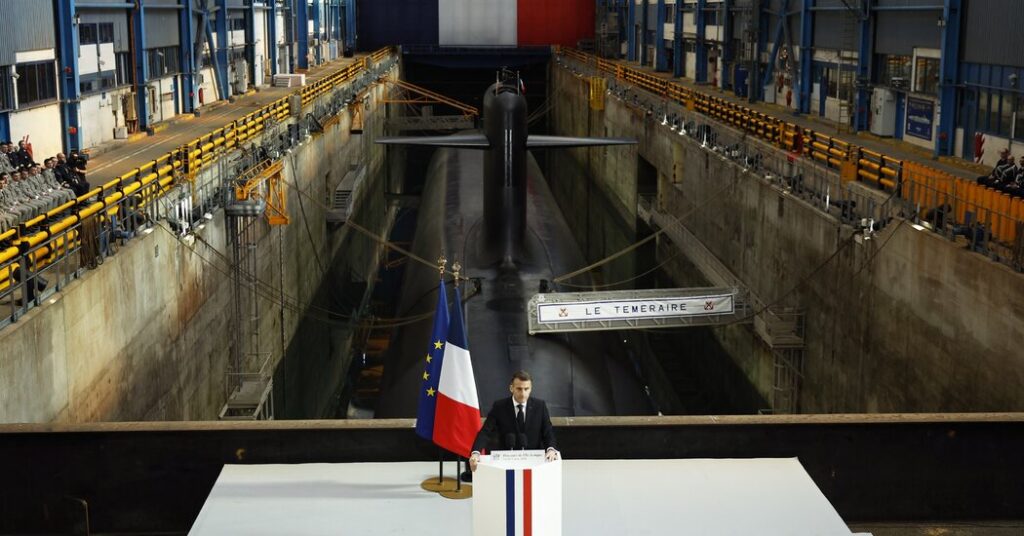
Speaking at a heavily fortified submarine port in Brittany, Mr. Macron said France would retain ultimate control over its nuclear arsenal. Unlike the United States or Britain, France will not join NATO’s nuclear planning group, reaffirming a tradition of French independence that dates back decades.
Still, Mr. Macron described a world that had changed radically since he gave his last major speech on France’s nuclear strategy in February 2020. Russia’s invasion of Ukraine and President Trump’s upending of the trans-Atlantic alliance, he said, had put the onus on France to update its definition of deterrence.
“Six years later, we are in another strategic universe,” Mr. Macron said. “We must go to a completely different stage.”
France is acting not just on its own initiative, but in response to quiet prodding by some of its neighbors to spearhead a Europewide nuclear deterrent. Germany, which has historically positioned itself squarely under the American nuclear umbrella, has raised the idea with France, privately and publicly.
On Monday, France and Germany said they would set up a high-level nuclear steering group to coordinate planning on issues like the best mix of conventional forces, missile defense technology, and French nuclear weapons. German conventional forces will take part in joint nuclear exercises with France.
In an essay last month in Foreign Affairs magazine, the German chancellor, Friedrich Merz, wrote that any European deterrent would have to be within the framework of NATO, and that it could not discriminate in the protection offered to European countries. Mr. Bollfrass said Mr. Macron’s insistence on continued French control of its arsenal would not surprise German officials, who would not have expected anything else.
Sweden, which mothballed its clandestine nuclear weapons program in the early 1970s and became fervently committed to nuclear disarmament, recently played host to a port call by the French aircraft carrier, Charles de Gaulle, which can carry fighter jets armed with nuclear-tipped missiles.
While parts of Mr. Macron’s speech were striking, nuclear arms experts said his plans would not, as a whole, transform European security. For political, doctrinal and hardware reasons, they said, France will never be able to replace the nuclear umbrella that the United States has provided to Europe since the end of World War II.
France also faces acute political uncertainty, with a far-right party currently leading the polls for presidential elections next year. If Jordan Bardella, the likely candidate of the National Rally party, succeeds Mr. Macron, it is not clear that he would continue on the path to deeper coordination with Europe.
In a statement, Mr. Bardella and Marine Le Pen, the leader of the party, said Mr. Macron’s proposal to disperse French nuclear weapons elsewhere in Europe was a “political public relations exercise, carried out without regard to national interests.”
France has the world’s fourth-largest nuclear arsenal, after Russia, the United States and China, with about 290 warheads, according to the Federation of American Scientists. It can deliver these weapons by plane, via medium-range missiles, or from submarines, via intercontinental ballistic missiles.
While France’s nuclear doctrine bears similarities to those of the United States and Britain — it is designed to deter attacks rather than be a tool of war — French leaders have long sought to keep it apart. That was most vividly illustrated in 1966, when Charles de Gaulle withdrew France from NATO’s integrated military command.
Unlike the United States and Britain, France has never explicitly committed itself to “extended deterrence” — the pledge to throw a nuclear umbrella over its NATO allies — though it has said its weapons are designed to protect France’s “vital interests,” a phrase left deliberately ambiguous.
On Monday, Mr. Macron clarified it slightly. “Can we consider the survival of our closest partners being put at risk without affecting our vital interests?” he said. “Or conversely, that an extreme threat in Europe concerns only us?”
Some experts contend that the differences between the nuclear doctrines of France and its NATO allies are overblown; there has been a “de facto” convergence in recent decades. France, for example, has shown a willingness to use nuclear weapons to deter the use of weapons of mass destruction by state sponsors of terrorism, bringing it more in the line with the United States.
France has already drawn closer to its neighbors. Last July, Mr. Macron signed an agreement on nuclear security with Prime Minister Keir Starmer of Britain that was the most significant update of the doctrine between Britain and France since 1995, when they agreed to deepen nuclear cooperation under John Major, the British prime minister, and Jacques Chirac, the French president.
European officials had been eager for Mr. Macron to announce his nuclear strategy in the hopes that France can lock in some of the changes before he leaves office next year. Mr. Bollfrass said he was encouraged by Mr. Macron’s emphasis on setting up consultative groups between France and Germany.
“Any successor can walk back presidential statements,” he said. “But it’s that working-level interaction that builds confidence and cooperation.”
Mr. Macron declined to say how many warheads France would add to its arsenal. But his speech, delivered with a submarine behind him, was meticulously choreographed to showcase France’s military might. He offered a stark tour of the world’s nuclear flash points — from India and Pakistan to China and North Korea. And he said Mr. Trump’s National Security Strategy was an invitation for Europe “to take more direct care of its security.”
“The next half century,” he concluded, “will be an age of nuclear weapons.”
Ana Castelain contributed reporting from Paris and Jim Tankersley from Washington.
Mark Landler is the Paris bureau chief of The Times, covering France, as well as American foreign policy in Europe and the Middle East. He has been a journalist for more than three decades.
The post Macron Expands French Nuclear Arsenal and Vows Protection for Neighbors appeared first on New York Times.