A heavy barrage of Israeli retaliatory strikes against the Iran-backed Hezbollah militia early Monday brought a fresh wave of displacement in war-weary Lebanon.
In villages across the country’s southern region near the Israeli border, parents bundled sleepy children into cars and crawled through miles of traffic toward the capital, Beirut, many clutching little more than a change of clothes. In Dahiya, the densely populated Hezbollah stronghold on the southern outskirts of Beirut, residents fled with barely a suitcase between them as explosions echoed nearby.
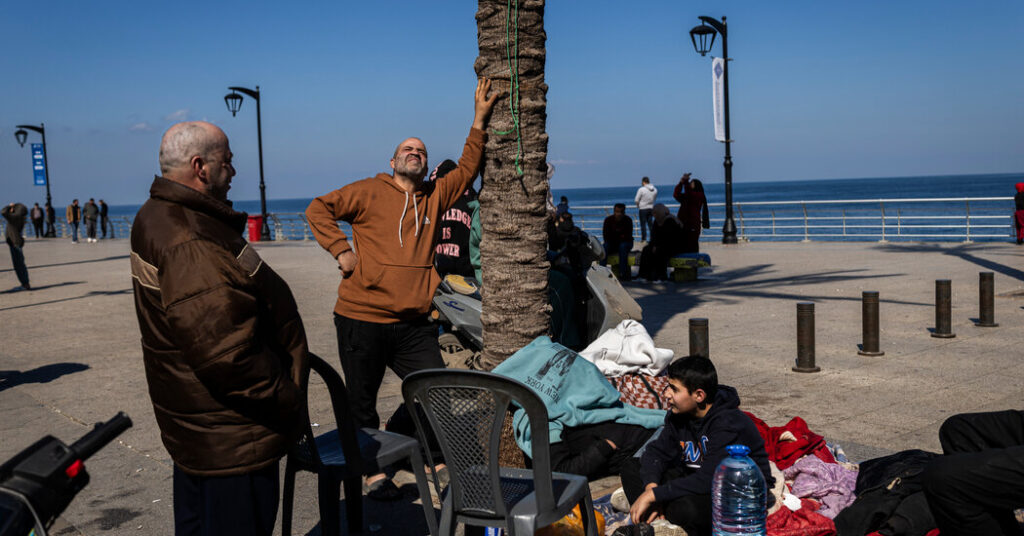
With no proper shelters to house them, the newly uprooted spilled into parking garages, schools and mosques. By midmorning, some had drifted to Beirut’s promenade along the Mediterranean. They settled beneath palm trees, wrapping themselves in blankets and sheets and waiting — for food, for safety, for whatever would come next.
“This country is beautiful, but we need peace,” said Musa Hashem, 50, a municipal worker who had fled Dahiya. He was sitting by the roadside with his twin brother and their eight children. “We just want this war to stop,” he said.
Lebanon’s disaster management agency said it had opened more than 40 schools as makeshift shelters. More than 3,000 displaced people had so far registered — a figure aid workers and government officials warned was certain to climb.
As concerns about a wider war grew on Monday, many people — both Lebanese and Syrian — began flocking to the border with Syria, hoping to leave the country.
On Monday, many fled not only in fear but in bitter disbelief, forced from their homes barely a year after a cease-fire that was meant to still the guns. Israel and Hezbollah signed that truce in November 2024, though near-daily Israeli strikes have since rattled Lebanon.
Some of those escaping on Monday spoke of homes still lying in rubble, businesses not yet recovered and their children’s schooling suspended once again by the thrum of war.
“We have been living daily with war for more than two years,” said Shadia Shahla, who works at a school in Tallouseh village in southern Lebanon, which she fled. During the 2024 war, she said she was displaced in Beirut for 66 days.
“Now a new war is here, and we are tired,” she said.
Ms. Shahla was among roughly 1,500 people who arrived at a technical training school in west Beirut on Monday. Some parents said no one was attending to their children, some of whom cried after going without food all morning. Many simply fell asleep in the cars or vans that had brought them, while aid officials at the school, visibly overwhelmed, scrambled to find and allocate rooms.
Haydar Baddah, a volunteer coordinating aid workers at the facility, said displaced people were arriving in droves, creating an urgent need for beds, food and medicine at the facility.
“The situation is really dire,” he said.
Many of those affected were observing Ramadan. Monday’s strikes hit close to 3 a.m. local time, just as many were waking for the pre-dawn meal, turning what should have been a quiet, sacred moment into terror and flight.
Many said they didn’t know where they would find food or water come sundown on Monday. Several said they were too afraid to return to their apartments in Beirut, fearing more strikes as Israeli drones buzzed overhead.
“God is the one who gives food and safety,” said Mr. Hashem, whose family sat along the waterfront promenade with nothing but a bottle of water and a plastic bag containing za’atar, a popular Middle Eastern seasoning blend. “But we never know when either will come.”
Abdi Latif Dahir is a Middle East correspondent for The Times, covering Lebanon and Syria. He is based in Beirut.
The post More Lebanese Flee Their Homes as Israel Strikes Back at Hezbollah appeared first on New York Times.