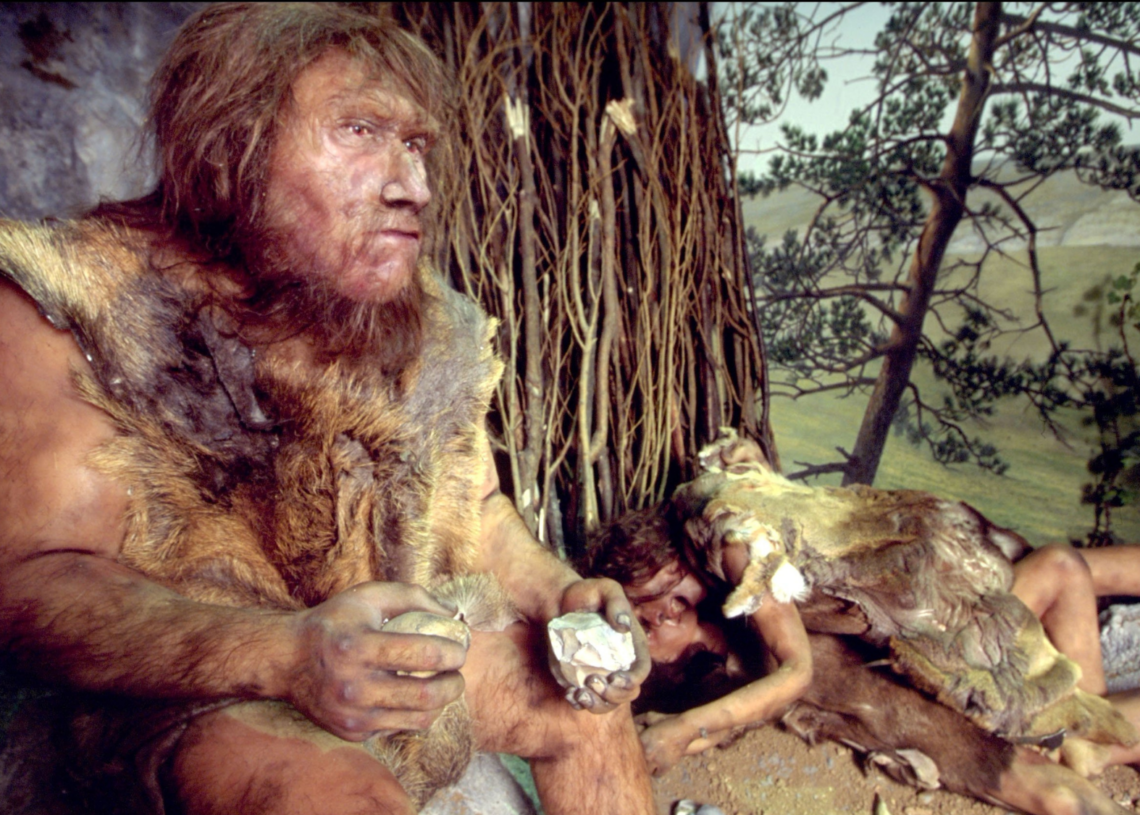
Many tens of thousands of years ago, when modern humans migrated into areas populated by our genetic ancestors, Neanderthals, Neanderthal men and human women were the most likely of all the pairings to go to town on each other.
Roughly two percent of modern human DNA comes from Neanderthals, and a new study published in Science argues that encounters between them and us may not have been evenly distributed between the sexes.
While analyzing ancient genomes, researchers at the University of Pennsylvania found Neanderthal X chromosomes show a 62 percent relative excess of modern human ancestry compared to their other chromosomes. That’s a little technical, so in simpler terms, that means when humans and Neanderthals interbred, the pairing may have more often involved the specific pairing of human women and Neanderthal men.
The reasons for this come down to simple attraction. Neanderthal men had a thing for human women and/or vice versa. The finding builds on earlier research that identified so-called “Neanderthal deserts” in modern human DNA, which are stretches of the genome, especially the X chromosome, that lack Neanderthal ancestry. There’s been some debate over whether those gaps were caused by population size, genetic incompatibility, or some kind of behavior that we can’t account for. Luckily, the research team developed a statistical approach to test these explanations.
Human Women Just Couldn’t Get Enough of Neanderthal Men
Working with senior author Sarah Tishkoff, the researchers modeled different scenarios to see which best matched the genetic data. The sex-bias hypothesis, based on the simple idea of attraction, fits best and appears to be a pattern that persisted across multiple interbreeding events separated by as much as 200,000 years.
Neanderthal man and human women were a match made in heaven, it seems.
Though the authors don’t want to oversell this conclusion. There isn’t a whole lot of direct evidence being used to support the theory, as the study relies on statistical modeling. Neanderthal genomes are also limited, and none of them come from the exact window immediately following interbreeding events.
In other words, there are blind spots that can’t be helped with the resources currently available. Still, the data is saying that while there were plenty of survival-driven factors fueling the need to reproduce, it looks like good old-fashioned social and cultural factors mattered a lot, too. The science says what it says: if you get a Neanderthal man and a human woman in a room together, you’re going to need a crowbar to pry them apart.
The post Neanderthal Men Were Banging Human Women for Hundreds of Thousands of Years appeared first on VICE.