Within minutes of arriving at a security conference with U.S. defense and intelligence officials in December, Palmer Luckey was stopped by a military officer who wanted to talk about killer robots.
Clad in a Hawaiian shirt and cargo shorts, Mr. Luckey nodded as the officer gushed over artificial-intelligence-backed drones and submarines made by Mr. Luckey’s defense-technology start-up, Anduril. Mr. Luckey was then besieged by other officials who wanted to shake his hand and pepper him with questions about his company’s weapons.
After Mr. Luckey escaped the crush, he spotted an Anduril co-founder nearby. He flopped onto the floor next to him, pulling out his phone to gawk over an online auction for a watch once worn by the actor Pierce Brosnan, who played James Bond.
If Mr. Luckey had instead opened a social media app, he would have seen a post by Defense Secretary Pete Hegseth celebrating his visit to Anduril’s Southern California headquarters the previous day. (“We are rebuilding the Arsenal of Freedom,” Mr. Hegseth proclaimed.)
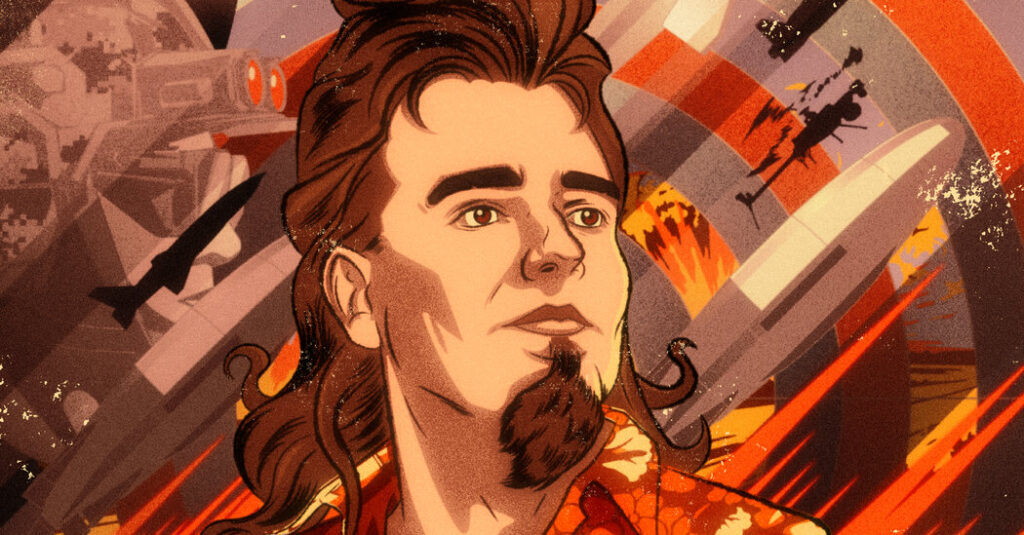
“I want to build the things that will scare the [expletive] out of our most dangerous enemies without bankrupting the United States in the process,” said Mr. Luckey, 33. He spoke to The New York Times by phone and in an hourlong interview at the security conference in Simi Valley, Calif., where he stood out with his billowing mullet and casual garb in a sea of dark suits.
Once shunned in Silicon Valley, Mr. Luckey has become the It Guy of the booming defense-technology industry. President Trump has welcomed him to Mar-a-Lago and praised Anduril’s weapons as “nasty looking things.” Army Secretary Daniel Driscoll has called Mr. Luckey “an amazing innovator.” And lawmakers such as Senator Kevin Cramer, Republican of North Dakota, have said the Anduril founder is “exactly what the military needs to stay afloat.”
Such fawning over Mr. Luckey once seemed unlikely. With a taste for cosplaying anime characters, a prolific social media presence and a big chip on his shoulder — Mr. Luckey founded Anduril in 2017 as a middle finger to Mark Zuckerberg, his former boss — the hyper-energetic tech billionaire is far from the prototypical buttoned-up defense executive.
But Mr. Luckey pioneered a vision of warfare — even when it was unpopular to do so — that defense officials found compelling. That vision boils down to one thing: autonomy. If A.I.-backed fighter jets, drones, submarines, warships and combat vehicles can act as autonomous frontline machines, the technology could save a lot of lives — and help the United States win any conflict.
Autonomy “fundamentally changes the cost of maintaining an arsenal that deters your enemies,” Mr. Luckey said. While a traditional fighter jet, submarine or tank requires an assembly line to produce and hundreds of soldiers to run and operate, autonomous weapons can sit untouched until needed, just like Twinkies, which have a long shelf life, he said.
Then “the moment I need to use them, I push a button, they turn on and they all remember their training because they’re robots,” he said.
Mr. Luckey’s ambitions dovetail with Mr. Trump’s aim to modernize the U.S. military, for which the president has allocated at least $1 trillion. Mr. Hegseth, who wants to apply A.I. expansively in defense, recently clashed with the A.I. start-up Anthropic over using the company’s technology in classified systems. People in the Pentagon have gravitated to Mr. Luckey as a disrupter to an industry that they believe has become too slow, too expensive and too ineffective.
That has turned Anduril into a major business with more than $6 billion in global contracts and roughly $2 billion in revenue last year. The company, which has raised nearly $7 billion from investors, is valued at almost $31 billion, is looking for more money and has talked about going public.
Anduril, based in Costa Mesa, Calif., is part of a growing pack of defense tech start-ups, which also include the drone makers Skydio and Shield AI. These young companies have taken a leaf out of Silicon Valley’s playbook by building products first and figuring out the rest later. Many foot the bill for developing weapons prototypes with no tender or order from the military.
The politics of their founders are complicated. Defense-tech entrepreneurs often eschew Republican or Democratic labels, driven instead by a belief that the United States needs to triumph against adversaries such as China.
In a group chat known as the “B-boys club” for founders of companies worth $1 billion or more, Mr. Luckey — who supports Mr. Trump but sees himself as more of a little “l” libertarian who believes in small government and does not agree with the current Libertarian Party — has led discussions about what a future U.S.-China clash could look like, said two members of the group, who were not authorized to speak publicly about private conversations.
“In general, where the United States has interests that are aligned with the continued existence of a democracy, it’s important that we work with them to keep that going,” Mr. Luckey told The Times.
Whether he can effectively carry out his vision of autonomous warfare is unclear. Anduril has produced only small numbers of weapons for the U.S. military. Some drone and missile tests that the company conducted in Ukraine in recent years were disappointing.
Several defense officials, who were not authorized to speak publicly on national security issues, said the country was taking a risk by placing big bets on Anduril’s weapons. The start-up has less experience and underlying infrastructure than longtime defense contractors like Lockheed Martin and Raytheon, they said.
“That’s the big question mark hanging over Anduril and any of the other new entrants that are trying to break into the defense industry,” said Stacie Pettyjohn, a senior fellow at the Center for a New American Security, a think tank that specializes in defense technologies.
For now, though, Mr. Luckey’s influence is unmistakable.
Before Mr. Trump’s inauguration last year, Mr. Luckey suggested to the president-elect that the Department of Defense change its name to the Department of War, four security officers with knowledge of the exchange said. Mr. Trump later did just that. The White House did not respond to requests for comment.
Ousted From Facebook
Mr. Luckey, the oldest of four siblings, grew up in Long Beach, Calif. His mother home-schooled him, allowing him to pursue his interests in electronics and engineering. In 2009, at age 16, he began building a virtual reality headset and attracted the attention of investors including Peter Thiel.
In 2014, Mr. Luckey burst onto Silicon Valley’s radar when Facebook shelled out $2 billion for his virtual reality start-up, Oculus VR, turning the 21-year-old into a billionaire.
Mr. Zuckerberg, Facebook’s chief executive, called virtual reality “the future.” Mr. Luckey believed Mr. Zuckerberg was passionate about the technology and would provide $1 billion annually to develop it, two people close to Mr. Luckey said. So Mr. Luckey moved to Silicon Valley to join Facebook, buying a home in the upscale town of Woodside.
But his time at Facebook was rocky. While he received positive performance reviews, he clashed with his team over the direction of virtual reality and how to work with Facebook, two people who worked with him said.
Before the 2016 presidential election, news leaked that Mr. Luckey had donated $9,000 to a pro-Trump organization that used the funds to erect an insulting billboard about the Democratic nominee, Hillary Clinton.
That did not go over well in Silicon Valley, which was largely liberal. Facebook employees demanded that Mr. Luckey be fired and posted on internal message boards that his money was being used to promote antisemitic, misogynistic and racist political messages, according to screenshots viewed by The Times.
“There were just all these headlines about me that weren’t true,” Mr. Luckey said, adding, “I was misrepresented.”
Privately, he drafted a note to Facebook employees blaming the media for what he saw as distorting his activism. Facebook executives asked him not to send the note or publicly fault the media, according to emails viewed by The Times. In one message, Mr. Zuckerberg suggested that Mr. Luckey explain that he was Libertarian and that his political support for Mr. Trump was misunderstood. (Mr. Luckey did not do so.)
In March 2017, Facebook fired Mr. Luckey without providing a reason. The company, renamed Meta, declined to comment on Mr. Luckey’s exit.
Mr. Luckey was furious. He took a break, flying to Japan for an anime convention with his longtime girlfriend, Nicole Edelmann, whom he had met at a debate camp when he was 15. There, the couple were photographed in matching bikini tops and leather fishnet stockings. Mr. Luckey also started growing a goatee. (He and Ms. Edelmann have since married.)
After the trip, Mr. Luckey went back to business. He considered creating a start-up to tackle obesity or the prison system, but landed on defense technology.
The topic was unpopular in Silicon Valley, which shied from having powerful technologies they worked on used for war and killing. But defense was close to Mr. Luckey’s heart.
His grandfather had been a pilot who flew as a civilian operator for the U.S. military during Operation Desert Storm in 1991. Mr. Luckey, who adores science fiction and gadgets, also once did an internship on virtual reality headsets to help military veterans treat post-traumatic stress disorder. And he had started buying retired military crafts, including a UH-1 Huey helicopter that he later used to make a dramatic entrance at his wedding.
“He is really interested, really invested, in national security,” said Trae Stephens, a partner at the venture capital firm Founders Fund and an Anduril co-founder.
Anduril’s name was inspired by “The Lord of the Rings,” in which Anduril refers to Aragorn’s reforged sword. Mr. Luckey has a replica of the sword. The company’s full name, Anduril Industries, also has a side benefit: the initials A.I.
To the Border
To establish Anduril, Mr. Luckey returned to Southern California and bought a $12.5 million home in Newport Beach, as well as a $3.8 million property across the street for his car collection.
Mr. Luckey took on the title of Anduril’s founder but decided to avoid day-to-day corporate management and focus on building products. Brian Schimpf, previously the head of engineering at the data analytics firm Palantir, became Anduril’s chief executive.
Mr. Luckey said he was “really motivated by what I perceived to be a national divorce between our most innovative technology creators and the government.”
He wanted Anduril to build virtual reality headsets that could alert soldiers to battlefield opportunities and dangers. But Anduril’s investors did not want to pursue a product that could be viewed as competing with Mr. Zuckerberg and Facebook’s virtual reality headsets.
Mr. Luckey said Brian Singerman, a partner at Founders Fund who invested in Oculus and Anduril, had told him that Anduril should “focus on things where you can have the biggest impact, not the things where you can settle your vendettas.”
So Mr. Luckey and his engineers turned to building a border protection system with laser sensors that could track people’s movements and try to identify them. The system was inspired by Mr. Trump, who was in his first presidential term and had talked about erecting a border wall between the United States and Mexico.
In June 2017, Mr. Luckey pitched Customs and Border Protection on the border security system, saying that it cost a fraction of similar systems and that Anduril would foot the bill for its development. By the end of that year, the technology had been selected for testing along the border of San Diego and Mexico.
Customs and Border Protection did not respond to a request for comment.
Mr. Luckey also started working on drones and warheads, drawing ideas from Robert A. Heinlein’s 1959 novel, “Starship Troopers,” and other science-fiction stories. Science fiction did not just predict the future, Mr. Luckey said, but “literally caused the future.”
Battlefield Failures
Russia’s 2022 invasion of Ukraine gave Mr. Luckey an opportunity to test Anduril’s weapon prototypes in the field.
On a weeklong trip to Ukraine that year, Mr. Luckey saw how drones were changing war. Ukrainian soldiers were remotely piloting Chinese-built consumer drones — which cost $3,000, half that of a traditional artillery shell — to precisely attack targets.
Ukrainian officials agreed to try Anduril’s drone, called Ghost, as well as its Altius munition, a missile designed for autonomous attacks.
But the Ghosts failed when they lost their GPS signal, two people familiar with the drones said, so the Ukrainian army stopped using them. The Altius munitions were more successful but were expensive compared to alternatives, the people said.
Ukraine’s digital ministry did not respond to requests for comment. Anduril said it continues to deliver the Altius to Ukraine.
Mr. Luckey was unfazed. “We don’t consider any of these tests setbacks or failures,” he said. “The challenge is going to be scaling these things into production.”
By then, Anduril had returned to developing Mr. Luckey’s first love: virtual reality headsets. The U.S. government was showing interest in the technology as a way for soldiers to better understand what was happening on the battlefield.
Mr. Luckey also cultivated defense officials and lawmakers, leading them on tours of Anduril’s Southern California factory and showing off virtual reality goggles and his collection of military vehicles. He sometimes took them on his Mark V Special Operations Craft, a retired Navy boat, for jaunts on the Pacific Ocean.
Mr. Cramer, the Republican senator from North Dakota, visited Anduril in February 2024.
“Palmer is eccentric — maybe even exotic — compared to the center of the North American continent and the fashion sense of North Dakotans,” he said. “But what intrigued me the most was his showroom of technology.”
Mr. Cramer later created the Senate Defense Modernization Caucus, a bipartisan effort to reshape the U.S. military with new technologies.
In April 2024, Anduril beat Boeing, Lockheed Martin and Northrop Grumman for a spot in the Air Force’s Collaborative Combat Aircraft program, an effort to build a fleet of unmanned autonomous fighter jets. The military did not respond to a request for comment.
‘I Told You So’
After Mr. Trump was inaugurated for his second term last year, he swiftly enacted directives — including more money for drones and speeding up how the military gets new technology — that put Anduril and other defense tech companies in prime position.
In February last year, Anduril was awarded a $99 million Air Force contract for software that allows people to autonomously control systems. That same month, the start-up took over Microsoft’s contract for a virtual reality headset project for the Army. Last March, it signed a 10-year $642 million Marine Corps contract for counter-drone systems.
Anduril now has more than 7,000 employees and plans to open a $1 billion factory near Columbus, Ohio, where it may employ as many as 4,000 workers. Other tech companies have followed by developing weapons systems and military tech.
Last year, Mr. Luckey launched what he called an “I told you so tour” to emphasize that he built military products before it became popular. In an interview on “TBPN,” an online business and tech show, he boasted that he “did in two weeks what the Army had been working on for years.”
Anduril’s ascendancy has led to unexpected alliances. In May, the start-up announced that it was working with Meta, Mr. Luckey’s former employer, on virtual reality technologies for the battlefield. The deal meant Mr. Luckey would regain access to Meta’s portfolio of virtual reality patents, many of which he had originated.
The reconciliation started when Meta invited Mr. Luckey to visit. In September 2024, Mr. Luckey posted a photo of himself posing with Meta’s new advanced augmented reality glasses.
Within days, Andrew Bosworth, Meta’s chief technology officer, publicly apologized to Mr. Luckey for some social media posts six months earlier arguing over Mr. Luckey’s 2017 firing from the company.
“I mentioned this in person, but I also wanted to publicly apologize for my previous comments about your time at (then) Oculus,” Mr. Bosworth posted. “I’m sorry,”
“I am infamously good at holding grudges, but Meta has changed a lot over the past 8 years,” Mr. Luckey wrote back. “At some point, the Ship of Theseus has sailed.”
Sheera Frenkel is a reporter based in the San Francisco Bay Area, covering the ways technology affects everyday lives with a focus on social media companies, including Facebook, Instagram, Twitter, TikTok, YouTube, Telegram and WhatsApp.
The post The Pentagon’s Favorite Tech Guy Is This Hawaiian Shirt-Wearing Founder appeared first on New York Times.