Have you ever walked around your neighborhood and noticed a space that has been forgotten or neglected, or isn’t being used to its full potential?
Have you ever imagined that space as something more useful or interesting, such as a bike path, skate park, playground or place for people to gather and hang out?
Have you ever wondered if you yourself have the power to make that change happen?
Headway, a team at The New York Times that reports on progress and possibility, has looked into these questions.
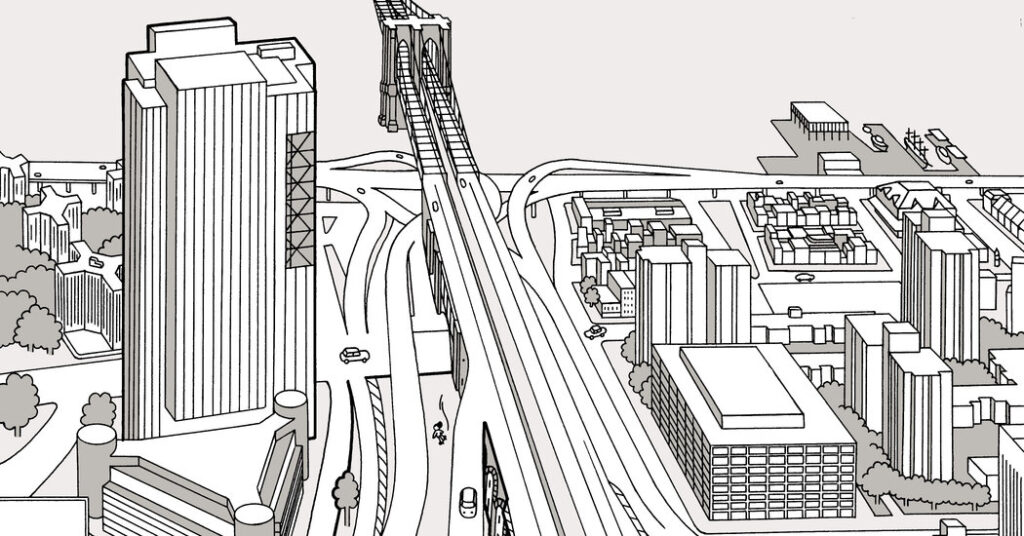
In the short video below, “The Hidden Park Under the Brooklyn Bridge.,” Michael Kimmelman, Headway’s editor-at-large, reports on how local residents are helping to transform a neglected space under this New York City landmark into a vibrant community hub.
In the related article “Want to Change Your Neighborhood? Start With a Power Walk,” Matthew Thompson, the editor of Headway, writes about Gotham Park and how others can start exploring the potential for transformation in their own communities:
We’ve come back to this park so often because it’s a living manifestation of civic power, which I’d define as people’s ability to change the place where they live. In Headway’s continuing exploration of how we make progress on the world’s challenges, we’ve found that this ingredient can be the difference between a community that stagnates and one that renews itself in the face of struggle.
“We define civic power as a capacity to ensure that others do as you would like them to do in community,” said Eric Liu, the chief executive of Citizen University, a nonprofit dedicated to helping people participate more fully in shaping the world around them.
The Headway team and Citizen University spent much of the past year developing an exercise for mapping civic power in a geographic space. We call it a Power Walk.
At its core, the Power Walk is a new lens through which to see a neighborhood, guided by a series of prompts to reflect on what could change and where capacity exists to change it. It’s a way of understanding the possibilities that people see in the world around them, and discussing what collective power they have to realize those possibilities. With our help, Citizen University developed a field guide to conducting your own Power Walk, which you can find here.
The article continues:
It’s easy to imagine that changing any city starts with big-money contracts, City Council approval, cranes and construction crews.
But change can also begin with a few people curious enough to ask why things are the way they are and what other possibilities might exist. Sometimes, all it takes to start transforming a place is civic power.
Students, watch the video and read the entire article. Then, tell us:
-
What is your reaction to Rosa Chang’s quest to transform Gotham Park from nine neglected acres into a lively gathering space? What surprised, stood out or interested you about this story?
-
Does Gotham Park remind you of a place in your own community that could be improved? What possibilities can you imagine for that space?
-
Mr. Thompson writes that sometimes change can begin “with a few people curious enough to ask why things are the way they are and what other possibilities might exist.” Do you agree? How much power do you think ordinary people have to shape the places where they live? Where have you seen examples of this kind of bottom-up transformation?
If you can, we invite you to take a Power Walk, on your own or with a group, in a neighborhood that is meaningful to you, such as where your school is or where you live. Use the Power Walk field guide to take notes and reflect on your experience. Then, share:
-
Is there a space in your own community that has the potential for transformation? Where is it? What is it like right now? Why do you think it might be the way that it is?
-
What makes this space suited for transformation?
-
What do you think this space could be instead?
-
Who would benefit from improving this space, and why? How might changing this one space affect the neighborhood or community?
-
Who could help make changes to this space? What steps could you take to begin this transformation?
Students 13 and older in the United States and Britain, and 16 and older elsewhere, are invited to comment. All comments are moderated by the Learning Network staff, but please keep in mind that once your comment is accepted, it will be made public and may appear in print.
Find more Student Opinion questions here. Teachers, check out this guide to learn how you can incorporate these prompts into your classroom.
Natalie Proulx is an editor at The Learning Network, a Times free teaching resource.
The post Take a Walk in Your Hometown. How Would You Change the Place Where You Live? appeared first on New York Times.