This post contains spoilers through Season 4, Episode 8 of Industry.
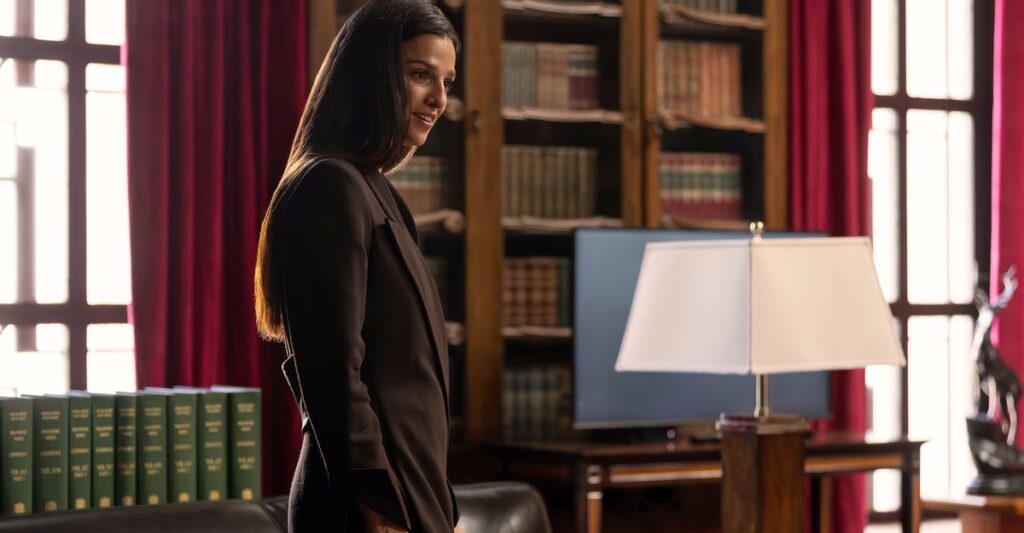
Over four seasons of HBO’s drama Industry, Yasmin Kara-Hanani has emerged as TV’s most lovable monster. The show portrays devious, cocaine-huffing young bankers climbing the ranks of global finance, and Yasmin—or Yas, for short—has cut the least noble path of all. The posh, multilingual daughter of a media magnate, she fails upward time and again by drawing upon her privilege rather than her competence. She’s sadistic in sex and in her friendships. Plus, she provoked her dad to jump off a boat, then let him drown.
And yet there’s something about Yas that makes her more than just fun to hate. The actor Marisa Abela plays her in a binary state of panic and swagger by sobbing like a dejected child or slyly grinning like one who’s about to wolf down an ice-cream cake. Whereas other characters are cold and sharklike, Yas feels her way through the world—and uses her vulnerability to manipulate others. Being born into wealth taught her that none of us is in command of our fate, so we had better cheat for whatever control we can. She’s the statuesque girlboss for the new gilded age, and though I hate to say it, I’ve been rooting for her.
I really hate to say it now that Industry’s fourth season finale has aired, because the last twist in this proudly convoluted show is that Yasmin transforms into a sex trafficker reminiscent of Ghislaine Maxwell. What’s really sick is how much sense the outcome makes. At a time when real-life conspiracy theories appear truer every day, Industry lays out the market logic underpinning the coordinated exploitation by elites that no longer seems like the kind of thing that happens only on TV shows.
Industry has been topical since its 2020 premiere. Early seasons were set at a London megabank that had—post-financial crisis, post-#MeToo, post-racial-reckoning—allegedly reformed its work culture. But despite all the HR-speak about inclusion and ethics, the competitive atmosphere remained as brutal as a gladiator pit. Season 3 saw the bank make a big bet on green investing—until it was acquired by a petrostate’s wealth fund that, in the finale, closed the trading floor where the show’s action had taken place. The characters exit their skyscraper office for new environs: a hedge fund, a fintech corporation, a golf-heavy retirement, and in Yas’s case, the socialite life as the new wife of a baronet.
With this reinvention, the show morphed from a workplace drama into something more like a magisterial airport novel. Season 4 roams from theme to theme—porn, privacy, fraud, techno-fascism, espionage, and, yes, sex crimes. The dialogue is overwrought, the plot contrivances are gratuitous, and the show has never been more fun. Watching has been like sitting in the passenger seat of a speeding sports car driven by someone who won’t stop talking about what they read in, say, The Atlantic, yet is charismatic enough not to bore.
A consistent theme underlies the chaotic story: At the highest levels, every crime is connected. Yas maneuvers her old-money husband, Henry Muck (played by Kit Harington), into becoming the CEO of Tender, a former payments processor for porn and gambling sites that rebranded as a respectable bank. Tender’s co-founder Whitney Halberstram (Max Minghella) had used creative accounting to cover up the fact that the company is a front for—dun dun dun—Russian intelligence. Harper Stern, Industry’s biz-wiz protagonist, exposes his fraud and makes a ton of money in the process. In the finale, Muck takes the fall for Tender while the true villains get away. And Yas, having studied the methods of those villains, divorces him to set about ushering young—possibly underage—escorts to the men who would run the world.
Yas’s fate has long been foreshadowed in her relationship with her dad, Charles Hanani (Adam Levy), a publishing baron and a sex pest who likely molested Yas when she was young. In adulthood, her contempt for him smolders while he pays her bills and uses his clout to secure her employment. In Season 3, their toxic dynamic turned fatal during an argument on his yacht, the Lady Yasmin. (Charles, drunk and belligerent, jumps overboard while the boat is still in motion, and Yas simply watches as he is left behind—then fails to alert anyone of what has happened. His waterlogged corpse is found weeks later.)
In retrospect, the parallels between Yas and Maxwell—who is currently serving a 20-year prison sentence after a 2021 conviction for child sex trafficking and other charges—are glaring. Maxwell’s father, Robert, was a newspaper mogul with a mean streak who, Maxwell has said, physically abused her as a kid. Robert’s yacht was named the Lady Ghislaine. In 1991, he fell off it and drowned under mysterious circumstances, although Ghislaine was not present. Around that time, his daughter met and began dating Jeffrey Epstein.
Observers of the Epstein case (including her own lawyer) have speculated that Maxwell’s childhood explains why she was willing to participate in exploitation. In Industry, Yas’s inner workings hardly seem complicated. Her habit of cruelty is clearly an example of someone paying forward their psychic damage; dialogue has repeatedly riffed upon the idea that hurt people hurt people. After her boss bullies her in Season 1, she bullies her own underling in Season 2. When that underling reports sexual harassment by a client, Yas doesn’t affirm or comfort—she minimizes the incident, saying, “We’ve all been there.”
But with her latest turn, Industry has made a point to move past a purely psychological read of abuse. Really, Yas’s story is a twisted fable about surviving and thriving in patriarchal capitalism. After her dad—who had been embezzling from his company—dies, she inherits his debts and is tarred in the media for appearing to benefit from his crimes. The scandal results in her firing, and she is made to stare down a possible descent from riches to rags. Similar to how Maxwell faced the consequences of her late father’s financial dealings—after Robert’s death, $565 million was discovered to be missing from his business’s pension fund—Yas finds security in the arms of a rich guy.
But Muck is no Epstein, malevolent and cunning. He’s a failson with terrible addiction and mental-health issues who helped drive a company into the ground last season, and loses an election for Parliament this season. Throughout Season 4, Yas tries to stabilize him by making him feel like a man—including by inviting his assistant, Hayley (Kiernan Shipka), into a threesome. Hayley turns out to be a call girl Halberstram had hired to woo and blackmail powerful figures. Yas realizes that she may have been the target of an extortion scheme—but instead of distancing herself, she pulls Hayley closer and treats her like a protégé.
The reason for that strange behavior is finally made clear in the finale. Viewers find Yas in a meeting between a newspaper owner (her former uncle-in-law, for whom she seems to be working) and a politician named Sebastian Stefanowicz (Edward Holcroft). Stefanowicz is a rising right-wing star in the United Kingdom, and he considers Peter Thiel a close friend. “High modernity is bust,” he says when asked about his worldview. “We need clarity. We need efficient, post-partisan governance to help our communities.”
Ambition glimmers in Yas’s eyes as Stefanowicz delivers this pitch that tidily echoes Curtis Yarvin–style authoritarianism. She offers to help “polish” his image, and plans a dinner in Paris to raise donations on his behalf. Their guests include “titans of industry, academics, evolutionary biologists,” as summarized by one attendee, an Austrian nobleman whose chateau is decorated with a painting by Adolf Hitler (as seen in a previous episode). Yas also brings Hayley and her sex-worker associates, including a girl named Dolly, who’s referred to as Hayley’s “little cousin.” Her passport—which may or may not be authentic—lists her as being born in 2011.
Harper has been invited to the dinner too because Yas thinks she could be a financial adviser to Stefanowicz. But after taking in the scene, Harper is horrified. She confronts Yas about the extreme viewpoints expressed around the table and all the young women “draped” on the men after dinner. Yas deflects her concerns as naivete. “I lost my virginity when I was 14, okay?” Yas says. Her rationalization continues: “The world is not exploitation or opportunity. It’s both/and.”
[Read: Your individuality doesn’t matter. Industry knows why.]
The show understands the gravity of this moment. Yas is not stumbling into evil unwittingly or being forced by circumstance. She’s making a choice. Harper looks Yas in the eyes and tells her, “That is not your voice coming out of your mouth.” She demands that her friend take her hand and leave the party. Yas stays put.
As shocking as it is for a series to turn one of its principals into a predator, this development has the feel of a puzzle coming together. Over the course of the show, Yas has searched and searched for ways to prove her worth. Here it is: a market role she’s uniquely qualified to fill. The elites need a madame. A demand exists for underage sex. And fulfilling demand feels good: Yas tells Harper that her new role brings her “joy” and makes her experience “less pain.”
This entire season has dissected the way that modern society conflates existential and economic purpose. Characters experience professional loss as mortal danger: A journalist is fired and then dies of a drug overdose; a stock trader who’d become a pariah throws himself off a balcony; Muck’s professional failures lead to a suicide attempt. The fear of uselessness explains why the banker Eric Tao (Ken Leung) leaves a cushy retirement to get back to finance, even at the cost of neglecting his kids. At a time when AI is threatening to wipe out sectors of the economy, Industry is making a dark point about the value of work and the lengths to which people will go to fill a void of meaning and money.
It’s also landing a hideously trenchant critique of the elite. The publicly released Epstein files have not proved that Maxwell helped traffic girls as part of a blackmail scheme—but they have shown how the powerful think. Epstein’s emails are laden with the same race science that Stefanowicz’s supporters use to justify the dehumanization of people they already feel superior to. Writing to Thiel, Epstein cheered Brexit for helping usher in chaos and tribalism from which they could profit. He wrote something that Industry’s most rapacious short sellers might say: “Finding things on their way to collapse , was much easier than finding the next bargain.”
Yas was on her way to collapse, and now she’s doing the unthinkable. As I watched, my brain rebelled at her transformation; it seemed so salacious, so over-the-top. But then the logic of this finale settled in my gut. Yas is no longer a sympathetic character, but she’s disturbingly understandable. She, like so many others, have bought into the view that we are all but predators and prey.
The post The Most Sickening Twist in Industry Is Also Its Most Insightful appeared first on The Atlantic.