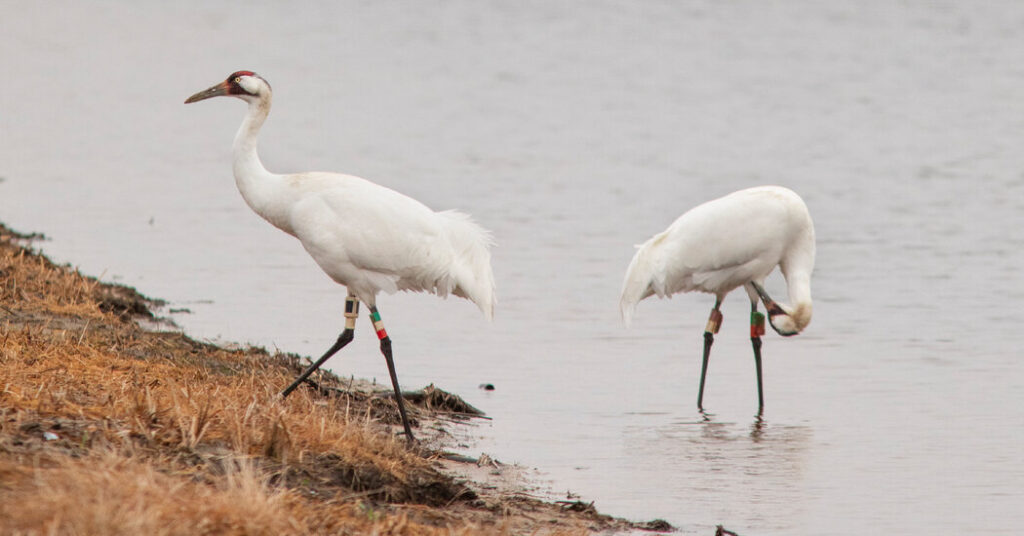
I probably wouldn’t have made the drive to Wheeler National Wildlife Refuge in North Alabama back in January if I hadn’t gotten an email bearing this subject line: “Whooping Cranes.”
The message came from Nicole Mashburn, a board member of the Wheeler Wildlife Refuge Association and the friend of a friend. Out of abject necessity, I ignore 90 percent of the emails I get, even emails from friends of friends, but put whooping cranes in the subject line, and you have me — hook, line, sinker and fishing net. “I thought you might like to know we have 18 whooping cranes this year,” Ms. Mashburn wrote.
I don’t keep a life list of birds I’ve seen, or go to any length to see rare birds, but the whooping crane is more than simply rare and more than simply beautiful. It’s a rare and beautiful bird that still exists because human beings decided a long time ago that it should exist.
Wheeler is a sprawling 35,000-acre sanctuary along the Tennessee River, and its wetland habitats offer ideal wintering grounds for migratory waterfowl of many types. It’s always worth the drive to Wheeler in winter because of the magnificent sandhill cranes that overwinter there every year. Gathering by the tens of thousands, they talk to one another continuously in a joyous burbling call that always makes me think an odd sort of marching band is tuning up, with instruments I don’t recognize.
But I’ve already seen the glorious flock of sandhills at Wheeler, and I was in the midst of an uncommonly busy winter. So I probably wouldn’t have made the trip again this year if not for Ms. Mashburn’s email about the whooping cranes.
Those majestic white birds are the tallest in America — each standing five feet tall, with a wingspan of nearly seven feet — and we almost lost them forever. Never known to exist in large numbers, whooping cranes were nonetheless geographically widespread in North America until farming and hunting pushed them to the brink of extinction. By 1941, the worldwide population of whooping cranes numbered barely more than 20.
But nearly that many were stalking around in the flooded fields of the Wheeler Wildlife Refuge in January, less than two hours from my house. My husband and I made plans to head down and see if we could find them.
Even after decades of intense effort to help the species rebound — through a combination of habitat conservation and an innovative breed-and-release program — the total population of whooping cranes today is only around 800. So if you’re a whooping crane, and you need a flock for safety, you throw in your lot with the much more numerous sandhills.
Thomas V. Ress, a Wheeler board member, longtime volunteer and the author of “Wheeler National Wildlife Refuge,” told us how to figure out which local predators are targeting the flock: “If all of sudden you see the ducks rise up, there’s a good chance there’s an eagle nearby. If you see all the sandhills rise up, there’s a good chance there’s a coyote going through the field.”
But coyotes aren’t the whooping cranes’ greatest danger, or the sandhills’ either. The Trump administration’s unceasing assault on environmental protections threatens to undo decades of conservation efforts on behalf of whooping cranes and every other threatened or endangered species. I wondered if this might be my only real chance to see a whooping crane in the wild.
The thing about trying to find a whooping crane tucked among a vast flock of sandhills in a vast wildlife refuge is that sandhills are also giant birds, and in certain light — as for example the light reflected from water on a sunny day — it is not easy to tell whether a bird is a pale gray sandhill or whether it is a white whooping crane. My husband and I stood behind one of the several bird blinds at Wheeler and debated. Is that one a whooper? Is that one?
Then someone pointed to the far right of the viewing area, and there they were: two whooping cranes, walking calmly among the sandhills. As it turns out, when you see a whooping crane, you cannot doubt you are seeing one. No other living thing like it exists in all the world. It’s like seeing something from myth. It’s like stepping backward onto an earth as yet untouched by human hands.
In that instant, I learned that I didn’t need to see Wheeler’s whooping cranes out of fear that I’d otherwise miss my chance. I needed to see them to remember what my own species is capable of. To see a whooping crane in the wild is to be reminded that we nearly killed something miraculous — and then, almost unbelievably, we didn’t. Against all evidence to the contrary, we are as much the healing species as the murdering one.
The question is whether we still have the wisdom to save what we have the ability to save. Back when a bipartisan effort by Congress saved the bald eagle and the peregrine falcon, when it protected our water and our air and set up a mechanism for protecting our most vulnerable species, we did. I would not have believed it possible even then, with the country in nearly the same turmoil the country is in now. But we did.
It was President Richard Nixon who signed into law the Clean Air Act, the Marine Mammal Protection Act and the Endangered Species Act, President Nixon who established the Environmental Protection Agency. He did these things because voters, newly awake to what they were on the precipice of losing forever, insisted on saving what could yet be saved.
Surely there is room now, too, even amid so many other fights to protect what we love, to protect the living world that sustains our wild neighbors. The living world that sustains us, too.
For us, it’s personal. If we lose our wetlands, we will have lost our best chance for absorbing storm surges in a time of extreme weather patterns. If our water is unsafe for amphibians, it is unsafe for us, too. When the air we breathe is full of toxins, wild creatures are not the only ones to suffer. At a species level, it is nothing less than suicidal to believe that human beings are exempt from the ravages that human beings keep subjecting the earth to.
But the living world also sustains us in ways we hardly recognize until we have been deprived of it for too long. The feel of turned soil in our hands, the scent of flowers on a breeze, the sound of birdsong pouring down from the trees — this is the world we evolved in, the world we were born for.
Lately my brother and I have been visiting schools and bookstores to read from our new picture book about the many lives a wildflower garden sustains. Small hands always shoot up when we ask if there are any questions, but rarely do the children ask questions. They prefer instead to tell us about the creatures they love. “I like squirrels,” one preschooler said when we called on her. “I like butterflies,” another said when it was his turn. These little ones were already all in: “I like worms.” “I like birds.” “I like ladybugs.” “I like bunnies.”
They reminded me of a child I met at Wheeler National Wildlife Refuge late in the day when we went to see the cranes. Peering through a cutout in one of the bird blinds, the toddler leaned forward to see the birds as they were just beginning to lift off at sunset. “Wow,” he whispered amid the rush of wings. “Oh, wow!”
Margaret Renkl, a contributing Opinion writer, is the author, most recently, of “The Weedy Garden.”
The Times is committed to publishing a diversity of letters to the editor. We’d like to hear what you think about this or any of our articles. Here are some tips. And here’s our email: [email protected].
Follow the New York Times Opinion section on Facebook, Instagram, TikTok, Bluesky, WhatsApp and Threads.
The post The Glorious Birds We Saved appeared first on New York Times.