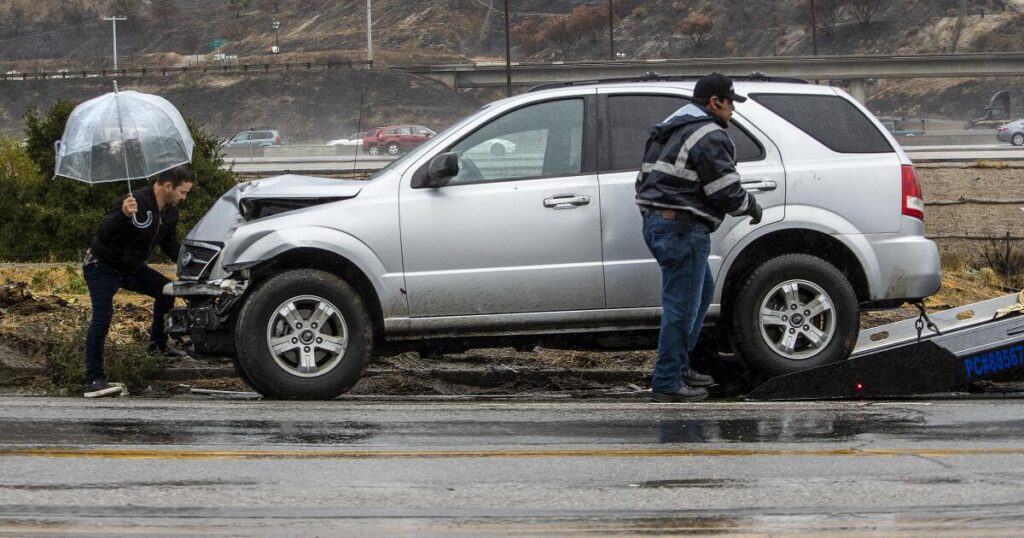
Jeff Phillips, a retired computer consultant who lives in Oceanside, did a double take when he saw his auto insurance bill from Garrison Property & Casualty. It was nearly $300 more than last year.
Phillips, 60, who primarily drives a 2010 Mercedes SUV and owns other vehicles, is now paying $3,244 a year for coverage from the USAA subsidiary, despite a multi-car and good driver discount.
“I didn’t have any incidents that would have caused it to go up,” he said. “So I was kind of shocked that it was going up as high as it was.”
If, like Phillips, you’ve recently received your renewal for auto insurance in the mail and can’t quite believe how much it has gone up, you aren’t imagining things.
The top 10 insurers in California got the nod last year to raise premiums an average of 6% — on top of a 15.4% hike in 2024 and a 13% jump in 2023, according to S&P Capital IQ.
Add it all up and rates by insurers who write about 85% of all California auto insurance have climbed on average more than one-third since the pandemic.
That means a California driver who paid the state’s average premium of $1,087 in 2022 could be paying hundreds more today.
And that’s only for drivers who have avoided accidents and tickets that can drive premiums even higher.
Rates have spiked not only in California but nationwide, despite new safety features in cars that help reduce collisions.
Several forces are driving the higher rates. They include sharply rising prices for new cars and parts driven by inflation and exacerbated by President Trump’s tariffs; more powerful, complex and heavier vehicles; increasing speeds on the highway and a greater severity of collisions, experts say.
Also contributing to higher premiums particularly in California are the popularity of electric vehicles, which are cheap to maintain but more costly to repair than gas-powered cars and trucks.
And while rates are leveling off — with State Farm, the state’s largest insurer, recently filing for a decrease — industry analysts predict that the higher premiums for the most part are here to stay in California.
“Auto insurance has become one of the least affordable necessities of daily life,” said consumer advocate Harvey Rosenfield.
A highly regulated state
The driving capital of the nation, California has had a long and tortured history with auto insurance.
Skyrocketing premiums led voters in 1988 to pass Proposition 103, authored by Rosenfield. It established an elected insurance commissioner with the authority to reduce or deny insurer requests for rate hikes. It allows consumer groups to challenge them too.
That has meant despite more than 30 million registered vehicles on the road, and jam-packed freeways in Los Angeles and other metro areas, rates have been kept down.
A 2019 study by the Consumer Federation of America found that from 1989 to 2015, California auto insurance rates rose by only 12.5% compared with a nationwide average of 61.1%, saving residents $154 billion.
More recent nationwide data calculated by industry trade publication Auto Insurance Report, found that in 2023 Californians spent an average of $1,223 on car insurance, about $60 lower than the national average.
Still, the increases were more acutely felt in California because they came after a period when regulators held the line on rate increases during the pandemic.
“The challenge is not so much average price or affordability. It’s the volatility of price,” said Pat Sullivan, editor of Auto Insurance Report. “It’s tough to stomach.”
Due to the pandemic slowdown in driving, Insurance Commissioner Ricardo Lara ordered insurers to refund premiums. Though Lara alleged insurers didn’t fully comply with his directive, spokesperson Gabriel Sanchez said $3.3 billion has been returned to policyholders.
However, Los Angeles-based advocacy group Consumer Watchdog maintains insurers actually reaped a windfall of $5.9 billion, and it filed unsuccessful litigation seeking to force greater refunds.
“It was a windfall that should have been used to offset any rate increases sought by insurance companies,” said Rosenfield, founder of Consumer Watchdog.
Sanchez disputed the claim, saying, “the department has premier experts who are doing everything they can to protect consumers and make sure they are not paying any more than they are legally required to.”
Heavier vehicles and higher claims
For any driver of a new car outfitted with the latest electronics, it might seem counterintuitive that auto premiums should be rising.
Approach a car too fast on the freeway and collision-warning bells ring. Start to pass a slow poke and blinking lights on side mirrors alert you if someone is in your blind spot. Indeed, experts say, all this new tech is beneficial.
“The key thing is they’re associated with some big reductions in claim frequencies,” said Matt Moore, chief insurance operations officer at the Insurance Institute for Highway Safety, an insurer-funded group that promotes vehicle safety.
However, while cars have been getting safer, they also have been getting larger, heavier and more powerful — with affluent buyers driving sales of cutting-edge, expensive luxury vehicles.
The average cost of a new vehicle topped $50,000 for the first time in December, up from less than $40,000 in January 2020, according to Cox Automotive.
All-wheel drive — a popular feature on already heavy SUVs that add hundreds of pounds to curb weight — is now a feature on more than 60% of new vehicles. Pickup trucks, once stripped-down utilitarian workhorses, now come equipped with engines sporting an average horsepower topping 350, according to IIHS.
Also, fast-accelerating electric vehicles are heavier than their gas-powered counterparts due to their batteries. A tiny Nissan Leaf has a curb weight of nearly 3,400 pounds. A Rivian R1T truck has a curb weight exceeding 7,000 pounds.
It didn’t help that during the pandemic drivers sped on open roads, ushering in an era of higher speeds.
“These are things which are fundamentally changing the equation of force in crashes. More force in crashes equals higher repair costs,” Moore said.
Increasingly common turbos and all-wheel drive power trains add mechanical complexity, on top of the computer systems that control new vehicles.
All those mechanical and technological advances means that the days of a cheap repair are over, especially given the persistent inflation since the pandemic.
The average cost of collision repair rose to $4,768 last year, well above the cost in 2019 when it was under $3,300, according to the Crash Course Report.
Diagnostic tools assist mechanics repairing the more sophisticated vehicles but only to a degree, driving up labor costs.
“There’s a short, but there’s three miles of cable in a car so where’s the short? I got to figure that out and take the car apart. It takes training. This person doesn’t have a high school degree. They have a college level degree in auto repair,” Sullivan said.
All these factors drove down California insurer profit margins from 16.2% in 2019 to 9.7% in 2022, according to Auto Insurance Report.
More recently, with medical, vehicle and repair costs up, California legislators in 2024 passed a bill that took effect last year raising the minimum liability coverage drivers must buy to cover injuries to other motorists and property. That drove up costs particularly for low-income drivers.
Tariff fallout
Then, when President Trump took office he imposed tariffs on Canada and Mexico, muddling up supply chainswith two key parts and vehicle suppliers — with more uncertainty following last month’s Supreme Court tariffs ruling.
“Californians are facing higher auto insurance premiums because the cost of nearly everything insurance covers has increased,” said Denni Ritter, a vice president of the American Property Casualty Insurance Assn. trade group.
But there’s some good news following the premium increases. California insurers reported better loss results in 2024, according to ratings agency AM Best, while 2025 was a very profitable for the industry as a whole, Sullivan said.
The National Safety Council recently reported a 12% decrease in nationwide crash deaths last year, suggesting vehicle speeds are coming down.
While some California insurers are still seeking rate hikes, GEICO held them steady this year and State Farm Mutual Automobile Insurance Co., California’s largest vehicle insurer, filed for a 6.2% rate decrease — which Sullivan said indicates they are seeking to increase their market share.
State Farm also announced recently it would be returning $5 billion to customers nationwide, or about $100 per policyholder.
It cited improved underwriting results, including lower accident frequency and repair costs, indicating the spike in those costs might be leveling off. It also lowered rates in 40 states in recent months.
“When we see positive trends, we look for ways to return value to our customers,” said State Farm spokesperson Bob Devereux.
The post Why auto insurance rates are surging in California appeared first on Los Angeles Times.