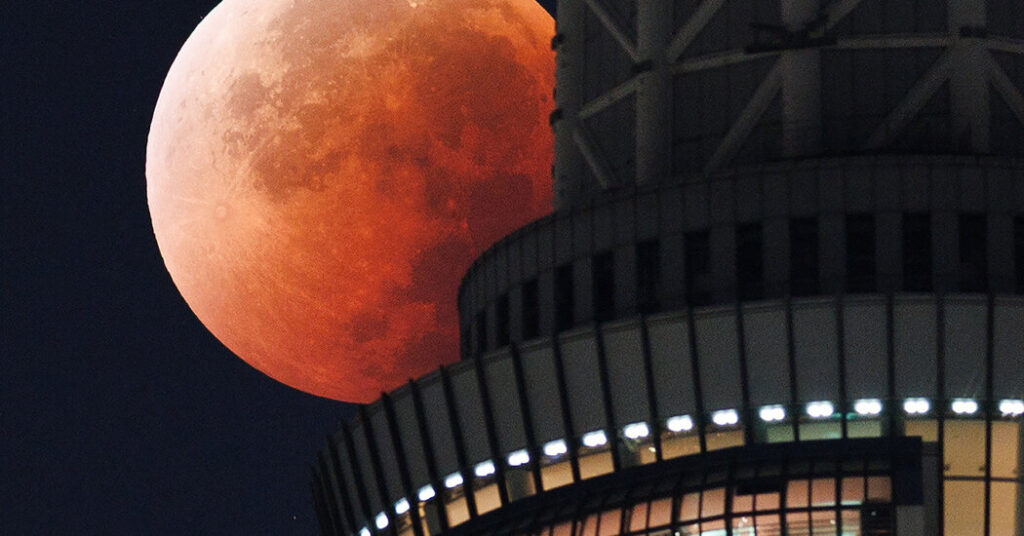
Early Tuesday morning, the moon will flush crimson as it creeps through Earth’s shadow during a total lunar eclipse.
Lunar eclipses occur when our planet slides between the sun and moon, which temporarily prevents the sun’s light from falling on the lunar surface. A total lunar eclipse is the most dramatic, and is often referred to as a blood moon.
Anyone on the night side of Earth can experience the blood moon. But what you see, and when you see it, will depend on where you are.
What is a blood moon?
There are different types of lunar eclipses. What you’ll see depends on how deeply the moon travels into our planet’s shadow, which consists of a darker, inner part known as the umbra, and an outer part called the penumbra.
A total lunar eclipse occurs when the entire moon slips into the umbra, during which most of the sunlight illuminating the lunar surface is blocked by Earth. But some sunlight spills over the edges of Earth and through its atmosphere, which more readily scatters blue light. That leaves red light, which has an easier time passing through the atmosphere, lighting up the face of the moon and causing it to shine scarlet.
How red the moon will be depends on the composition of the atmosphere during a total lunar eclipse. Clouds, dust storms and volcanic eruptions can make the lunar surface appear redder.
When and where can I see the lunar eclipse?
Moongazers in North and Central America, as well as the western coast of South America, will be able to see the lunar eclipse early Tuesday morning. It will also be visible from East Asia and Australia on Tuesday evening.
The event can be seen with the unaided eye. NASA recommends finding a dark place, away from bright lights, for the best view.
Total lunar eclipses occur in phases. According to NASA, the moon will begin to slide into Earth’s penumbra, the outer part of its shadow, at 3:44 a.m. Eastern time. During this phase, the lunar surface will slightly dim.
At 4:50 a.m., the moon will reach the darkest part of Earth’s shadow, the umbra. Over the next hour, a growing chunk of the moon’s surface will appear missing.
Totality occurs when the moon is fully engulfed by the umbra, creating the effect of a blood moon. It begins at 6:04 a.m. and lasts for 59 minutes.
On the East Coast of the United States, the sun will rise as totality is ending, which will make it difficult to see. Viewers on the West Coast will experience more of the main event
As the moon leaves Earth’s shadow, this process will reverse. The lunar surface will whiten and grow brighter as the moon slowly slips out of the umbra, then the penumbra. The lunar eclipse ends at 9:23 a.m., which in some places is after the moon has already set.
When will the next eclipse occur?
Lunar eclipses can happen several times a year, but not all of them reach totality. According to NASA, the next lunar eclipse will be partial, with only part of the moon entering Earth’s umbra. That will occur on Aug. 28 over the Americas, Europe and Africa. The next total lunar eclipse will be in 2028.
Solar and lunar eclipses often occur in pairs a couple of weeks apart from each other. This year, on Aug. 12, a total solar eclipse will be visible over parts of Iceland, Greenland, Portugal, Russia and Spain.
Katrina Miller is a science reporter for The Times based in Chicago. She earned a Ph.D. in physics from the University of Chicago.
The post Watch the Moon Turn Blood Red During a Total Lunar Eclipse appeared first on New York Times.