At his childhood home in Nebraska that lacked the comforts of television and air conditioning, Joe Ricketts learned that honest work and neighborly values were keys to success.
After graduating college, he persuaded friends and family to lend him $12,500 in seed money for what became Ameritrade, the investing firm that would go on to disrupt the Wall Street trading establishment and put Mr. Ricketts on a path to riches. By 2015, his wealth had grown to $1 billion, and even that stunning figure now feels like a quaint memory, as the powerful elixir of rising stocks and falling taxes that has minted new billionaires across the country has catapulted Mr. Ricketts’s personal net worth to $8 billion.
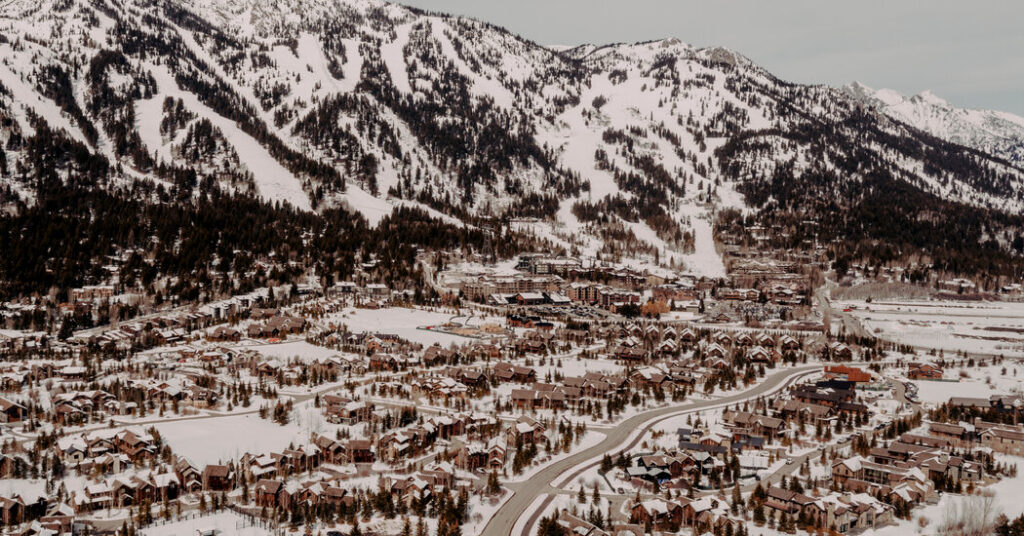
Along the way, Mr. Ricketts found new community in and around Jackson, Wyo., a playground for the rich. For some things, he has been celebrated: He has donated to research on conservation of red squirrels and American beavers. He contributed $1 million to building a hospital. He has taken pride in building a herd of white bison.
But lately some of his neighbors have come up against the raw power of Mr. Ricketts’s financial muscle. Many of them fought against a plan he advanced a few years ago to turn his ranch into a resort for wealthy tourists, proposing to bypass regulations that limit construction during the brutal winter months to protect local wildlife.
Then, when community opponents dug in, Mr. Ricketts simply acquired a different piece of land — a $9 million parcel that officials had hoped to turn into public land that could benefit everyone.
“There is not much we can do to rein that in,” said Luther Propst, a county commissioner in Teton County, home to Jackson and the mountain outposts that surround it.
The Jackson Hole region has long been a refuge for the rich, but an explosion of new affluence has allowed a growing cadre of extraordinarily wealthy people to dominate both the local economy and Wyoming state politics.
Teton County is not merely the richest county in the country, per capita, by far; it is a window into America’s near future, as the country enters a new gilded age, one in which millionaires are turning into billionaires overnight.
A New York Times analysis shows the stunning velocity at which the fortunes of the 1 percent have increased across the country since President Trump first took office in 2017. The richest Americans saw their net worth soar 120 percent between 2017 and 2025, a colossal leap from the 45 percent growth they had seen over the previous nine years.
The number of U.S. billionaires jumped 50 percent by some estimates between 2017 and 2025, to more than 900 people.
The list includes Elon Musk, who could become a trillionaire, and celebrities like Arnold Schwarzenegger, Tiger Woods, Bruce Springsteen and Jerry Seinfeld. But it also includes a number of people who are largely unknown to most Americans, people whose fortunes were lifted by investments and assets whose values have skyrocketed.
The minting of dozens of new billionaires occurred in the immediate wake of the 2017 tax cuts championed by Mr. Trump at the beginning of his first term, the nation’s biggest tax overhaul since 1986. The legislation, which slashed personal income taxes and doubled the estate tax exemption, was billed by Mr. Trump as “tax cuts for American families.” But the Times analysis, backed up by a range of new studies, shows that it disproportionately benefited wealthier taxpayers.
Most important, it cut the corporate tax rate and laid the groundwork for a surge in stock prices — creating a phenomenal accretion of wealth. The coronavirus pandemic intensified the dynamic. Tech prices soared as employees geared up to work at home and inflation tripled, weighing on the middle class and devastating the poor.
While the rich have been getting richer at a fairly steady pace over the years, the analysis shows that the net worths of those who were already billionaires experienced a pronounced shift after the tax cuts were signed into law, growing by 49 percent over eight years.
Overall, the top 1 percent now control $55.8 trillion in assets — more than the G.D.P. of the United States and China combined.
One of the central quandaries the country now faces is how to govern in an era when such vast wealth both controls a large part of the economy and is increasingly used to access political power.
In Wyoming, the conservative Freedom Caucus rose to power in the state Legislature at the end of 2024, aided in part by wealthy donors like the former commodities trader Dan Brophy, who lives in Wyoming, and an out-of-state PAC that traces some of its money to groups backed by the billionaire businessman Charles Koch. Lawmakers last March approved a substantial cut in property taxes, one of the state’s few sources of revenue from wealthy residents, and in November were considering a bill that would repeal property taxes entirely.
Teton County has long had the highest wealth inequality in the country. But that disparity has escalated sharply since 2017. The county’s top 1 percent of households, including Mr. Ricketts, now have an estimated average annual income of about $35 million, 221 times what the bottom 99 percent is making, according to a Times analysis of tax data. The average single-family home price last year pushed past $7 million.
The result has been a critical housing shortage for anyone who is not wealthy, and a strain on local services as tax cuts favored by the rich cut into local government revenues. The morgue in Teton County operates out of a former parking garage.
“I’ve never seen anything like the explosion of wealth, the influx of wealth in the past five years,” said Rosie Read, founder of the Wyoming Immigrant Advocacy Project, which provides affordable legal aid and education services to immigrants, who are among those most affected by the rising housing prices. “Immigrants often work as housekeepers, dishwashers and landscapers, and no one will pay them the $150,000 a year or more they need to live comfortably here,” she said.
More Money
To understand how the fortunes of billionaires diverged so sharply from the rest of the country, it’s essential to understand precisely how the 2017 tax cuts and the economic pressures unleashed by the pandemic helped widen the wealth gap.
The disparity between America’s rich and poor has been growing for 50 years thanks to Reagan-era tax cuts, Clinton-era financial deregulation and decades of U.S. companies relying on cheaper foreign workers — moves that generally boosted corporate salaries and kept wages lower.
Mr. Trump supercharged this trend in 2017 when he passed his tax reform plan. It is not possible to measure how much the tax breaks accrued to any one billionaire’s bottom line, as the impact differed based on each person’s unique portfolio of assets.
But of an estimated $2 trillion in savings that U.S. taxpayers will accrue over a decade as a result of the tax cuts, more than a third — $750 billion — will flow to the richest 1 percent of Americans, according to the Brookings Institution. At the moment, that includes those with assets of $11.1 million or more.
Some pieces of the 2017 tax law explicitly helped wealthy people, like a provision that allowed private jet buyers to write off the cost of the plane. (The private jet market grew by 42 percent between 2017 and 2025, according to Global Jet Capital.) The new law also doubled the amount of money that households could pass on to heirs tax-free, from $11 million per married couple to $22 million.
Most important, though, the law slashed the corporate tax rate to 21 percent from 35 percent. Mr. Trump and some of the richest people in the country who championed the tax cut contended that it would create economic benefits for all. Companies, they predicted, would spend their tax savings on higher employee salaries and corporate improvements.
The cut indeed bolstered corporate earnings, and stock prices soared. The S&P has gained about 80 percent since 2018, delivering a 190 percent total return to investors, including corporate dividends. U.S. corporations delivered their best post-tax profits in decades, even when adjusted for inflation, according to the Federal Reserve. Flush with cash, public companies bought a record $910 billion worth of their own stock, supercharging shareholders’ portfolios.
The private equity behemoth Blackstone, for instance, saw its effective tax rate drop from 18 percent in 2017 to 7 percent in 2018 to -1.3 percent in 2019. Over the same period, Bloomberg estimated that chief executive Stephen Schwarzman, whose personal fortune is largely reflective of his ownership stake in the firm, saw his net worth grow to about $19 billion in 2019 from around $11 billion in 2017. He is now worth an estimated $45 billion, a more than 300 percent increase in eight years.
Most companies did not meaningfully reinvest in businesses and employees, a Brookings analysis found. Workers received raises, but nothing like the big boosts that wealthy people received and rarely enough to offset higher food and housing costs. Economists found that only the top 10 percent of wage earners saw any appreciable increase in their net earnings.
The pandemic blew open the socio-economic gaps that emerged during Mr. Trump’s first term. Widespread lockdowns pushed the United States into a short, sharp recession in the spring of 2020. Market prices fell and companies slashed tens of thousands of jobs. While a significant number of people were worried about illness and job insecurity, wealthy Americans used the downturn as an opportunity to buy stocks, real estate and other assets, essentially on sale.
When the markets recovered, the rich disproportionately reaped the rewards. Federal Reserve data shows that the wealthiest 1 percent of Americans now own about $25.6 trillion worth of stocks and mutual funds, the same amount as the remaining 99 percent of the country. About half the stock owned by the wealthiest Americans — $13.7 trillion worth — is owned by the richest 0.1 percent.
After the shutdowns began, the 2,000 or so billionaires in the world at that time added more than $2 trillion to their wealth, a 28 percent jump over just four months, according to UBS.
As the pandemic ground on, supply-chain issues and shortages drove up prices on essential items like food, energy and building supplies. Companies sold more products at higher prices to meet demand, boosting stock prices and enriching ultrawealthy corporate owners.
The Walton family, which controls Walmart, currently has an estimated combined wealth of $550 billion, up from $256 billion in the spring of 2020. Over that same time, the Mars family, which manufacturers pantry staples, snacks and pet food, saw its combined wealth grow to $162 billion from $92 billion. And Warren Buffett, whose Berkshire Hathaway sells insurance, clothing and construction supplies, saw estimates of his net worth jump to $150 billion from $84 billion.
Remote work and social isolation also fueled an explosion in technology use, underpinning a pandemic-era boost for tech stocks. Since the spring of 2020, tech billionaires saw their net worths swell. Mr. Musk’s estimated fortune increased more than 2,100 percent; Jeff Bezos’s jumped by 165 percent; Mark Zuckerberg’s increased more than fourfold; and Larry Ellison, the billionaire co-founder of Oracle Corp., saw his fortune rise by 275 percent.
The explosion of wealth did much more than increase inequality; a presidential administration run by a billionaire and the easing of legal restraints on political contributions over the past 15 years have allowed the nation’s wealthiest people to exert a growing level of influence on political power — planting the seeds of an American plutocracy.
When President Trump was inaugurated last year, 11 billionaires worth a combined total of $1.35 trillion, according to Forbes, were in attendance at various events. This included Mr. Musk, who spent more than $250 million in the final months of the 2024 campaign to help Mr. Trump get elected. Mr. Trump’s cabinet now includes 12 billionaires.
Wyoming tycoons were among Mr. Trump’s supporters. Marlene Ricketts, the wife of Joe Ricketts, and B. Wayne Hughes Jr., a fellow Wyoming billionaire, each donated $1 million to the president’s inaugural committee; and Mr. Ricketts’s son Joe co-hosted a pre-Inaugural Ball reception for wealthy donors with fellow hosts Mark Zuckerberg and Miriam Adelson, the widow of the casino magnate Sheldon Adelson.
Mr. Hughes also owns Cowboy State Daily, a widely read news website with a right-leaning editorial board that gives him the additional political clout of a publisher, and he has donated more than half a million to Republican state candidates since moving to Wyoming in 2017.
Scott Ellis, a former technology executive from California and member of Patriotic Millionaires, a group of rich Americans pushing for higher taxes on the ultra wealthy, said the consolidation of wealth threatens to transform the nature of how government operates.
“At some point there’s nothing you can spend money on that actually makes your life materially better, so money simply becomes power,” he said. “The question for us is not how much wealth we want other people to have, but how much power.”
A Land for the Rich
The billionaire boom has been particularly pronounced in Teton County. The region’s per-capita investment income — the average amount earned per person from investments like stocks and other assets — nearly doubled between 2017 and 2022 and is now 29 times the national average, according to an analysis by The Times.
The boom propelled Adam Forste, a longtime Teton County resident and private equity executive, into the ranks of Wyoming’s billionaire class. The cohort already included members of the Mars family, the owners of the candy and snack company; Christy Walton, an heir to the Walmart fortune; Amy Wyss, a Swiss-American heiress; and Mr. Ricketts.
But the latest burst in new wealth has threatened to make the region — once merely expensive — unlivable for everyone else.
With rising rents, businesses have been hard-pressed to keep employees. Ali Cohane, who owns bakeries in Jackson and also in Wilson, an even wealthier town in Teton County, said she has enough business to expand, but cannot find the workers to do it. “We’re at a standstill,” she said.
Kat Jacaruso, a manager at Rendezvous River Sports, rents an affordable one-bedroom apartment from her employer, an increasingly common arrangement. While Ms. Jacaruso loves her boss, she cautioned that such deals could force some employees to choose between bad jobs and being priced out. Rendezvous, which offers kayak rentals and tours, employs spring and summer workers who live in their cars — not an uncommon scenario.
“We’ve added 4,300 jobs in the last 10 years, but only added 300 year-round residents,” said April Norton, the Teton County housing director.
The majority of the county’s new workers commute into the area, often from Idaho towns like Driggs and Victor. There are now traffic jams on the mountain pass between Driggs and Jackson, a 45-minute drive in good weather that includes steep grades and an elevation gain of more than 1,600 feet.
Many employees work in downtown Jackson, where tourists take selfies beneath an arch made of elk antlers and drink at the kitschy watering hole the Million Dollar Cowboy Bar. Real estate prices are so high that a 0.75 acre lot currently costs $1.3 million.
The county’s truly rich live in rural enclaves outside of Jackson, where three-bedroom houses cost around $5 million and realtors just broke the record for the number of $10 million homes sold in a year.
The richest residents, who have to live in Wyoming for only six months a year to qualify for the tax breaks, often have two or three homes elsewhere. When they come to Jackson Hole, they may fly in their own doctors, private chefs and nannies, then turn their private jets around to fly their teenagers to an athletic tournament on the other side of the state. The Teton County airport has become so busy that officials commissioned a new terminal for private aviation at a cost of about $50 million, much of it funded by issuing bonds.
Yet it is a place where the wealthy often take pains to remain inconspicuous. Unlike such places as Palm Beach or the Hamptons, wealth in a mountain town like Jackson Hole is not a badge to wear proudly; it is something to disguise. Drive a truck. Wear Levi’s, work boots or trail shoes, a plaid shirt and a trucker hat. Get a dog. That guy behind you getting a coffee? He might be a billionaire.
Some of the county’s wealthy residents are disturbed by the changes. “I remember a friend of mine bragging about us having the highest net worth in the country, and I said to him, ‘You know that means we also have the most inequality,’” said Margot Snowdon, a philanthropist who has lived in Teton County for nearly 50 years and whose $35 million family foundation funds social services.
The county’s total estimated wealth is now more than $14 billion, most of it concentrated among a tiny sliver of the area’s fewer than 10,000 households. “It means we have so much money that people don’t have to care if they don’t want to,” Ms. Snowdon said.
A Haven in Wyoming
It is not merely the majesty of the Teton Range and the winding Snake River that have made Jackson Hole a destination for the ultrawealthy. Unlike states like Washington and California, which are moving to tax millionaires and billionaires, Wyoming has helped the rich hold on to their wealth.
In 2022, the county assessor went to the state Legislature to support a bill closing the loopholes that allowed wealthy landowners to claim agricultural tax exemptions even when their large spreads were hardly working farms. But lawmakers declined to make the change.
After its rise to power in 2024, the Freedom Caucus adopted the property tax cut — 25 percent on a home’s first $1 million in value — resulting in an immediate loss of money for schools.
“Those tax dollars covered personnel and other costs that towns could use at schools, police forces, road and parking maintenance crews, and hospitals,” said Mike Yin, a Democratic state legislator who represents Teton County.
Nor has state or local government raised other taxes to tap the enormous amounts of money circulating in places like Jackson Hole.
“We sell hundreds of millions of dollars of real estate every day, and it’s not taxed,” said Jonathan Schechter, a Jackson town council member who has a think tank that studies growth and sustainability. “There’s no real-estate transfer tax. We have no income tax, so salaries and wages aren’t taxed. There’s billions of dollars of investment income that residents claim, and none of that is taxed.”
The result is that Teton County, for all its wealth, is struggling to maintain basic services.
The hospital has cut clinics. The health department has reduced staff. Last year, two sheriff’s deputies assigned to patrol duty did not have proper vehicles.
Dr. Brent Blue, the county coroner, conducts autopsies in a garage once used to park the vehicles of pest-control workers. He and his employees at the morgue hoist bodies using an old hospital lift, modified with some rock-climbing rope and plastic zip ties. He has sought a new building for years but has not received the funding to move.
“I’m not trying to build a Taj Mahal,” Dr. Blue said. “I’m trying to build a functional facility.”
Teton County public schools face steep financial challenges. At Jackson Hole High School, locker rooms and bathrooms are not wheelchair accessible. The cafeteria is so crowded that students eat in the hallways. And most classrooms are over capacity, with teachers leaving over the high cost of living.
After state lawmakers allocated money for a new building, inflation pushed costs well above the agreed-upon budget and no one can say for sure when construction will begin.
Yet on the other side of town, a private school started up by the billionaire Friess family has thrived.
Visitors to the Jackson Hole Classical Academy are greeted by a portrait of Foster Friess, the multibillion-dollar investment fund manager, and his widow, Lynn. Co-founded by their son Stephen and his wife, Polly, the school moved into its new 75,000-square-foot building this fall. The campus includes a new soccer field, greenhouse, labs and libraries.
Teton County commissioners rejected the proposal in 2017, determining that it was in conflict with local zoning rules that limit the size of buildings in the area.
The Friess family went straight to the state Legislature, which passed a measure in 2019 that essentially undermined the ability of local authorities to decide that issue.
The academy stands to gain substantially from another new state law, passed last year with backing from the Freedom Caucus, that would give Wyoming families $7,000 a year in taxpayer funds to spend outside the public school system. The new law could provide the academy with up to $1.85 million a year in taxpayer funds, depending on enrollment. The Wyoming Supreme Court is weighing whether the law will take effect.
The Friess family said in a statement that the Legislature passed a “fair and just law,” and noted that the family had purchased two dozen condos to provide affordable housing for teachers. More than 60 percent of families do not pay the full $30,000 tuition, they added, and some parents work full time at the academy.
While some students’ parents are wealthy, Stephen Friess added, “My daughter’s friends’ dads are the plumber, the linen laundry serviceman, an integrative-medicine doctor and a teacher at our school.” He said the school saves Wyoming money by reducing the number of students that the state must educate.
As might be expected in a place with so much private money, the more than 200 nonprofits in Teton County have supported upgrades to the hospital, bike paths, a legal aid center for the poor, the library and the 100-plus fire department volunteers.
But Justin Farrell, a sociology professor at Yale University who wrote a book about the local economy, “Billionaire Wilderness,” found that rich people in Teton County tend to favor causes that improve their own lives, like the Community Center for the Arts, whose assets grew to $30 million in 2014 from $268,158 in 2000. Over that same time, Mr. Farrell found, assets for the county’s three most prominent social welfare nonprofits — the Latino Resource Center, Jackson Hole Community Housing and the Community Resource Center — topped out at around $355,000 each.
“Nonprofits can’t be the solution,” said Mr. Yin, the state legislator. “They’re funded by the rich, so the rich dictate who gets served.”
For his part, Mr. Ricketts sees the resort project he is proposing to build as a net benefit to the community. The plan has attracted far less resistance than his original idea, which could have resulted in disruptions to wildlife during construction; neighbors packed community meetings to challenge the development.
But not everyone is happy with the new proposal, either. The U.S. Forest Service had been looking to acquire the land to fill out public forest lands near an iconic waterfall where part of the 1992 film “A River Runs Through It” was shot. County commissioners initially expressed worry about development in such an isolated area. But it turned out that the land already had most of the necessary zoning, and commissioners said they felt that they had little recourse but to allow it to proceed. “He’s got kind of a free pass,” Mr. Propst, the county commissioner, said.
Mr. Ricketts’s team said it was working to minimize the project’s environmental impact, with plans to use prefabricated building components and erect them within the footprint of an existing structure, restore any disturbed wildlife habitat and provide housing for resort employees on site to limit traffic.
Mr. Ricketts’s representatives have said he was unaware of the U.S. Forest Service’s interest in acquiring the property when he purchased it. “Joe Ricketts has been a leader in supporting conservation initiatives focused on protecting the Yellowstone ecosystem and believes thoughtful development and environmental stewardship can coexist,” a spokesman said in a statement.
Many longtime Jackson residents wonder how long their community can continue on its current trajectory.
Dozens of people gathered at a rally in Jackson’s town square in July to honor the memory of the Georgia congressman and civil rights leader John Lewis.
Many held “No Kings” protest signs. Another one said, “Let’s Take Care of More Hungry Kids Before Billionaires Get More Tax Cuts.” Kathy Chandler, a retiree who moved to Jackson as a single mother 29 years ago, said she feared that she would be forced to leave. “Billionaires buy up huge tracts of land, build huge estates and then they’re not here. But they use our local resources,” Ms. Chandler said.
Andrew Munz, who was raised in Jackson Hole, is trying to revive the old Pink Garter Theatre in downtown Jackson, which was nearly converted to office space a few years ago.
He lives alone in a 495-square-foot townhouse for which he pays $3,300 a month.
“I keep caring and honoring my own love for the place, and my own fight to preserve some semblance of my hometown that, hopefully, these new people will value just as much,” Mr. Munz said. “That has been the biggest fight of the past decade.”
Did he like the way the fight was trending?
“No,” Mr. Munz said. “I’m losing.”
About this story
For this story, The New York Times analyzed data from a variety of sources, including Forbes, Bloomberg, the Internal Revenue Service, the Federal Reserve, the Bureau of Economic Analysis and the U.S. Census Bureau.
Official statistics do not directly indicate how much income, in any given county, goes to the top 1 percent of earners. To estimate those figures, The Times followed statistical methods published by economists Thomas Piketty and Emmanuel Saez. Working with Regina Nuzzo, professor of mathematics and data science at Gallaudet University, The Times re-created Piketty and Saez’s analysis of incomes and then updated it using Internal Revenue Service data for 2022, the most recent year available.
Using a similar approach, The Times also calculated the average income for the bottom 99 percent of residents in each geographic area. The Times then compared the average incomes in the top 1 percent and the bottom 99 percent to calculate a disparity metric that has previously been used by Mr. Piketty and Mr. Saez, among other economists.
The Times repeated that analysis for prior years of data to track how those disparities have changed over time.
Katie Benner is a correspondent writing primarily about large institutions that shape American life.
The post Welcome to Wyoming, the Frontier of America’s New Gilded Age appeared first on New York Times.