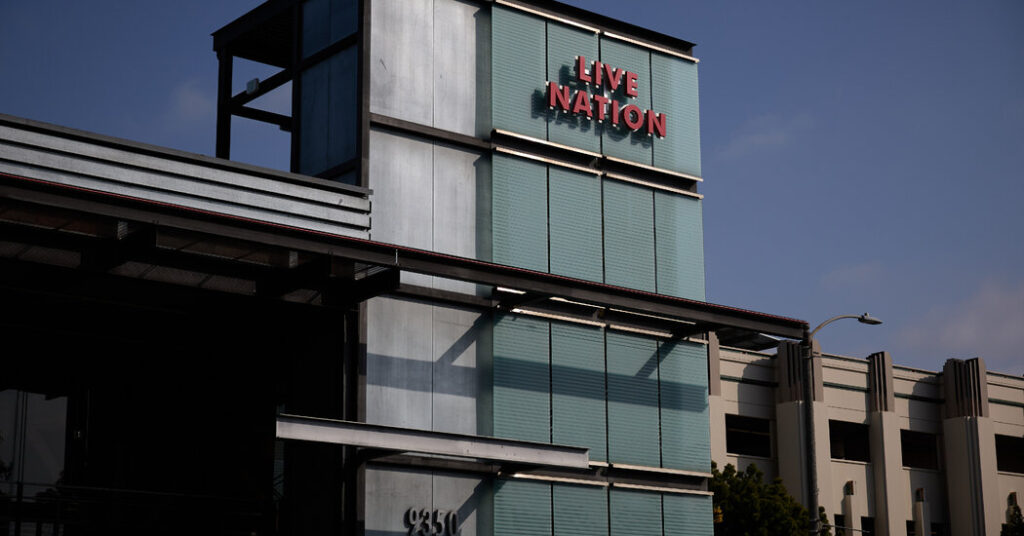
The biggest legal case the music industry has seen in years will open Monday in a New York courtroom, as Live Nation, the concert giant that owns Ticketmaster, defends itself against accusations that it operates a far-reaching monopoly in violation of federal and state antitrust laws.
For Live Nation, the stakes are high — a possible breakup of the company, or at least a disruption of the lucrative business model that over the last 16 years has made it a colossus of the music industry.
For the Justice Department and the smaller companies that say they cannot compete with Live Nation, the case has the promise of leveling the playing field, which they say has been tilted since the government allowed Live Nation and Ticketmaster to merge in 2010.
Since then, the combined company has come to dominate nearly every aspect of the multibillion-dollar concert business. The government contends that Live Nation has used its power to stifle competition and drive up ticket prices for millions of fans. Last year, the company put on 55,000 events and sold 646 million tickets around the world. It also owns or controls 460 venues and manages more than 300 artists, according to its annual report.
“Live Nation and its wholly owned subsidiary, Ticketmaster, have used that power and influence to insert themselves at the center and the edges of virtually every aspect of the live music ecosystem,” the government wrote in court papers. “This has given Live Nation and Ticketmaster the opportunity to freeze innovation and bend the industry to their own benefit.”
Live Nation denies that it is a monopoly. In court papers last year seeking to dismiss the case, the company argued that “if there was a lick of truth” to the accusations against it, the government, which brought the case nearly two years ago, would have presented “mountains of evidence demonstrating monopoly power and the anticompetitive effects of Live Nation’s conduct.” Yet after an investigation and extensive legal discovery, Live Nation argued, the government presented “barely a molehill.”
The case against Live Nation was originally filed by the Biden administration, which began monopoly actions against tech giants like Apple and Amazon, blocked several corporate mergers and began an unsuccessful effort to break up Google. President Trump’s appointees have been more willing to settle cases — especially when scrutinizing mergers — raising questions about their desire to continue aggressive litigation against big companies.
But the Live Nation trial, before a jury in Federal District Court in Manhattan, would be a departure from those practices.
Though the Live Nation case is a complex antitrust matter, its core issues — including high ticket prices and fair treatment of consumers — are perennially popular political issues among both parties. Attorneys general for 39 states and the District of Columbia have joined the Justice Department as plaintiffs.
In its complaint, the government argued that Live Nation maintains monopolies in a series of interconnected businesses involving concert tours and tickets. A ruling last month by the judge overseeing the case, Arun Subramanian, narrowed the scope of the trial, dismissing some claims like the accusations that Live Nation acts as a monopolist in how it sells tickets to the public and in how it works with artists to put on tours in “major concert venues,” which the government defines as arenas and large amphitheaters.
But Live Nation will still have to defend itself against accusations that it pressures venues — and has even threatened some of them — to sign exclusive ticketing deals or else face losing access to the company’s popular concert tours, and that it demands that artists use its promotions arm in order to perform in Live Nation’s amphitheaters.
“A reasonable jury,” Judge Subramanian wrote, “could certainly find that artists were coerced into going with Live Nation as their promoter to get into its amphitheaters.”
After that ruling, a top Live Nation executive, Dan Wall, said in a public letter that the judge’s order meant that “structural relief,” meaning a breakup of the company, was now “off the table,” and he urged the government to settle. “It’s time to move on,” Mr. Wall wrote. So far no settlement has been reached.
Rebecca Haw Allensworth, a visiting professor at Harvard Law School and an expert on antitrust law, said the judge’s decision meant the Justice Department would be left to argue only its strongest claims. She also said it was “premature” to say what the judge’s ruling meant for the government’s ability to obtain a breakup of Live Nation.
“Having narrowed this down to the things that the court is telegraphing are the most meritorious,” Professor Allensworth said, “and given that this is a jury trial with a company that’s well-known and unpopular, I think that their chances are pretty good on winning at least some of these claims.”
At the trial, which is expected to last a month or more, most of the witnesses will be executives from music and ticketing companies, including Michael Rapino, Live Nation’s longtime chief executive. One of the few performing artists cited in court papers as a potential witness was Kid Rock, the outspoken rap-rock star who has emerged as a vocal critic of the industry’s status quo when it comes to ticketing. In a Senate subcommittee hearing in January, he called the Live Nation-Ticketmaster merger an experiment that “has failed miserably.” (Still, he is working with Live Nation for his latest tour, and is using Ticketmaster in a way that he says protects fans.)
For years, some of Live Nation’s most vocal critics have been small venues, who say the company’s dominance makes it harder for them to put on shows. “We are not competing; we’re barely surviving,” Stephen Parker, the executive director of the National Independent Venue Association, said in an interview. He pointed to a study the group commissioned last year, which found that 64 percent of independent venues, promoters and festivals across the United States reported being unprofitable in 2024.
Even well-capitalized competitors have been hindered, according to the government, which cites complaints by two ticketing rivals, SeatGeek and AXS — a ticketing division of Live Nation’s biggest corporate rival, AEG — that they have made only minimal gains in signing ticketing deals with major venues.
According to court papers, some SeatGeek ticketing contracts obligated it to pay venues if Live Nation steered shows to other places as retaliation for signing with SeatGeek. One incident expected to be covered at trial involves Barclays Center, the basketball and concert arena in Brooklyn, which in 2023 said it was returning to Ticketmaster after a brief run with SeatGeek. The government said it had evidence showing that Live Nation routed tours away from Barclays Center after it left Ticketmaster for SeatGeek. Live Nation has denied diverting shows away from the arena.
The case is going to trial amid tumult in the antitrust division of the Justice Department, engulfing lawyers and economists who specialize in abstract commercial law in debates about the influence of big corporations on the Trump administration. Last month, Gail Slater, who led the division, abruptly left her role. Her departure came after a former deputy made allegations that a technology company had used well-connected political operatives to go over her head and settle a lawsuit with the department.
Last year, Live Nation added Richard Grenell, a former U.S. ambassador to Germany who has led Mr. Trump’s contentious remaking of the Kennedy Center for the Performing Arts, to its board. In announcing the move, the company cited Mr. Grenell’s “decades of diplomatic and leadership experience” and its own interest in promoting live music internationally.
Omeed A. Assefi, the acting head of the Justice Department’s antitrust division, has privately expressed his support for the case against Live Nation, said a person with knowledge of his views.
The roots of the merger go back to 2009, when in the depths of a financial downturn, Live Nation, then primarily a concert promoter and venue operator, proposed merging with Ticketmaster. Live Nation had already tried to build its own ticketing service, an effort that had largely failed.
The Justice Department, after scrutiny, blessed the merger in 2010 under the conditions that the expanded company divest some assets and sign a legal agreement with the government. That agreement, known as a consent decree, laid out rules the company would have to follow, like not threatening venues with the loss of Live Nation tours if they did not use Ticketmaster.
Gene Kimmelman, who was a deputy in the Justice Department’s antitrust division when the deal was being reviewed, said in an interview that government lawyers had considered litigation but thought it “virtually impossible” to win. For one thing, he said, in the closely knit music industry, it was “very hard to find credible witnesses” who would testify that the combined company would harm them.
“People thought it was the best they could do at the time,” Mr. Kimmelman recalled.
In 2018, The New York Times reported that Live Nation had been accused of violating its decree by threatening venues, and the next year the Justice Department said it found evidence that the company had “repeatedly” violated the agreement. The government modified and extended the decree, which expired at the end of 2025, and now, barring a last-minute settlement, is taking the company to trial.
Ben Sisario, a reporter covering music and the music industry, has been writing for The Times for more than 20 years.
The post Antitrust Trial to Challenge Live Nation’s Grip on the Music Industry appeared first on New York Times.