The billionaire class has never been bigger.
Supercharged by Trump-era tax cuts and other policies that favor the rich, America’s wealthy minority has more power over the country than at any time in the last century.
At the dawn of this new plutocracy, the United States faces a central quandary: Will it allow several hundred families to continue to amass economic control and political influence? And what will the country look like as it becomes increasingly shaped by the needs and beliefs of its top 1 percent?
Nowhere is the dilemma more pronounced than in Teton County, Wyo., the area around Jackson Hole. Long the richest per capita in America, the county is now the home of the nation’s most pronounced wealth gap. With the help of the Freedom Caucus (itself supported by ultrarich donors), the top 1 percent has exerted influence over many decisions on land use, education and tax policy. Life for those who are not rich has become unaffordable.
Here are five takeaways.
About 350 people became billionaires in just eight years.
A New York Times analysis shows the stunning velocity at which the fortunes of the 1 percent have increased in recent years. The richest Americans saw their net worth soar by 120 percent from 2017 to 2025, a colossal leap from the 45 percent growth they had seen over the previous similar period.
As a result, the number of U.S. billionaires jumped by 50 percent from 2017 to 2025, to more than 900 people, according to some estimates.
Moreover, the top 0.1 percent of households — the richest of the rich — saw their fortunes grow at a faster pace than everyone else did, in part because wealthy people benefit the most when stock markets rise.
The top 1 percent of American households, which have a minimum net worth of $11.1 million, now collectively own about $25.6 trillion worth of stocks and mutual funds, the same amount as the remaining 99 percent of the country, according to the Federal Reserve.
Of the $25.6 trillion worth of stock owned by the 1 percent, more than half is in the hands of the top 0.1 percent.
Trump’s tax cuts bolstered private jet sales, corporate profits and billionaire bank accounts.
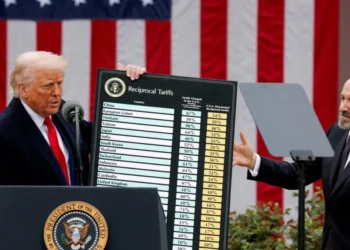
While the wealth gap has widened steadily for 40 years, President Trump’s 2017 tax cuts supercharged the trend, according to a Times analysis and a range of new studies.
The tax law allowed private jet buyers to write off the cost of planes — ostensibly purchased for business — and global jet transactions grew by 42 percent from 2017 to 2025, according to Global Jet Capital. The law also doubled the amount of money that households could pass on to heirs tax-free.
The provision that lowered the corporate tax rate to 21 percent from 35 percent had the biggest impact on the ultrarich. As companies became more profitable, they used the additional profits to buy back stock. The stock market soared, benefiting the executive class, which receives much of its compensation in company shares. Few companies meaningfully reinvested in businesses and employees, a Brookings analysis found, and the raises that wage workers received were rarely high enough to offset higher food and housing costs.
The pandemic was a force multiplier.
The coronavirus pandemic supercharged the effects of the tax cuts. Tech prices soared as employees geared up to work at home, and technology gains contributed to about half of the wealth gained by all billionaires. About two-thirds of new billionaires minted since the start of 2020 also made their money in tech.
Elon Musk led the pack, with his wealth growing to well over half a trillion dollars, from $25 billion in early 2020 — a 2,100 percent increase. Jeff Bezos’ net worth jumped by 165 percent; Mark Zuckerberg’s increased more than fourfold; and Larry Ellison, the billionaire co-founder of Oracle, saw his fortune rise by 275 percent.
The pandemic blew open the socioeconomic gaps that emerged during Mr. Trump’s first term. Most of the country sheltered at home and weathered a sharp recession in early 2020, and then grappled with skyrocketing inflation that ate up most of the wage increases that companies had given workers.
But rich Americans used the downturn to buy stocks, real estate and other assets, essentially on sale. UBS found that the 2,000 or so billionaires in the world at that time added more than $2 trillion to their wealth, a 28 percent jump from April to July 2020. And their spending, especially on real estate and construction, helped increase housing and construction costs for all.
Vast wealth in Teton County
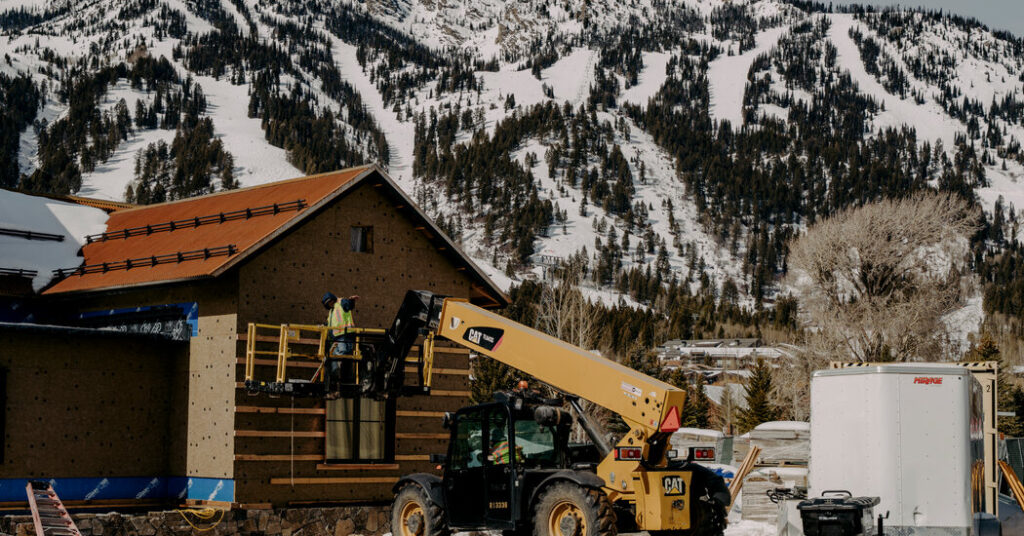
This confluence of events was deeply felt in Teton County, where the rich saw their fortunes rise during the first Trump administration. Even more elites flocked to the area during the pandemic, sending prices for real estate (and everything else) sky-high. The average price for a single family home has pushed past $7 million.
By 2024, Teton County’s per capita income hit $532,903, the highest county-level figure in the country; Summit County, Utah, clocking in at around $280,000, was a far second. That high income was largely driven by the top 1 percent of residents, who have an estimated annual income of about $35 million, according to a Times analysis of tax data. That amounts to 221 times the average annual income of the bottom 99 percent in the county.
Nowadays, some people no longer recognize their town. Andrew Munz, who was raised in Jackson Hole, said that it was as if the region went into a deep slumber during the pandemic and awoke to find that the uberwealthy had taken over.
The conservative Freedom Caucus rose to power in the State Legislature at the end of 2024, thanks in part to wealthy donors like the former commodities trader Dan Brophy, who lives in Wyoming. Soon after that year’s general election, lawmakers approved a substantial cut in property taxes, one of the state’s few sources of revenue from wealthy residents — a move that many economists said was regressive. In November, they considered a bill that would repeal property taxes entirely, another boon for the rich.
They also passed a universal school voucher program that would give Wyoming families $7,000 a year in taxpayer funds to spend outside the public school system. The new law could divert funds from public schools and toward the kinds of private and charter schools often favored by wealthy families. The Wyoming Supreme Court is weighing whether the law will take effect.
In Teton County, the social contract is fraying.
Local residents said there used to be much to like about living among the 1 percent, even as inequality rose. Teton County had better medical care than the rest of the state. The public schools had better academic outcomes. But the latest billionaire boom, paired with a tax regime that favors the rich, has eroded the quality of life.
The property tax cut took an immediate toll on funding for schools, police forces, road and parking maintenance, and hospitals, according to Mike Yin, a Democratic state legislator who represents Teton County. The county hospital has cut clinics. The Health Department has reduced staff. Last year, two sheriff’s deputies assigned to patrol duty did not have proper vehicles.
And the affordable housing shortage, which has been a problem for decades, is now so acute that teachers, medical staff members and even doctors are being priced out of the county.
Katie Benner is a correspondent writing primarily about large institutions that shape American life.
The post 5 Takeaways on America’s Boom in Billionaires appeared first on New York Times.