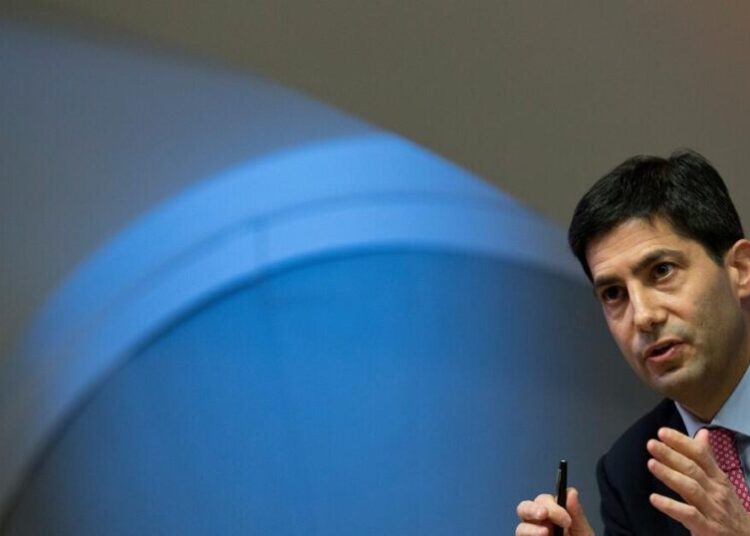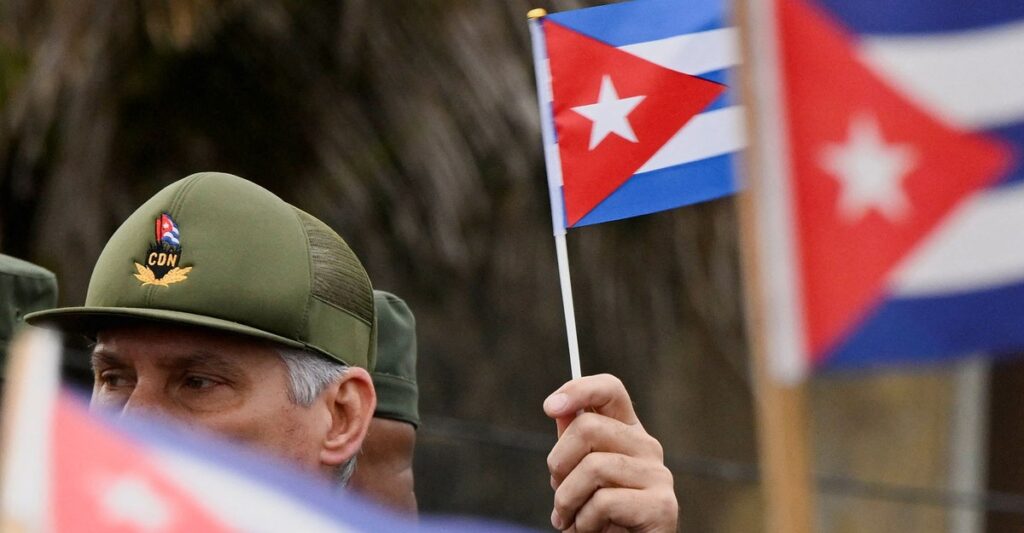
In the basement Situation Room at the White House and a gilded secure room at Mar-a-Lago are whispers of a Trumpian grand plan that many in Washington and in capitals around the world once considered unthinkable: the toppling of not one, not two, but three autocracies that have tormented generations of American presidents. As U.S. and Israeli missiles fell on Iran this weekend, just weeks after Donald Trump ordered a lightning strike that put Venezuela’s president in a New York City courtroom, Trump is already eyeing his next target: Cuba.
“The president is feeling like, ‘I’m on a roll,’ like, ‘This is working,’” one administration official told me.
The president has been open about what he would like to see in Cuba, floating the possibility while speaking with reporters at the White House on Friday of a “friendly takeover” of the island of 11 million people. He said that Secretary of State Marco Rubio is in discussions with Cuban leaders at a “very high level” to potentially “make a deal.” Rubio also is in contact through unofficial channels with Raúl Guillermo Rodriguez Castro, the grandson of former President Raúl Castro, Fidel’s brother and successor, according to Axios. Trump has repeatedly emphasized Cuba’s dire economic state, telling reporters last month that “there’s no oil, there’s no money, there’s no anything.” He has also argued that the post-Castro Cuban regime is so fundamentally weak that its own rot would inevitably do the work of an invading army.
But the idea is fraught with risk. A Cuba in turmoil could cause an influx of refugees to the U.S. at a time when the administration is trying to reverse immigration flows. A military campaign might set the stage for a revolt, but there is little organized opposition in the country after almost seven decades of repressive rule. That could make a negotiated settlement that leaves the regime in place but puts America in charge (à la Venezuela) a tempting option. But such an outcome would fall far short of turning Cuba into the world’s newest democracy—a goal of many of Trump’s South Florida supporters and a move that would allow the president to claim that he hadn’t just changed leaders but changed the fundamental character of the country.
At play behind the president’s public Cuba musings is something big and personal, administration officials and Trump confidants told me. The president sees himself as the first modern American leader with the guts to complete what others only flirted with: map-changing transformations across the world that could, in his mind, cement his legacy above that of Ronald Reagan (who bested the Soviet Union in the Cold War), Jimmy Carter (who secured the 1978 Camp David accords between Israel and Egypt), and Richard Nixon (who restored U.S. relations with China). In a remarkable pivot from the isolationist rhetoric that suffused his three presidential campaigns and his first term in office, Trump is now pursuing a trio of regime changes in countries that have long vexed the American foreign-policy establishment.
Iran’s nuclear ambitions, its closeness with U.S. adversaries, and its threats to American service members placed Tehran in Trump’s sights. He withdrew from the pact that Iran signed over curtailing nuclear development and has been frustrated by what he views as Tehran’s unwillingness to offer sufficient concessions for a new deal. He also has referred to the 1979 seizure of American hostages, and the failed helicopter-borne mission to rescue them, as a grand humiliation for the United States.
Venezuela and Cuba fit into the administration’s oft-articulated objective of solidifying dominance in the Western Hemisphere—a goal that, since Trump’s reelection, has included threats to annex Greenland, take over the Panama Canal, and make Canada the 51st state.
These proposals have outraged some of Trump’s fellow Republicans, who would like the president to focus on challenges at home and not aggravate America’s allies and neighbors. But Cuba represents something different. For almost 70 years, ousting the Communist regime in Cuba has been an unrealized dream for presidents of both parties. Trump has already indicated that he is interested in how history will judge him. In his video address announcing the start of military action in Iran, he stressed that, although there may be U.S. casualties, “we’re doing this for the future.” The president, according to aides I spoke with, is more than ever of the opinion that, whether in Venezuela or Iran or Cuba, I alone can fix it.
I asked Timothy Naftali, a presidential historian, about Trump’s ambitions with respect to Cuba. He responded that this moment reminded him of December 2001. The ease with which the U.S. military was able to overthrow the Taliban in Afghanistan after 9/11 had bolstered the confidence of the George W. Bush administration, which began talking about tackling Saddam Hussein. “He had been a boil on the backside of American foreign policy and in the wake of 9/11, the country’s willingness to tolerate threat was low, and its ambitions to make the world a safer place were high,” said Naftali, a scholar at the Columbia University School of International and Public Affairs.
Defending the idea of a Cuba takeover on national-security grounds is straightforward: A country 90 miles from Florida with a socialist government intent on destabilizing the U.S. and providing a perch for Russia and China can pose a threat to the homeland. Havana has been a persistent and bipartisan annoyance, from the humiliation of the Bay of Pigs and the anguish of the missile crisis during John F. Kennedy’s administration to “Havana Syndrome,” the enigmatic health incidents of uncertain origin that have debilitated U.S. personnel.
In response, U.S. presidents have treated Cuba like a policy lab experiment. Reagan named Cuba as a state sponsor of terrorism in 1982 and leaned heavily on sanctions, an approach followed by both Presidents Bush. Bill Clinton launched a covert democracy-promotion program, coupled with economic sanctions, in a bid to bring about Castro’s downfall. Barack Obama lifted the terror designation and sought a thaw in relations that allowed Americans to visit more freely. Trump, in his first term, restored the terror designation. Joe Biden gave notice in the final days of his presidency that he would rescind it anew, but the measure never took effect.
“Every single one, except, I would say, Obama, had as a policy, one way or another, to bring an end to the Cuban government,” William LeoGrande, a co-author of Back Channel to Cuba, a history of negotiations between Washington and Havana, told me.
[Read: The death of Khamenei and the end of an era]
Those are just the above-board measures. Fidel Castro reportedly survived many U.S.-backed assassination attempts, some of which could have come straight from the workshops of James Bond’s Q: an exploding mollusk for Castro’s underwater forays; a girlfriend with poison pills in her cold-cream jar; a pen syringe to administer poison; and a lethally toxic cigar. (That method became obsolete when Castro quit smoking in the 1980s.)
None of it worked. Castro handed power to his brother, Raúl, in 2006, then died of natural causes in 2016 at the age of 90.
This year, the island is a flashpoint once again. The administration’s dramatic seizure of Nicolás Maduro made clear the lengths to which Trump is willing to go to effect a change in leadership. And the strong links between Venezuela’s and Cuba’s economies (Caracas has provided oil to Havana and Havana has sent intelligence agents, doctors, teachers, and other professionals to Caracas) meant the reverberations from that raid were felt across the Caribbean.
At the time, though, senior administration officials dismissed the notion that there were any imminent efforts to carry out a similar regime-changing operation in Cuba. One laughed when I asked the question. They argued that unlike in Venezuela, which had a long legacy of democratic institutions and a clear opposition leader, the challenges in Cuba were too great.
In the weeks since, though, Trump has upped the pressure, declaring in late January a national emergency over Cuba’s hosting of Russian-signals intelligence facilities and its alleged safe harbor for transnational terrorist groups such as Hezbollah and Hamas. The Trump administration also authorized punitive tariffs on imports from any third country that directly or indirectly supplies oil to the Cuban government. U.S. forces have begun intercepting vessels en route to Cuba as part of a broader strategy of isolation (although there’s been no articulated legal authority for such action). And a strict blockade remains in place (although the administration recently authorized U.S. companies to sell fuel, and resell Venezuelan oil, exclusively to private Cuban businesses and humanitarian organizations).
In a sign of how edgy the relationship has become, last week Cuban soldiers confronted and then opened fire on a speedboat carrying 10 people as the vessel approached the shore, killing four and wounding six. The Cuban government said the Florida-registered boat fired first and was trying to infiltrate to engage in terrorism. Rubio said it was not a U.S.-government operation, and the incident was quickly overtaken by new headlines.
A White House official told me that the current emphasis is on talks with Cuba in pursuit of a deal. “Cuba is a failing nation whose rulers have had a major setback with the loss of support from Venezuela, and with Mexico ceasing to send them oil,” the official said.
So what could go wrong if Trump moves ahead with more forceful action? “Oh my God,” Naftali said. “What could go wrong is what could go wrong in Iran. When you have a police state populated by people who have no future in a pro-American successor government, they have no incentive to give up, and they have the monopoly on firepower.”
The U.S. military is already stretched thin from the Caribbean to the Persian Gulf. “No one has used open military operations since the Bay of Pigs,” LeoGrande told me, adding with a chuckle, “and that didn’t go very well.”
[Read: ‘The worst-case outcome is complete chaos’]
The justification for any attack based on imminent threats to the U.S. also is unclear. Maduro was seized with a federal arrest warrant based on narco-trafficking charges. Trump said Iran had to be dealt with because of its nuclear-weapons threat and malign influence throughout the region. But “there’s no predicate like that in Cuba,” LeoGrande said. “There’s the listing of Cuba as a state sponsor of terrorism—I suppose they could point to something like that. But even when you really look at the rationale for that, it’s nonsensical.”
Last month, UN Secretary-General António Guterres warned that the Trump administration’s recent actions to deny Cuba access to oil would turn what is already a grave economic and humanitarian crisis into humanitarian “collapse.” The Cuban economy, which was hit hard by the coronavirus pandemic, is now facing crippling challenges. Living standards for most Cubans are declining rapidly. Havana’s most stalwart ally, Russia, isn’t in position to offer much support as it struggles with the cost of its war against Ukraine.
Dozens of civil-society organizations last week sent a letter to Congress calling for a reversal of the current U.S. policy toward Cuba, writing, “Over 60 years of the embargo have not achieved the policy’s purported goals. Far from promoting reform, the embargo has reinforced a siege mentality and narrowed space for both civil society and pro-reform actors inside the political system.”
The clamor for action in Trump’s world, however, is loud. Rubio is the grandson of Cuban exiles and has long advocated for the end of the Castro regime, which is now headed by Miguel Díaz-Canel. Many of Trump’s closest advisers hail from South Florida, where Cuban and Venezuelan exiles are an influential and growing voting bloc. Success in Cuba, on Trump’s terms, could offer a bump to his intended GOP successor.
Administration officials tell me that Rubio has thought about regime change for years, though publicly he’s refrained from specifying who should lead the country, nor has he offered a specific economic plan that would rehabilitate Cuba following decades of sanctions. Instead, Rubio has focused on trying to change one-party rule to a democratic system by encouraging what few dissidents and civil-society groups remain inside Cuba to rise up and lead, much as Trump told Iranian opposition protestors to take control of their government when the U.S. and Israeli bombardment ends.
How Trump proceeds may be, at least in part, determined by the outcome of his two existing operations. Venezuela has been relatively calm since Maduro’s capture, after Trump decided to work with Maduro’s vice president, Delcy Rodríguez. Some political prisoners have been released, and the Venezuelan economy has been shored up by U.S.-arranged sales of Venezuelan oil. But the Trump administration has given no timeline for any moves toward democracy. It may be that simply having Maduro out of the way is enough to satisfy Trump’s ambitions.
The strikes in Iran that killed the supreme leader, Ayatollah Ali Khamenei, are so fresh that it is impossible to determine what happens next there. The regime in Havana, presumably, is hoping for another U.S. quagmire in the Middle East akin to the aftermath of the 2003 invasion of Iraq, to discourage Trump from pursuing regime change No. 3. But within the Trump administration, the pressure is likely only to grow. “Cuba’s status quo is unacceptable,” Rubio told reporters last week. “Cuba needs to change.”
The post Cuba Is Next appeared first on The Atlantic.