This weekend’s attack on Iran gave a veteran European diplomat flashbacks to one of the worst moments of his career.
Thomas Greminger was managing secret Swiss mediation efforts in a Latin American conflict several decades ago. His mediator was planning to meet with a rebel group. But the country’s military took advantage of those plans to stage a surprise attack.
“Those that trusted him were expecting him,” Mr. Greminger recalled. “Instead, there was an armada of helicopters.”
In diplomacy, even mortal enemies rely on some measure of trust to engage in negotiations that both sides may find beneficial. For President Trump, who presents himself as the deal maker in chief, that could become a problem in the wake of his attack on Iran.
The attacks, in much of the world’s eyes, appeared to short-circuit the Trump administration’s nuclear talks with Iran. It was at least the third time — after his Iran bombings in June and his attack on Venezuela in January — that Mr. Trump deployed heavy force against a country with which he had been negotiating.
In so doing, experts say, Mr. Trump may be gaining leverage in the short term but sapping his, and America’s, credibility in ways that could resonate for years to come.
“This is basically abusing diplomacy to cover up a military operation,” said Mr. Greminger, who now heads a Swiss think tank that deals with conflict resolution, the Geneva Center for Security Policy. In the future, he warned, countries whose support the United States seeks in negotiations could “think twice about re-engaging if you’re faced with this kind of bad faith behavior.”
Trump administration officials say the United States and Israel went to war with Iran because the flurry of negotiations over Tehran’s nuclear program, mediated by the Gulf nation of Oman, ran aground. But on Saturday, hours after the bombing began, Badr Albusaidi, the Omani foreign minister, declared that “active and serious negotiations have yet again been undermined.”
He had met with Vice President JD Vance in Washington just the day before and told CBS News that “the peace deal is within our reach.” The whiplash echoed the start of last June’s U.S. and Israeli bombing campaign on Iran, which also began while negotiations appeared to be continuing.
For now, the United States’ power remains so great that countries largely have no choice but to try to engage with it diplomatically. European allies, which were furious over what they saw as Mr. Trump’s disregard for international law in trying to wrest Greenland away from Denmark, were muted in calling for restraint in the United States’ latest war of choice. And Mr. Albusaidi said on Sunday that “the door to diplomacy remains open.”
Mr. Trump’s defenders argue that his willingness to resort to force — as he also did after negotiating with President Nicolás Maduro of Venezuela, who landed in a jail in Brooklyn — only strengthens America’s hands in future negotiations.
But while fear of the United States could drive some countries to agree to Mr. Trump’s deals, there is mounting evidence that the president’s disregard for diplomatic norms is accelerating countries’ efforts to reduce their reliance on the United States. The European Union has cinched long-awaited trade deals with India and a bloc of South American countries. Canada, Australia and much of Europe are rebuilding ties with China.
And analysts predict that more countries will seek nuclear weapons, because they increasingly appear to be the best defense against U.S. overreach.
“The deterrent value of the bomb is now more obvious,” said Ray Takeyh, a senior fellow at the Council on Foreign Relations. “Everyone in the Iranian leadership recognizes that if they had the bomb, they wouldn’t be getting bombed.”
Mr. Trump’s aggressive approach to negotiations leaves open the question of how he will handle diplomacy with the two countries that have the greatest ability to hit back with force: Russia and China. The countries’ respective foreign ministers, Sergey V. Lavrov and Wang Yi, spoke by phone on Sunday and condemned the Iran war, “an operation carried out despite Tehran’s stated openness to dialogue,” the Russian Foreign Ministry said.
Russia and China have both tried to court Mr. Trump, who praises both countries’ leaders and is traveling to Beijing for a summit at the end of this month.
One of Russia’s best-known foreign policy commentators, Fyodor Lukyanov, said that the killing of Iran’s head of state, Ayatollah Ali Khamenei, shifted international affairs “to a new, dangerous level.” Without naming President Vladimir V. Putin of Russia, he implied that U.S. adversaries could be more tempted to use nuclear weapons or other last-ditch measures when the possibility of compromise appears out of reach.
“Negotiating with the Americans is almost meaningless,” Mr. Lukyanov wrote on Telegram. “It’s really either about surrender or an imitation to prepare for a military solution.”
That means that leaders facing off with Washington could be in a situation “where there is no room to retreat and nothing to lose,” Mr. Lukyanov went on. “And then any of the last available arguments — whatever kind of ‘button’ is available — is legitimate.”
For now, however, Mr. Trump can continue to claim that his approach to negotiations is about dispensing with ingrained niceties to maximize results for the United States, in terms of money and security.
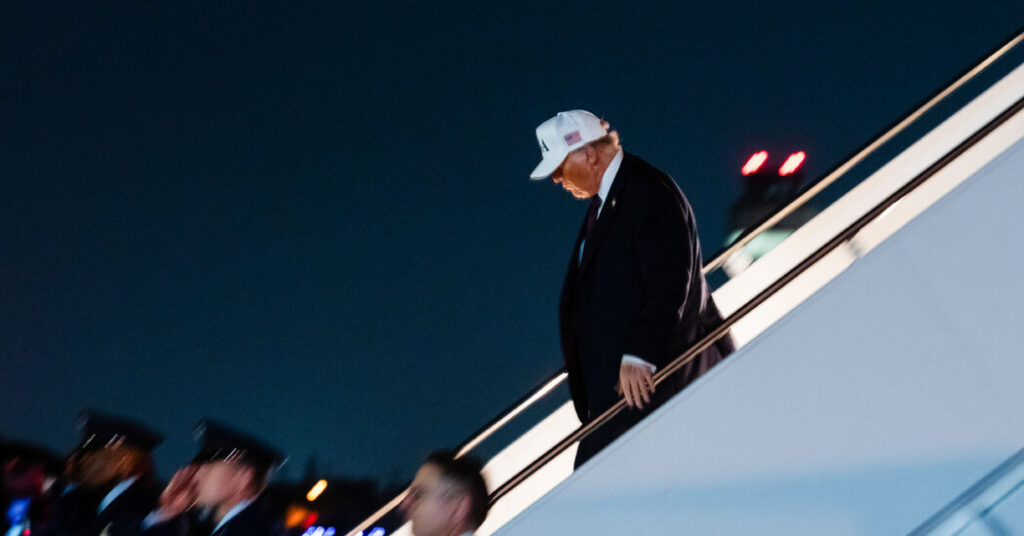
“They’ve rejected every opportunity to renounce their nuclear ambitions, and we can’t take it anymore,” Mr. Trump said when he announced the attack on Iran on Saturday.
In India, Kanwal Sibal, a retired senior diplomat, said that the bombing campaign represented a “blatant war of aggression” that would further harm the United States’ reputation. It would accelerate, he said, efforts by countries around the world to reduce their dependence on the U.S. dollar and on other aspects of American power.
But he said that India’s government, which emerged from months of bruising trade negotiations with Mr. Trump last month, remains intent on keeping “America as much on our side as is possible.”
“India will continue to deal with him,” Mr. Sibal said. “Even though on the tariffs issue and everything else, he has humiliated us and insulted us.”
Anton Troianovski writes about American foreign policy and national security for The Times from Washington. He was previously a foreign correspondent based in Moscow and Berlin.
The post In Latest Turn From Talks to War, U.S. Casts Doubt on Diplomacy appeared first on New York Times.