HOUSTON — When Zahra Hormoz managed to reach her siblings in Tehran by phone early Saturday, she said, they were overjoyed, dancing as they celebrated Iran’s leadership being “eliminated.”
But Hormoz, a chemistry professor in Texas, was still worried. Her family remained in hiding, and for days she had been watching as Iranians posted videos online saying that their loved ones had been killed by the Iranian regime before the United States and Israel launched a major joint attack on her home country.
Ayatollah Ali Khamenei, Iran’s supreme leader since 1989, was killed by an Israeli airstrike on Saturday. Hormoz is hopeful the military action will lead to liberation but knows that is unlikely to happen immediately.
“It is the best point in our history after 47 years this regime has been in our country,” said Hormoz, 61, and now, “we are waiting for this dark time to pass and the light to come back.”
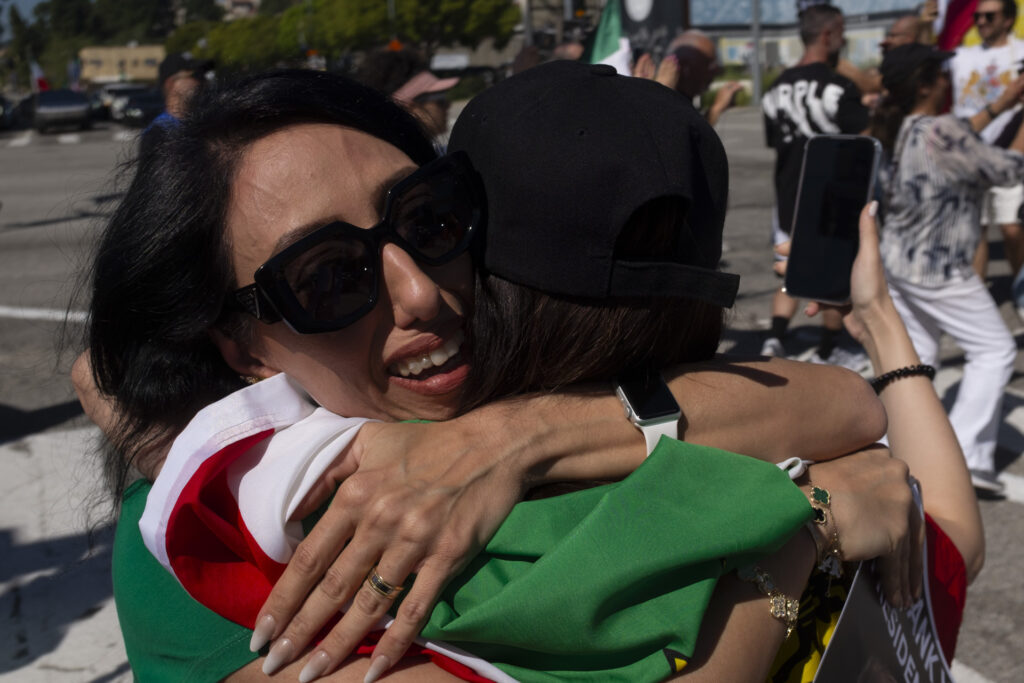
Across the United States, Iranian Americans expressed conflicted feelings about the joint U.S.-Israeli attacks on Iran. In enclaves from Los Angeles to Chicago, South Texas and New York, they shared joy, frustration, hope, dread and above all concern for relatives still in Iran.
Some took to the streets to celebrate, carrying Iranian flags and chanting “USA! USA!” Others organized protests, wary of the U.S. becoming embroiled in a widening conflict and warning that military action in Iran could only further destabilize the region after decades of violence.
In Los Angeles, home to the largest Iranian community outside of Iran, hundreds gathered Saturday in the Westwood neighborhood, cheering and dancing in celebration of the strikes.
Reza Arian, 38, of Culver City, California, was wrapped in an Iranian flag as he cried.
“They tortured us, they killed us, they imprisoned us,” Arian said. “We have been trying to get rid of this regime for 47 years, now with the help of U.S. and Israel, I’m free.”
Arian said he was born in Iran and came to the U.S. 12 years ago. He said he was imprisoned for six months when he lived there. Now, he said he wants to go back to see his family.
“Finally, I’m free,” he said.
But 14 miles away, a smaller gathering outside Los Angeles City Hall had a much different mood as the crowd chanted “Hands off of Iran,” denouncing the strikes and the involvement in another conflict abroad.
Activist Aida Ashouri, 43, can still recall hiding in her grandmother’s basement and watching as bombs shook jars of preserves when she was a small child during the Iran-Iraq War. She doesn’t want others to experience such violence and said she is tired of the U.S. funding wars over social services.
“Our generation is exhausted by this, that we are seeing our own financial autonomy held back at the expense of these forever wars,” she said.
She believes the strikes will only lead to more violence and suffering for the Iranian people.
“They deserve to thrive and build a country that they want without intervention, without bombs,” she said. “And I’m angry and disappointed that we can’t have that.”
Hormoz, who teaches at Texas A&M University at Corpus Christi, sees it differently. On Friday, she attended President Donald Trump’s speech in Corpus Christi and handed a letter to a member of his staff urging the administration to take action in Iran.
She moved to Texas eight years ago and became a U.S. citizen in 2022. At first, she said, she supported Democrats. But she doesn’t think they did enough to hold Iran accountable and now plans to vote for Republicans, she said.
After the strikes, she helped organize a rally in support of the military actions. She said she wants those protesting the attacks to understand they were needed to keep people safe — including Americans.
“As an American citizen also, I want to make it safe here, too,” she said. “Living with that regime is not safe for anybody.”
Sahar, who is Jewish, said she was persecuted and arrested in Iran before moving to the U.S. as a refugee at 17. (Like some others interviewed for this article, she spoke on the condition that her last name not be used out of fear for her family’s safety.) She said she is glad that Israel and the U.S. attacked Iran’s leaders, even though she was worried that innocent people may have been harmed.
Sahar sat in a salon on Westwood Boulevard in the L.A. neighborhood commonly called “Tehrangeles.” She couldn’t sleep the night before as she watched the news.
“It’s sad that we are happy, but what can we do?” she said, “We have the worst government ever; they didn’t even care about their own people. They killed their own people. So of course we are all happy about it.”
More than 400,000 people of Iranian descent live in the U.S., according to the 2020 Census. Many left after the 1979 revolution, establishing lives in the U.S. while also intently following political developments in Iran.
On Saturday, several political leaders, including New York Mayor Zohran Mamdani (D), stressed that Iranian Americans will continue to be welcomed.
“You are our neighbors, small business owners, students, artists, workers, and community leaders,” Mamdani, New York’s first Muslim mayor and an opponent of the U.S. airstrikes on Iran, said in a statement. “You will be safe here.”
In Texas, Stephanie, 55, plans to drive more than three hours from Corpus Christi to Houston on Sunday to attend the rally that Hormoz helped organize.
“We were waiting for this attack, praying. I was praying every night,” said Stephanie, who spoke on the condition that she be identified by her American nickname because she fears for her family’s safety as they shelter in Tehran. “Last night was the best night for years. We were up until 2:30 a.m. posting, thanking the U.S., the president and the troops for this move.”
Still, she doesn’t want U.S. troops deploying to Iran. Instead, she said she hopes the Iranian military will abandon the regime and allow the son of the former shah to assume power and hold elections.
“People are chanting his name on the streets of Iran,” Stephanie said of Reza Pahlavi, the son of Iran’s shah who was deposed in 1979, adding: “Under his father’s era, Iran had a good economy and was prospering compared with this regime — they are very corrupt.”
Pahlavi, who emerged as Iran’s most prominent opposition leader, has called on the Iranian people to protest and reclaim their country. Iran’s crackdown on anti-government demonstrations killed more than 6,800 people, according to an advocacy group tracking the fatalities.
Hatem Abudayyeh, the national chair of the U.S. Palestinian Community Network and an organizer of an anti-war protest in Chicago on Saturday, said it is disappointing to see some Iranian Americans celebrating the U.S.-Israeli attacks.
“If any of these Iranian Americans … who support bringing back the shah’s kid think that the United States cares about the people of Iran, or cares about them, they have another thing coming,” said Abudayyeh, a Palestinian American.
“The only reason that the United States is doing what it’s doing in Iran, and in Palestine, Syria and Congo, is because the United States wants to continue to exploit the resources of other people’s countries.”
Ehsan, 52, a mechanical engineer in Corpus Christi who spoke on the condition that only his first name be used out of concern for the safety of his family in Iran, said those who oppose U.S. intervention “don’t see what people are dealing with on a daily basis in Iran.”
“The economy collapsed. The security forces, the government, the military police guys are getting worse and worse, forcing people not to do any kind of complaint or protests,” he said. “The people are just suffering.”
His parents and cousins are still in Tehran, hiding at home. Communication remains sporadic, but Ehsan said his father was able to call his sister in Canada early Saturday after the strikes.
“That was good news at least, just to hear their voice, to make sure they’re fine,” he said. “The people of Iran, you’re kind of happy but at the same time worried about how it goes.
“It’s still a war.”
Hennessy-Fiske reported from Houston, Kirkpatrick from Los Angeles and Craig from New York.
The post Mix of joy, unease grips Iranian diaspora watching U.S.-Israeli strikes from afar appeared first on Washington Post.