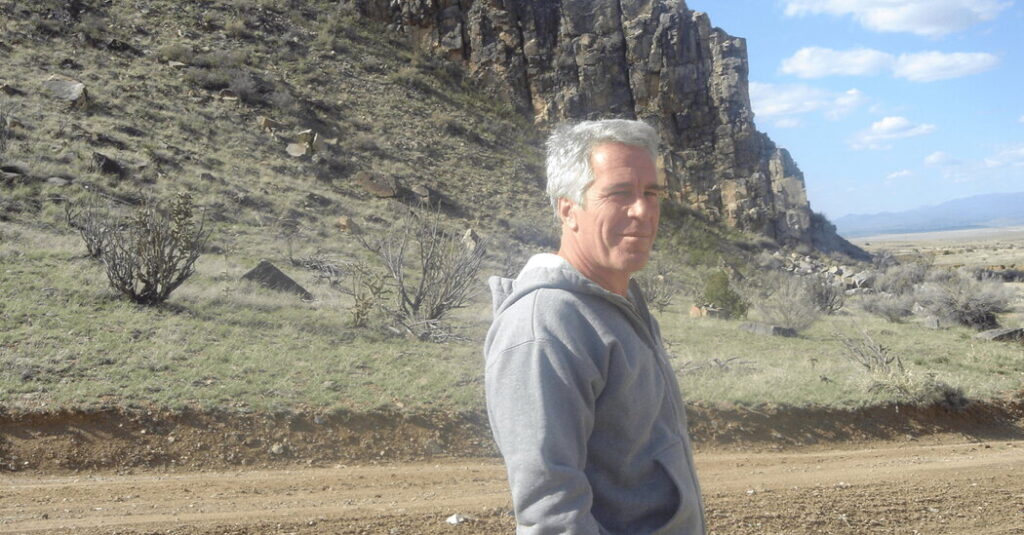
It was early evening on Saturday, July 6, 2019, when Jeffrey Epstein disembarked from a private plane for the final time. Federal agents were waiting at Teterboro Airport in New Jersey to arrest him.
“Is this about sex trafficking?” Mr. Epstein asked as he was being driven to the Federal Bureau of Investigation’s offices in Lower Manhattan, according to notes taken by an agent. “Is this about underage?”
Nobody replied, but the answer was yes. Later, as he was being booked into jail, Mr. Epstein remarked: “Oh, this is bad. This is really bad.”
That was certainly true for Mr. Epstein, who would die in a jail cell five weeks later. But for the vast majority of the men and women who had either enabled Mr. Epstein or may have committed sexual assault, it turned out that there was little to fear.
Aside from Mr. Epstein’s longtime conspirator Ghislaine Maxwell, none of his friends or associates have been criminally charged in the United States. In the six-plus years since his death, the lack of prosecutions has given rise to outrage and conspiracy theories about why powerful people have gone unpunished.
The millions of pages of recently released Justice Department emails, prosecutorial memos, interview transcripts and other records help explain why more people weren’t charged and why Mr. Epstein was able to act with impunity for so long.
Part of the reason was a series of missed opportunities, in both Democratic and Republican administrations, to bring him and others to justice: A tip that went unaddressed in the 1990s. A controversial plea deal in Florida that left F.B.I. agents and prosecutors unsatisfied. A yearslong investigation by federal drug agents that went nowhere. And a miscommunication among federal officials in 2016 that scuttled a potential investigation in New York.
The records also show that in their initial zeal to quickly build a case against Mr. Epstein, federal prosecutors focused primarily on sex crimes against teenage girls in the early 2000s. Within months of Mr. Epstein’s death, prosecutors believed that they did not have enough evidence to charge anyone besides him and Ms. Maxwell with the trafficking of minors or other federal crimes.
They lacked proof, for example, that other men participated with Mr. Epstein in a child-sex-abuse ring. They did have evidence of possible crimes against women, but they believed those were state offenses, not federal ones. Yet the records also show that prosecutors did not aggressively pursue other potential avenues, such as how Mr. Epstein moved his money through banks around the world. They did not interview any of the men who were Mr. Epstein’s main financial sponsors.
Outside the United States, law enforcement is moving swiftly to build cases based on revelations in the new records. In Britain, for example, police last month arrested Andrew Mountbatten-Windsor, the former Prince Andrew, and Peter Mandelson, a recent ambassador to the United States, as part of their investigations of corruption-related crimes. Authorities in France and Norway also have opened investigations.
In the United States, top Justice Department officials have said they do not plan to file additional charges related to Mr. Epstein based on materials in the latest disclosures, leading lawmakers from both parties to clamor for more action.
“Over two dozen people have resigned — C.E.O.s, members of government — worldwide,” Representative Thomas Massie, a Kentucky Republican who sponsored the legislation requiring the Justice Department to release its Epstein files, said on the House floor this past week. “But I haven’t seen any arrests or investigations here in the United States from this Department of Justice.”
An Unexamined Tip
Inside her West Village apartment, Maria Farmer picked up her phone and looked down at the scrap of paper in her hand. It was the number to the F.B.I.’s field office in New York.
It was the summer of 1996. That year, she had been growing increasingly wary of her boss, Mr. Epstein, for whom she had been hired to acquire artwork, she recalled in a recent interview. Ms. Farmer, who was 26 at the time, suspected he was a pedophile.
Ms. Farmer’s first stop had been the New York Police Department. It referred her to the F.B.I. As she dialed the number, she knew she was taking a risk. Mr. Epstein had entwined himself with powerful men, ranging from President Bill Clinton to Leslie Wexner, the billionaire behind brands like Victoria’s Secret. Yet because she was flagging potential crimes against children, she said, she assumed the authorities would take her call seriously.
Ms. Farmer reached an F.B.I. agent. She told him that Mr. Epstein had stolen nude photos of her sisters, ages 12 and 16, that she’d kept in a storage box as reference material for her paintings. She also said that Mr. Epstein had instructed her to take photos of young girls at swimming pools, according to the agent’s notes, which the Justice Department made public to comply with a recent law requiring the disclosure of most Epstein-related documents. Ms. Farmer said Mr. Epstein had threatened to burn her family’s house down if she told anyone.
For months, Ms. Farmer heard nothing. She later left New York and began to move around, trying to stay in hiding from Mr. Epstein and Ms. Maxwell. She said she hoped that behind the scenes, law enforcement was building a case.
Her optimism was misplaced. Neither the F.B.I. nor the police appear to have taken action — the first instance in a decades-long pattern of often-anemic responses to reports of Mr. Epstein’s crimes.
Years later, F.B.I. agents would knock on her door in a remote corner of North Carolina. The agents were investigating reports of Mr. Epstein’s widespread abuse of teenage girls in Florida. The girls had been pulled into his orbit in the years after Ms. Farmer’s warning.
‘I Don’t Feel Like Celebrating’
In March 2005, the police in Palm Beach, Fla., where Mr. Epstein had a home, received a complaint from the parents of a 14-year-old girl.
Her school principal had found $300 in her purse, according to a newly released document from the Florida investigation. The girl initially said she had earned the money working at Chick-fil-A, and then said the cash had come from selling drugs; neither story was believed. She eventually acknowledged she’d been paid $300 to massage a man, who turned out to be Mr. Epstein, the document says.
A sprawling investigation was soon underway. The police identified as many as 27 girls and young women, ranging in age from 14 to 23, who had gone to Mr. Epstein’s house to perform “sexual massages” or been paid to recruit others. The police found that Mr. Epstein had raped some of the girls.
The state attorney’s office in 2006 charged Mr. Epstein with soliciting prostitution, a felony. But the Palm Beach police believed the charge didn’t reflect the scope and severity of Mr. Epstein’s crimes. They brought the case to the F.B.I., which began an investigation.
Dozens of victims told federal investigators that Mr. Epstein had abused them when they were girls. Interviews grew raw with emotion as victims described their trauma.
“I wish you could have been there to see how much this has affected them,” Ann Marie Villafaña, the prosecutor who was handling the case, wrote to her boss, R. Alexander Acosta, the U.S. attorney for South Florida at the time.
Ms. Villafaña began to expand the investigation to Mr. Epstein’s opaque business empire and potential money laundering, subpoenaing his financial records from banks.
Ms. Villafaña prepared a draft 54-page indictment that would have charged Mr. Epstein and three of his female assistants with the sex-trafficking of minors and other crimes involving more than a dozen girls. Those charges would have come on top of the state prostitution charge against Mr. Epstein.
But the draft indictment, which the Justice Department recently made public as part of its release of millions of pages of documents, never made it to a grand jury vote. Under intense pressure from Mr. Epstein’s lawyers, Ms. Villafaña’s superiors in the U.S. attorney’s office struck a deal over her objections, according to a recently released statement she provided to investigators in 2019. Mr. Epstein would avoid federal prosecution in return for pleading guilty to two state charges, including soliciting prostitution from a minor. And he would be required to register as a sex offender.
As part of the so-called non-prosecution agreement, the federal government also pledged not to pursue charges against any of Mr. Epstein’s “potential co-conspirators,” including the former assistants who had been named in the draft indictment. The agreement was to be kept confidential.
The newly disclosed files do not provide additional insight into one of the key mysteries of the Epstein case: why Mr. Acosta engineered the widely criticized deal. He has said that trying Mr. Epstein in federal court would have been “a roll of the dice.” (In 2019, he stepped down as labor secretary amid an outcry over the deal.)
On June 30, 2008, Mr. Epstein entered his guilty plea and began serving what was to be an 18-month jail sentence.
Afterward, Ms. Villafaña, the prosecutor, received congratulatory messages from colleagues. “But for your tenacity,” one wrote, “he’d be somewhere ruining another child’s life.”
But she found little satisfaction in the outcome. “I don’t feel like celebrating 18 months,” Ms. Villafaña wrote to a colleague in an email. “He should be spending 18 years in jail.”
It turned out that Mr. Epstein would serve only 13 months; he was released in July 2009 and faced a year of home arrest. “Free at last,” he triumphantly emailed an acquaintance.
By then, federal prosecutors in Florida were considering taking further action against him. In an August 2009 email, an assistant U.S. attorney there discussed with colleagues the possibility of building a case around Mr. Epstein’s victims in New York or handing the case to federal prosecutors in a different jurisdiction.
But another decade would pass before prosecutors filed any charges.
A Drug Enforcement Investigation
Not long after Mr. Epstein was freed from house arrest in the summer of 2010, a different group of federal authorities began pursuing him. This time it was the Drug Enforcement Administration.
D.E.A. agents were investigating Mr. Epstein and others for “illegitimate wire transfers which are tied to illicit drug and/or prostitution activities,” according to a memo that was prepared by federal officials and was released in January.
The agents collected information about Mr. Epstein’s flights, border crossings, finances and companies. Their focus appeared to be on his activities in New York and the U.S. Virgin Islands, where he owned a private island that victims said was the site of frequent sexual abuse.
In 2015, investigators produced a 69-page memo, marked “sensitive but unclassified,” that listed Mr. Epstein as one of 17 targets of the D.E.A. case. More than 50 of the memo’s pages are completely or mostly redacted, but Ms. Maxwell appears to have been among the targets.
One focus of the D.E.A. investigation was Mr. Epstein’s use of his private aircraft. He had multiple planes and a helicopter, which he used to transport guests and young women to his private island.
The investigation also appeared to be looking at Mr. Epstein’s use of banks to move money. The memo noted that on at least seven occasions from 2013 to 2015, banks had alerted federal authorities to about $5.7 million in potentially suspicious transactions in Mr. Epstein’s accounts.
The outcome of the investigation is unclear, but it did not lead to charges against Mr. Epstein or his associates.
Silence From the F.B.I.
Since Mr. Epstein’s release from jail, lawyers had filed a slew of lawsuits against him on behalf of victims.
In February 2016, Bradley J. Edwards and J. Stanley Pottinger, who represented many of the victims, met with Amanda Kramer, a federal prosecutor in Manhattan who was responsible for coordinating investigations into human trafficking. The lawyers urged her to open a new investigation into allegations that Mr. Epstein sexually abused girls, according to her handwritten notes and other documents about the meeting and its aftermath.
At the meeting, the lawyers said that Mr. Epstein’s friend Jean-Luc Brunel, a French modeling scout who had “helped get girls,” was interested in cooperating with the authorities, according to the notes, which were previously reported by The Wall Street Journal.
Mr. Edwards and Mr. Pottinger had other news to share. They said Mr. Epstein’s non-prosecution deal in Florida had upset F.B.I. agents who had worked on the case. In other words, the lawyers said, there were ample grounds for Ms. Kramer and her colleagues in the Southern District of New York to take a fresh look at Mr. Epstein.
Prosecutors eventually contacted Mr. Brunel’s lawyer, who said his client refused to meet. Mr. Brunel died by suicide in 2022, after French authorities charged him with raping teenage girls.
Ms. Kramer spoke to a top prosecutor in her office. They agreed she should contact an F.B.I. supervisor and ask him to get in touch with the Florida agents and let her know if they “in fact were unhappy with the outcome and felt like justice had not been served,” according to Ms. Kramer’s recollections as later summarized by the U.S. attorney’s office.
The F.B.I. supervisor never called her back, and Ms. Kramer did not follow up with him, according to the summary. She took his silence to mean the F.B.I. agents in Florida had not actually expressed dissatisfaction with the outcome of the 2008 case.
Neither she nor her superiors in the U.S. attorney’s office took further investigative steps.
A ‘Covert Posture’
Nearly three years later, The Miami Herald published a series of articles detailing Mr. Epstein’s abuse of girls in Florida and his deal with Mr. Acosta to escape federal prosecution.
After reading the articles, Ms. Kramer told her colleagues that she “felt horrible” that she hadn’t followed up with the F.B.I. in 2016, according to the summary.
Now, though, the prosecutors began investigating. Geoffrey S. Berman, then the U.S. attorney for New York’s Southern District, was shocked by Mr. Epstein’s “sweetheart of all sweetheart deals” in Florida and “felt a great sense of urgency” to pursue him, he wrote in his memoir.
As they raced to build a case against Mr. Epstein, prosecutors focused on conduct that had taken place in the early 2000s — the same period that officials in Florida had investigated a decade earlier. That allowed them to build on the work that F.B.I. agents had already done. After interviewing a handful of victims, the New York prosecutors decided that they had enough evidence to seek an indictment.
Going forward, they adopted what they called a “covert posture,” holding off on additional interviews out of fear that word of their investigation might leak.
In June 2019, they decided to charge Mr. Epstein with one count of sex-trafficking an underage girl in New York and one count of sex-trafficking conspiracy, which involved dozens of underage victims in New York and Florida. In each location, they wrote in a memo seeking authorization to indict him, “Epstein essentially operated a pyramid scheme of sexual exploitation.”
A grand jury returned the sealed indictment on July 2.
The Men Not Interviewed
Mr. Epstein was arrested at Teterboro four days later. On Aug. 10, he was found hanged in his jail cell in what the authorities said was a suicide.
Prosecutors and the F.B.I. were now focused on Mr. Epstein’s potential co-conspirators.
By December, prosecutors and agents had interviewed more than three dozen of his accusers, according to recently released Justice Department memos. Women accused more than a half-dozen of Mr. Epstein’s associates, including Ms. Maxwell, of either sexual abuse or facilitating Mr. Epstein’s abuse, the memos show. Some women told investigators that they had been abused by prominent men, including Mr. Mountbatten-Windsor; the billionaire investor Leon Black; the bank executive James E. Staley; and President Trump. (The allegations have not been corroborated, and all four have denied engaging in inappropriate sexual conduct.)
Yet prosecutors ultimately charged only one other person: Ms. Maxwell, who was convicted of sex trafficking of minors and sentenced to 20 years in prison.
Why was no one else prosecuted?
The authorities weighed charges against at least one of Mr. Epstein’s longtime assistants, Sarah Kellen, but ultimately decided not to. The apparent reason, according to recently released emails and documents, was that while Ms. Kellen had helped recruit girls and young women for Mr. Epstein, prosecutors also regarded her as one of his victims.
Another reason no one else was charged is that after interviewing the accusers, prosecutors did not find what they regarded as credible evidence of Mr. Epstein trafficking underage teenagers to anyone other than himself. But it is not clear that prosecutors investigated whether Mr. Epstein was trafficking young women to other men. Under federal law, the threshold for proving trafficking is higher when it comes to adults than for minors.
Prosecutors interviewed one victim, Virginia Giuffre, who was 16 when she met Mr. Epstein and said she had been “lent out” to and abused by other prominent men, including the former Prince Andrew. But prosecutors said they could not corroborate her accounts.
“No other victim has described being expressly directed by either Maxwell or Epstein to engage in sexual activity with any other men,” the prosecutors wrote in a December 2019 memo summarizing the investigation.
Recently released emails suggest that Mr. Epstein may have been connecting wealthy acquaintances — including Mr. Staley, Elon Musk’s brother, Kimbal, and Steve Tisch, the co-owner of the New York Giants football team — with young women. Mr. Tisch has acknowledged discussing women with Mr. Epstein but hasn’t directly addressed his interactions with them. Kimbal Musk has not denied dating one of Mr. Epstein’s assistants but said they met through a friend, not Mr. Epstein. Mr. Staley has admitted having consensual sex with a woman he met through Mr. Epstein.
Federal prosecutors did not interview any of those men.
Nor do they appear to have investigated the rape and abuse allegations made by women against Mr. Black or Mr. Staley, instead deferring to the Manhattan district attorney to investigate alleged violations of state laws, according to the files. (Rape is generally not a federal crime, though it can be a component of federal offenses such as sex trafficking.)
The district attorney did not file charges.
A lawyer for Mr. Staley declined to comment. Susan Estrich, a lawyer for Mr. Black, said that “there is absolutely no truth to any of the allegations against Mr. Black,” and that “state and federal authorities conducted lengthy investigations” before deciding not to charge him.
Sifting Through Tax Returns
Federal authorities took steps to examine Mr. Epstein’s finances and vast wealth, but those efforts were limited, and nothing came out of them, according to the recently released documents.
Early on, the F.B.I. had listed Mr. Wexner, the retail tycoon who was one of the main sources of Mr. Epstein’s wealth, as a potential co-conspirator.
But prosecutors never interviewed Mr. Wexner directly. Instead, they spoke to his lawyers a few weeks after Mr. Epstein’s 2019 arrest. The lawyers said Mr. Wexner had cut ties with Mr. Epstein around 2007 after discovering that he’d stolen at least $100 million and that Mr. Wexner had been unaware of Mr. Epstein’s sex crimes. The files do not show signs of further investigation into Mr. Wexner. His spokesman said that a prosecutor told Mr. Wexner’s lawyer that they saw him as a witness, not a target of the investigation.
After Mr. Wexner and Mr. Epstein split, Mr. Epstein’s most important source of money became Mr. Black, who paid him $170 million over several years. Federal investigators do not appear to have closely examined that financial relationship, in which Mr. Epstein dispensed tax and estate-planning advice. He also counseled Mr. Black on paying millions of dollars to several women, including how to structure payments so they could be treated as gifts for federal tax purposes, according to recently released emails.
A spokesman for Mr. Black declined to comment on the payments.
Prosecutors and F.B.I. agents did look into some of Mr. Epstein’s companies, including the corporation that owned the palatial Manhattan townhouse in which Mr. Epstein abused victims. And as recently as 2021, an F.B.I. file indicates, the Internal Revenue Service had investigators sifting through the tax returns of some of his companies in the U.S. Virgin Islands.
None of his companies were charged.
There is no sign that prosecutors or investigators interviewed Mr. Epstein’s longtime accountants about his finances. Nor do they appear to have interviewed executives at JPMorgan Chase, which for 15 years was Mr. Epstein’s primary bank.
Federal authorities subpoenaed records from Deutsche Bank, where Mr. Epstein had dozens of accounts that were used to pay young women and wire money to banks in Russia and Eastern Europe. But by late 2019 — before F.B.I. agents had interviewed a number of Deutsche employees — the prosecutors seemed to have cooled on the prospect of bringing any charges. In a memo that December, they noted that they found “no immediate indication of financial criminal activity or misconduct” at the German lender.
“To this day, there has not been a comprehensive, follow-the-money investigation of Epstein’s network performed by any federal law enforcement agency,” said Senator Ron Wyden of Oregon, the top Democrat on the Senate Finance Committee, who has spent years digging into Mr. Epstein’s finances. “I find that totally inexcusable.”
Jessica Lustig contributed reporting.
Benjamin Weiser is a Times reporter covering the federal courts and U.S. attorney’s office in Manhattan, and the justice system more broadly.
The post Why the Epstein Investigations Took So Long and Did So Little appeared first on New York Times.