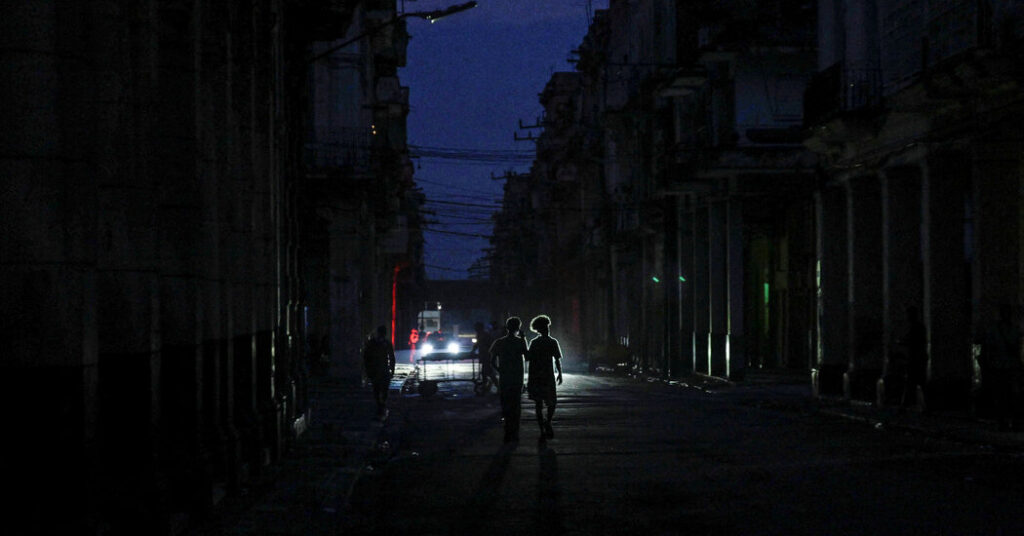
For some time now, much of Cuba has found itself increasingly in the dark. In cities and towns across the island, power outages can last for hours or even days. When the lights come back on, families scramble to cook what they can and store what little remains until service is interrupted again.
Public transportation is practically nonexistent. Many hospitals do not have enough medicine to treat their patients; many schools do not have enough staff members to teach their students. For most people, getting food means waiting in long lines and paying exorbitant prices.
The Cuban government has repeatedly presented the island’s emergency as a phenomenon imposed from the outside. It is true that the Trump administration’s recent efforts to restrict oil shipments to Cuba have added pressure to the economy. But Cuba’s economy was already on the brink of collapse. What is happening in Cuba today is essentially the result of decades of structural economic failure under a rigid political system that has consistently resisted any reform.
Since the regime came to power in 1959, the Cuban economic model — built around a centralized administration, the nationalization of the essential means of production and severe restrictions on markets — has proved incapable of generating sustained growth, development and social well-being. Now the implicit social contract that sustained the regime for years is crumbling. The extreme rigidity of the country’s totalitarian political system has become the main obstacle to the reforms the economy urgently needs. Without a political transformation, economic recovery will remain an illusion.
The regime’s economic structure is driven by an obsession with state control as the ultimate guarantor of political survival. By centralizing production and limiting the private sector, the Communist Party has sought to prevent the formation of any independent power that could challenge its authority, creating, in turn, a citizenry highly dependent on the state. This system is intrinsically reluctant to reform; even modest shifts are perceived as ideological threats to the party’s monopoly on power. The current crisis was triggered in 2021, with a botched currency overhaul that unleashed an inflationary spiral, aggravated by the collapse of tourism during the Covid-19 pandemic.
Cuba is governed by a closed and bureaucratic elite within the Communist Party — the only legal political party — which has turned into a rentier class. Power is concentrated in a small circle of old-guard leaders and their successors, including President Miguel Díaz-Canel, alongside business conglomerates controlled by the armed forces, which dominate the most profitable sectors like tourism. Over the past six decades, this system has given rise to a web of interests in which the leadership prioritizes political control over the needs of the population.
The Cuban economy has suffered greatly for it. The country is no longer capable of producing the basic goods it needs; today it imports most of the food it consumes, despite the fertility of its lands and its long agricultural tradition. Cuba’s industrial base has fallen behind, weighed down by obsolete technology, by limited access to capital and by an investment policy that has prioritized hotel construction over shoring up the deteriorating energy grid.
There is no more eloquent symbol of Cuba’s decline than what has happened in the sugar industry. For centuries, sugar defined the island’s economic identity and sustained its integration in the international economy. In 1989, before the collapse of the Soviet Union, the country was producing around 8 million tons of the stuff; by 2025, production had fallen below an estimated 200,000 tons — the lowest level since the war of independence against Spain ended in 1898. Fidel Castro’s 2002 decision to dismantle a large part of the industry in the face of falling international prices and crumbling infrastructure marked a turning point in the country’s economic trajectory. Instead of modernizing the mills, the government closed nearly half of them. Shuttered factories and abandoned fields still dot the island’s landscape.
In recent decades, the regime attempted to reorient the economy toward tourism and the export of professional services, such as medical missions, in which the state sends doctors abroad and retains a substantial portion of their income. For a time, tourism provided some relief, generating employment and foreign currency. But that boom has not lasted in the face of deteriorating infrastructure, diminishing service quality, competition in the Caribbean and tightened restrictions on travel from the United States.
The export of professional services, particularly to Venezuela, became a key source of income, but Nicolás Maduro’s ouster demonstrated the fragility of a model based more on alliances, not competitiveness. The fuel shortage, aggravated by Mr. Trump’s recent measures, has also highlighted the cost of depending on foreign subsidies.
The result is a deeply stagnant economy with few sources of foreign currency, minimal purchasing power and little capacity to absorb external shocks. The country’s economic collapse, hastened by the regime’s shifting political priorities, has eroded the social achievements in health and education that for decades were pillars of legitimacy for the Cuban model.
Despite this downward spiral, the government has shown little willingness to undertake the reforms — allowing more private initiative, liberalizing markets, cultivating conditions that are favorable for investment — that could help. Fearing that an economic opening could lead to political changes, the state has refused to relinquish its grip on the economy, letting the situation worsen past the point of no return. If the regime were truly interested in improving conditions on the island, it would create spaces for public debate and political deliberation. Instead, it has intensified its control and repression.
The scarcity and repression that define life in Cuba today are, above all, a visible expression of the exhaustion of a model that has lost the ability to sustain itself.
The Cuban leadership has acted as if its system were immune to the forces of history. It has assumed its supporters abroad could forever prop up the model, in a cycle that would perpetuate itself indefinitely. The 2019 Constitution enshrines the irrevocable nature of socialism, as if a political and economic order could shield itself from the passage of time. But no system is permanent. For decades, the Cuban regime has confused its survival with eternity. Now the game might be up.
Mauricio de Miranda-Parrondo is a professor of economics at the Pontificia Universidad Javeriana in Cali, Colombia, and co-director of the CubaxCuba Civic Thought Lab. This essay was translated from the Spanish by Mara Faye Lethem.
The Times is committed to publishing a diversity of letters to the editor. We’d like to hear what you think about this or any of our articles. Here are some tips. And here’s our email: [email protected].
Follow the New York Times Opinion section on Facebook, Instagram, TikTok, Bluesky, WhatsApp and Threads.
The post The End of the Illusion for Cuba’s Regime appeared first on New York Times.