EL PASO: Five Families and One Hundred Years of Blood, Migration, Race, and Memory, by Jazmine Ulloa
Growing up in Southeast Texas, I thought of El Paso as if it were an appendage of Texas — or even an appendix. It was too far west to be included in the original Texas that Austin and Houston and Travis and Crockett fought for. It even has a different time zone than most of the state. A person standing in the lobby of the grand old Hotel Paso del Norte is closer to the Hollywood sign than to Texarkana; closer to Mexico City than to Washington, D.C.
In “El Paso,” a compelling chronicle of the city, the New York Times journalist Jazmine Ulloa makes a case that, rather than a vestigial organ, El Paso is the heart not only of Texas, but of the American experience. El Paso is Spanish and Mexican, Indigenous and mestizo, Anglo and Arab, Chinese and German, white and Black — and, to borrow a phrase from Ulloa, “Blaxican.” The city, in her estimation, deserves to be acknowledged as another Ellis Island.
“El Paso,” Ulloa writes, “is alive. It breathes and heaves with human life. Your poor and huddled masses. Your staunch conservatives. Your rebels and living saints. Your Border Patrol officers and your paisanos. And you and me.”
Of course, before there was an El Paso, or its Mexican twin, Ciudad Juárez, the surrounding valley was home to Indigenous tribes including the Suma, Manso and Jumano — although, as Ulloa tells us, those people would never have responded to those names, which were hung on them by Europeans.
From the time the Spanish, French, English and, later, Americans pulsed in and out of the place, El Paso had taken on many forms: sometimes a place of integration, other times the site of confrontation; a land of revolution and retrenchment where live-and-let-live joy would give way to lynchings. In short, in its push, pull and contradiction, El Paso has always been quintessentially American.
A native El Pasoan, Ulloa decided to write this history after being dispatched by The Boston Globe to cover the slaughter of 23 people at an El Paso Walmart in 2019. The diversity of the American city had so terrified a white supremacist that he drove 650 miles from his home north of Dallas to kill, as he told the police, “Mexicans.”
Ulloa is a terrific storyteller, and as she explores her hometown, she breathes life into dusty names from its past. In addition to describing the dramatic events and outsize personalities drawn to El Paso, she seeks the ground-level truth by following the interlacing paths of five families across generations and borders.
The first family we meet, the Chews, are Chinese. One of the many revelations to this güero is that El Paso was home to a sizable Chinese population that was drawn to North America in the 19th century to work on the railroads, in the fields and in the mines. Down four generations the Chews moved from China to Mexico to America. Around 1900, they were hoteliers and shopkeepers. About 100 years later, their descendant, the Texas district court judge Linda Yee Chew, arraigned the man who committed the Walmart murders.
Famous figures, too, gallop across the towns that became El Paso and Juárez. Ulloa follows the troublemaking movements of the 19th-century Mexican president Benito Juárez as well as numerous revolutionaries and counterrevolutionaries. She also guides us through the exuberant, joyful border culture. Juárez, we learn, was a place where Hemingway went to drink, Etta James went for music and Elizabeth Taylor went to get divorced.
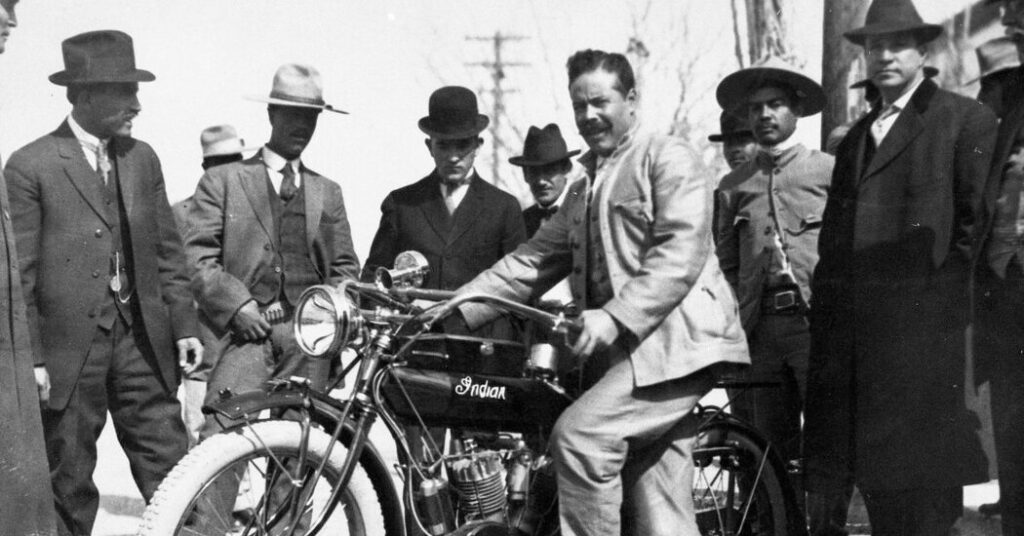
Of course, no telling of the region’s history would be complete without the guerrilla leader José Doroteo Arango Arámbula, better known as Pancho Villa. Military genius, Hollywood movie star, scourge of Gen. John “Black Jack” Pershing, Villa and his legend are still alive in El Paso. A teetotaler, the loved and loathed Villa could often be found sucking back strawberry soda and ice cream at the old Roma Hotel’s Emporium Bar, where, Ulloa writes, a Burger King now sits.
Even as it transports us through El Paso’s sepia-toned centuries, Ulloa’s history reads like today’s headlines. Over a century ago, El Paso newspapers demanded — are you ready for this? — a border wall to stop what 19th-century politicians had started calling a Chinese “invasion.” At the dawn of the 20th century, xenophobes claimed immigrants coming north brought “contagion.”
And then there was Dr. Claude C. Pierce, who believed in what he called “race betterment.” In 1916, he persuaded El Paso to set up “delousing baths” of vinegar and kerosene, and subjected immigrants to the humiliating and dangerous cocktail. One day, a spark ignited the gasoline. Mexicans were burned alive. Afterward, authorities switched to chemical pesticides, including Zyklon B, a cyanide-based miasma invented in Germany in the 1920s. (Years later, the Nazis took note, and used the same gas with horrific results.)
In 1924, President Calvin Coolidge signed the K.K.K.-backed Johnson-Reed Act, which restricted access to citizenship and established the Border Patrol. Coolidge crowed that the law would “keep America American.” His successor, Herbert Hoover, signed another restrictive law, the Undesirable Aliens Act of 1929, and, in the ’30s, kicked off a wave of mass deportations, vowing to protect “American jobs for real Americans.”
There truly is nothing new under the sun or on the border. When America needed workers during the Second World War, it set up the Bracero Program, liberalizing access to agricultural jobs. But by the mid-50s the Eisenhower administration had launched — forgive me for quoting the racist name — Operation Wetback. Military tactics were used to round up and deport up to 1.3 million people — some of whom were American citizens. Once again, supporters justified it by claiming Mexicans were “dirty” and “disease-bearing.”
Repeatedly, Ulloa returns to the Walmart massacre with the keen eye of a reporter and the sensitivity of a native. Meg Juarez, whose 90-year-old father was shot and killed, spoke for many when she sat before the murderer in court and said, “Native Americans and Mexicans were already here in Texas when your American settler homies rolled up. Think about that when you say it is your country that you’re defending.”
I do not know how covering carnage changes a reporter, especially a racially motivated rampage against her own community in the place where she was born. One hopes Ulloa’s broken heart will heal stronger at the broken places. The fine book she has written about her home is an important contribution to understanding a fascinating, complicated, vibrant, richly diverse city. It is also a reminder that, for most of us, to be an American is to be an immigrant. There were no Millers or Bovinos or Noems among the Native Americans. Somos todos El Pasoans.
EL PASO: Five Families and One Hundred Years of Blood, Migration, Race, and Memory | By Jazmine Ulloa | Dutton | 337 pp. | $30
The post A Startlingly Vivid Portrait of El Paso, and of America appeared first on New York Times.