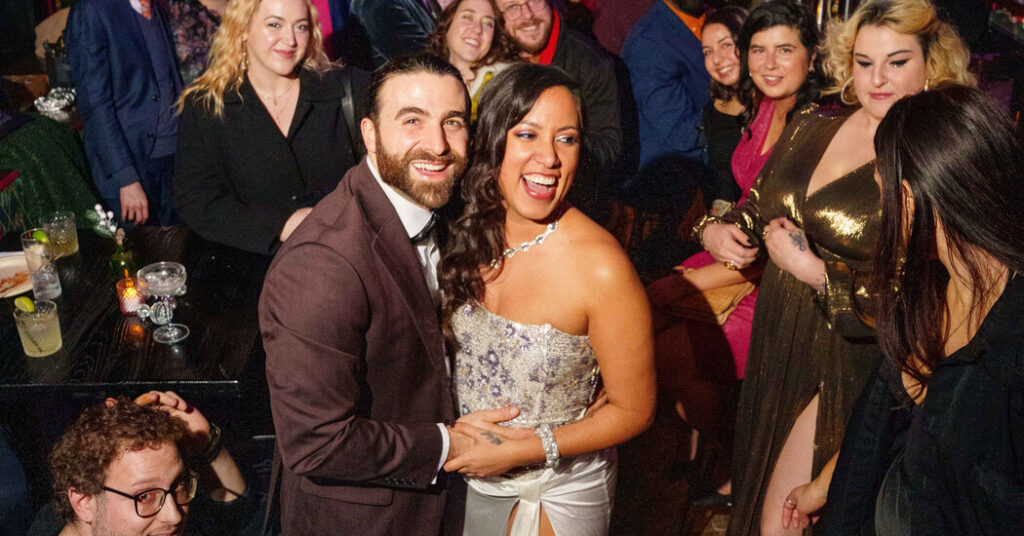
Hope Morawa and Vincent Stracquadanio left the Manhattan City Clerk’s Office on April 1 and walked blissfully past streets covered in confetti and rice. The couple grabbed a quick meal at Thai Diner in NoLIta and stopped in Little Italy for two dozen cannoli. An hour later, they had taken over the back room of the nearby Spring Lounge, where 30 friends gathered to make speeches.
This wasn’t a wedding. This was a celebration acknowledging the couple’s domestic partnership. In New York State, this is a legally recognized relationship for couples in an ongoing, committed partnership. No officiant spoke in front of the guests. No vows were exchanged.
A growing number of couples are choosing domestic partnership over marriage. For some, it’s practical. For others, it’s philosophical. Still, for many of these couples, the celebration is important.
Shafonne Myers, the owner and chief executive of Aisle Society, a wedding media company that publishes 12 digital magazines featuring real couples, said she has seen a 15 percent increase in domestic partnership celebrations, particularly from Millennials and members of Generation Z, even as traditional wedding submissions have declined slightly over the past two years.
“Domestic partnership parties tend to be smaller and more intimate. Often there’s a D.J. and dancing, maybe there’s pies or cupcakes instead of a cake, but there’s only one venue — like a bar or restaurant or someone’s home,” Ms. Myers said. “They’re eliminating walking down the aisle and other wedding traditions. They’re very focused on the love part.”
Ms. Morawa, 33, a freelance event producer who lives in Bushwick, Brooklyn, with Mr. Stracquadanio, agreed.
“We love each other and have been together for three years,” she said. “We were serious about our relationship and wanted something that spoke to that, but we weren’t ready to get engaged.”
A domestic partnership is “about enabling people to declare that they are family, and to make sure they have legal, family rights without becoming financially integrated,” said Diana Adams, a lawyer and managing partner at Diana Adams Law & Mediation, a boutique firm in New York specializing in L.G.B.T.Q. and nonnuclear families.
New York City established a domestic partnership registry in 1993 under Mayor David N. Dinkins and expanded it in 1997 under Mayor Rudolph W. Giuliani. In 1999, California became the first state to pass a domestic partnership law and create a statewide registry. In many states, however, the legal benefits remain limited to hospital visitation, access to a partner’s employer’s health insurance and, at times, housing rights.
Ms. Morawa is now legally tied to Mr. Stracquadanio and to his insurance, a benefit since she said she didn’t have coverage before. Ms. Morawa said she suffered from chronic knee pain, which required physical therapy twice a week last summer. Thanks to their now shared insurance, she was able to get the medical care and coverage she needed.
“We put effort into making the day special, but there’s the unromantic side of health care and economic realities of living in New York,” said Mr. Stracquadanio, who works as an educator at the Jewish Museum, whose health care covers domestic partnerships. “A domestic partnership removed the obligation to have a huge wedding, but gave us many of the same privileges that marriage allows, while making us feel our relationship had purpose.”
Domestic partnerships can be alluring, but they do not provide the full federal protection of marriage, which includes the ability to file joint federal taxes, receive Social Security spousal benefits or automatically inherit a spouse’s estate or assets without filing legal documents.
That distinction is precisely the point for couples who want to avoid financial entanglements.
“When you get married, you share all of your losses and gains from the date of marriage, unless you opt out with a prenup,” said Mx. Adams, who uses they/them pronouns, “and so you really become one legal financial unit before the federal government, which can lead to complicating entanglements.”
Ikiya Devonish, the founder of Intimate Occasions by Ikiya, based in Bushwick, has noticed a shift away from marriages in favor of domestic partnerships.
“For same sex couples, it’s very much about political turmoil and protecting their rights,” said Ms. Devonish, whose company specializes in planning intimate weddings and celebrations. “For younger couples, it’s about cost, tariffs and the freedom they’re retaining while still legally being together.”
According to the Manhattan City Clerk’s Office, which issues certificates across all five boroughs, domestic partnerships remain far fewer than marriages but have increased in recent years. In 2019, 75,370 marriage licenses were issued, compared with 6,004 domestic partnership certificates. By 2024, marriage licenses rose slightly to 77,812, while domestic partnerships increased to 6,910. The growth is modest but noticeable among younger couples. In 2019, 3,686 Millennials and 460 members of Generation Z registered for domestic partnerships. In 2024, those numbers rose to 4,106 Millennials and 1,774 Gen Z registrants.
For Bia Izidoro, 33, an assistant company manager for “Oedipus” on Broadway, and Andrew Higgins, 32, a federal employee, who live in Crown Heights, Brooklyn, a domestic partnership allowed them to formalize their commitment.
“Being domestic partners puts a legal legitimacy to our relationship. It’s less formal and less pressure than a wedding,” Ms. Izidoro said.
In lieu of a wedding on Dec. 3, the couple and 100 of their friends and family danced and ate pizza and cake at Medusa Bar in Brooklyn. Guests came in jeans or fancier dresses. Some stayed 20 minutes; others all night. Everyone celebrated the couple, who had been together for four years, including their families, who met each other for the first time. Ms. Izidoro’s mother flew in from Brazil.
“This was an easy step toward what society expects in a wedding,” Ms. Izidoro said. “We consider this a marriage and call each other husband and wife.”
In New York City, the process to become a legal domestic couple is simple. Both people must be at least 18 and share a residence. The couple cannot be related by blood, married or in another domestic partnership within the last six months. Unless they agree otherwise in writing, any assets or debts each person brings into or acquires during the partnership remain that individual’s separate property. The registration fee is $35.
Couples are choosing these partnerships because “it lets them decide for themselves how and whether they share their finances,” Mx. Adams explained. “They want to define their relationship in a modern way, like being ethically nonmonogamous, or polyamorous, or that they want to live separately.”
Pepper Schwartz, a sociology professor at the University of Washington who has studied relationships since the 1970s and serves as an expert on the reality show “Married at First Sight,” has also seen an uptick in domestic partnerships.
“People have gotten practical and private,” Dr. Schwartz said. “They want security and something that differentiates them from living together or dating. They may not want the legalese of a wedding.”
She added that Millennials, many shaped by the high divorce rate of their parents, and wary of economic instability, are cautious about traditional institutions.
Some couples find comfort in knowing that the commitment can be undone more easily than a divorce.
“We didn’t feel like we were taking a huge plunge,” Ms. Morawa said, adding that not everyone wants to be, or has to be, married to feel complete.
The post Don’t Call It a Wedding. It’s a Domestic Partnership Party. appeared first on New York Times.