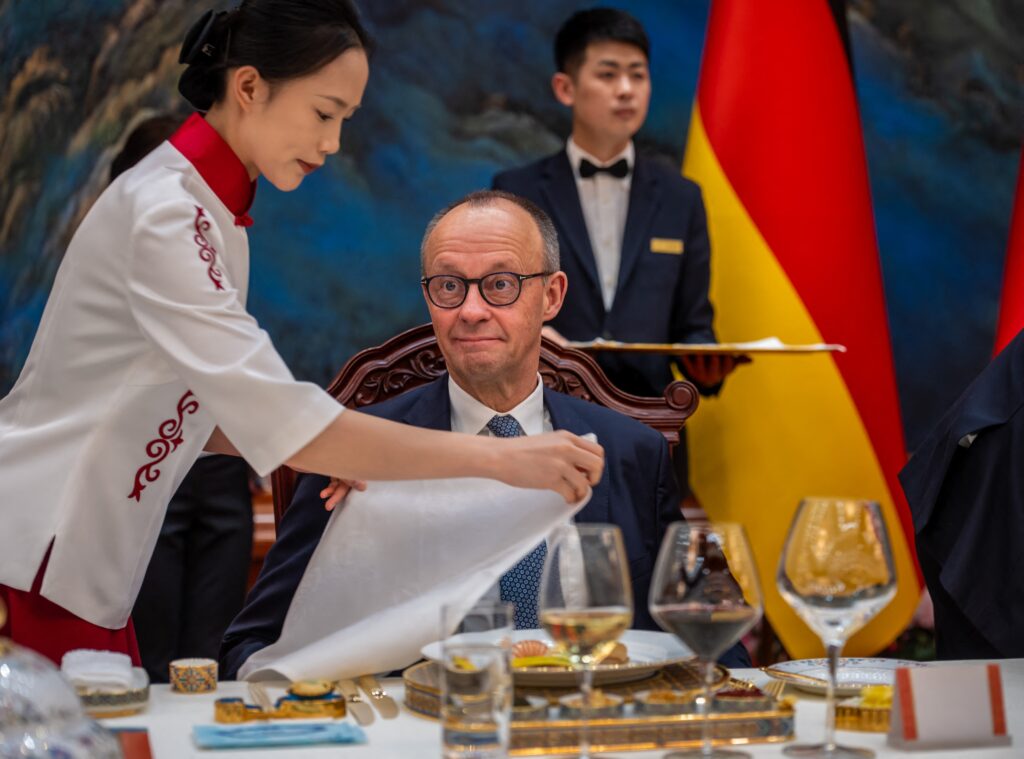
President Xi Jinping has grown accustomed to Western leaders arriving in China and kissing his ring. But German Chancellor Friedrich Merz remained clear-eyed on his trip to Beijing last week, publicly challenging China’s underhanded efforts to manipulate trade and refusing to capitulate to Xi’s pressures to decouple from America.
Merz was a polite guest, thanking his host for “good cooperation,” particularly around digital development. Both Merz and Xi agreed there are plenty of bilateral opportunities worth pursuing, as Merz took a spin in a new Mercedes-Benz and traveled to Hangzhou to watch robots box each other.
But rather than waiting until he got back home, like other leaders tend to do, the German chancellor directly engaged with the “not healthy” elements of their trading relationship, including how China’s state-subsidized overcapacity has undermined free market competition.
Merz’s words carried weight and risk. China was Germany’s largest trading partner last year. To publicly criticize a country so important for his people’s economic success requires real backbone — the kind the Trump administration has been encouraging its European allies to grow.
The chancellor deserves to be rewarded for that when he meets on Tuesday with President Donald Trump at the White House. The U.S. was Germany’s largest trading partner in 2024 but lost that spot to China after Trump’s “Liberation Day” tariffs. It’s in the interests of Washington and Berlin for the U.S. to regain the top spot and to restore as much certainty as possible to one of the world’s most important trading relationships.
Despite China clamoring for countries like Germany to leave the North Atlantic Treaty Organization, Merz — who has a demonstrated history of valuing America — has bluntly rejected those calls and suggested instead the formation of a “new transatlantic partnership.” Germany has also been increasing its military readiness in more tangible ways than other NATO members who have promised to do so.
Trump said in his State of the Union speech that countries who already secured trade deals with the U.S. are eager to stick to them. An easy signal of friendship would be to confirm the deal he struck with the European Union last July will stay in place. But that’s only the first step. Merz avoided sycophancy in China; he should know his preferred ally has his back.
The post Germany’s chancellor sets the standard for negotiating with China appeared first on Washington Post.