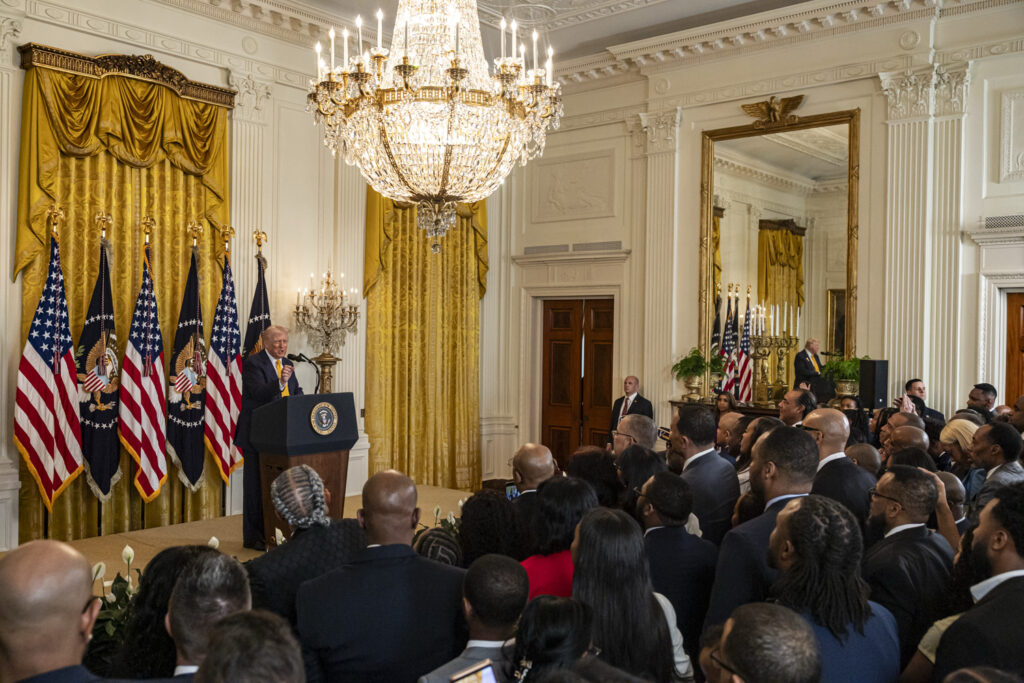
President Donald Trump marked the centennial of what became Black History Month by praising his record on behalf of Black Americans, hosting a champagne-filled East Room event with ardent supporters and high-profile Black leaders last month.
Yet he has frequently suggested — in rhetoric and policy — that the civil rights movement and the push toward racial equity are matters largely resolved, a view that sets him apart from recent presidents, and from his own first term, when the emphasis was more often on unfinished work.
Those tensions were evident throughout February, as Trump’s words and actions demonstrated his approach to race.
In the East Room, he praised as necessary his past efforts on criminal justice reform and funding for historically Black colleges and universities. But in his State of the Union address, Trump celebrated his efforts to eliminate diversity, equity and inclusion programs, declaring, “We ended DEI in America.” Earlier in the month, he posted — and later deleted — a video with a racist depiction of the first Black president and first lady as apes. The White House said it was a staffer’s mistake. Trump still refused to apologize.
This month’s dissonant tones — celebrating Black historical figures, while at times insulting the equity they fought for — reflected the enduring complexities of Trump’s relationship with race. The president has said the Civil Rights Act led to White people being “very badly treated.” He has described efforts at societal equity as reverse discrimination. And he stressed to his Black supporters that their focus should be on the prosperous future he said his policies will deliver, not the sins of the past.
“Black History Month is really all about American history. And this is a big year. This is a big year for you. During my first term, I was honored to deliver unprecedented victories for Black Americans and all Americans, frankly,” Trump said during the East Room event on Feb. 18. “And it’s no wonder that in 2024, we won more African American votes than any Republican presidential candidate in history.”
“We’re the hottest country right now anywhere in the world, and you’re a big part of it and you’re a big beneficiary to it,” he added.
Trump’s vantage point is a marked change from previous administrations — and even from Trump’s first term — which have focused on historical inequities, but also on the ongoing work to address them, said Terrance Sullivan, the racial justice program director at Amnesty International USA, a nonprofit organization focused on human rights.
“Past administrations have talked about challenges that still persist, and even if it was at times performative, there was … an acknowledgment that there are challenges that need to be overcome,” Sullivan said. “And the difference is the current administration speaks to the challenges as being nonexistent and uses its time to implement policies that are detrimental to the Black community.”
Since returning to office, Trump has presided over the most sweeping rollback of federal civil rights protections in six decades. He has blamed inclusion programs for broader problems in government and social life, targeted them in public and private institutions, and sought to delete references to slavery in public exhibits. His administration is conducting a content review of the Smithsonian designed to purge “improper ideology” that does not comport with the administration’s views.
The institution was focused too much on “how bad Slavery was” and not enough on the “brightness” of America, Trump wrote on social media in August, part of a broader push to reshape how the country presents its history ahead of the 250th anniversary.
A White House spokesperson decried efforts to “sow division” and said in a statement that Trump’s tenure has had a profound, positive effect on Black Americans.
“No President in history has done more for black Americans than President Trump. From creating record low unemployment, establishing opportunity zones, providing long-term funding for Historically Black Colleges and Universities, expanding school choice, signing into law historic criminal justice reform, and putting American children on a path toward generational wealth through Trump Accounts, all of these actions have bettered the lives of black Americans,” said White House spokesperson Allison Schuster.
As proof of Trump’s commitment to Black Americans, the White House pointed to several policies, many broad programs such as savings accounts for newborns and changes to taxes on tips and overtime that are aimed at economic uplift.
Trump and his Black supporters highlighted several of those programs during the East Room event, where a roomful of mostly Black supporters chanted, “Four more years!”
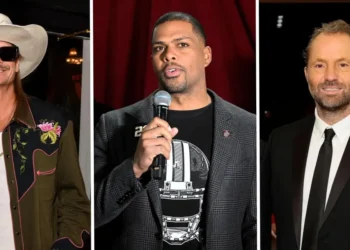
There, former housing secretary Ben Carson spoke of Trump’s effort to create “opportunity zones” to increase investment in economically distressed communities. Alice Johnson, the White House “pardon czar,” talked about Trump’s efforts to commute unfair sentences of Black people — including her own.
The event also functioned as a show of political support for Trump in an election year. He won the largest share of Black votes by a Republican in the 2024 election, but has since seen his popularity erode among many minority groups, polls show.
D.C. resident Forlesia Cook credited Trump with taking bold action to address crime in D.C., an issue close to her heart after her oldest grandchild was killed in 2018.
“I don’t want to hear nothing you got to say about that racist stuff,” she said after embracing Trump. “I’m standing up for somebody that deserves to be stand up for. Get off the man’s back. Let him do his job. He’s doing the right thing. Back up off of him. And Grandma said it.”
WATCH: D.C. resident who lost her grandson to violence speaks at the White House: Thank God for this President… It seemed like nobody cared… nobody heard me—Democrats—until this Republican sent his people out there to interview me in my home… and we need the National Guard… pic.twitter.com/u6BKp7uuaJ
— Rapid Response 47 (@RapidResponse47) February 18, 2026
The emotional testimonials kept the emphasis of Trump’s impact on individuals instead of delivering a blueprint for widespread progress, said Theodore Johnson, senior director of the fellows program at the Brennan Center for Justice, who studies the role of race in politics and policy.
“He doesn’t point to policy reforms. … It was a festival of co-signers more than it is a relationship between the president and a vital bloc of electoral support that’s needed to win elections,” he said. “It’s become sort of performances that are more personal and a shield against whatever negative things people say about the president.”
American presidents have long used Black History Month to highlight strides toward a more pluralistic and equitable America, and to push for policies that would further those aims. Yet across administrations, those moments have also underscored a familiar tension: Lofty rhetoric in February has not always translated into durable policy gains in the months that follow.
As president, Barack Obama frequently spoke during Black History month celebrations of the “ongoing struggle for inequality” and the “unfinished work” of the civil rights movement, and he often alluded to the Rev. Martin Luther King Jr.’s words about the moral arc of the universe. He also stressed that the Affordable Care Act’s implementation and other policies were aimed at addressing inequity.
When he was in the White House, Joe Biden connected the Black History Month observance to efforts to shore up voting rights protections and policing reform.
“We’re protecting our country’s threshold liberty, the sacred right to vote, which I’ve never seen as under such attack,” Biden said at an event in February 2023 during his presidency. “We’ve directed federal agencies to promote access to voting … and again call on Congress: Pass the John Lewis Voting Rights Act. Pass the Freedom to Vote Act.”
The voting bills he mentioned never became law, despite periods when Democrats had control of the White House and both chambers of Congress, something critics attribute to a lack of political will. Still, Biden got credit for symbolic strides — he picked a Black woman as his running mate and another as his pick for Supreme Court justice. Juneteenth, a day that has come to symbolize the end of slavery in the United States, became a federal holiday on his watch.
Trump, at least in his first term, had a similar relationship with Black History Month, even identifying himself as a collaborator in efforts to make progress for Black Americans.
“We’re going to need better schools, and we need them soon. We need more jobs, we need better wages, a lot better wages. We’re going to work very hard on the inner city,” he said at a Black History Month ceremony at the White House in 2017. “We need safer communities, and we’re going to do that with law enforcement. We’re going to make it safe. We’re going to make it much better than it is right now.”
“I’m ready to do my part, and I will say this: We’re going to work together.”
The post In Black History Month, Trump casts racial progress as largely settled appeared first on Washington Post.