Criticism, confusion, finger-pointing, and the new Formula 1 season has not yet started.
After 11 days of testing in Barcelona, Spain, and in Sakhir, Bahrain, in January and February, Formula 1 moves into its new regulatory era with uncertainty.
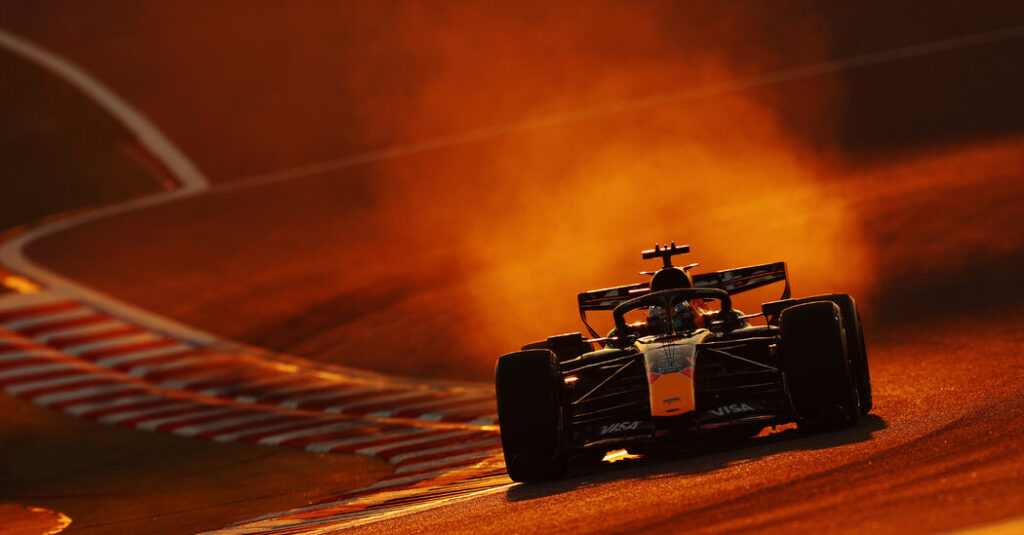
Max Verstappen, a four-time champion, set the tone after testing his Red Bull racecar. “It is not a lot of fun to drive,” he said. “The feeling is not very Formula 1-like. It feels more like Formula E on steroids.
“The livery looks great, the car looks great, the proportion of the car looks good, that is not the problem. It is just that everything else for me is a bit antiracing. People will probably not be happy with me saying this right now, but I am outspoken.”
The reference to Formula E, the all-electric racing series, is because of the significant change to the power unit, with a 300 percent increase in electrical power, leading to an even split between the internal combustion engine and electric power.
“A lot of what you do as a driver, in terms of inputs, has a massive effect on the energy,” Verstappen said. “For me, that’s just not Formula 1, so maybe it would be better to drive in Formula E because that’s all about energy efficiency and management.”
Over the first few days of testing in Bahrain, Verstappen was not alone in his judgment.
“None of the fans are going to understand it, I don’t think,” said Lewis Hamilton, a seven-time champion. “It’s ridiculously complex. I was sitting in a meeting the other day, and they were taking us through it. It’s like you need a degree to fully understand it all.”
Hamilton’s concerns relate to managing the energy provided by the battery. Drivers can use that energy to assist with the new overtaking and boost modes.
The overtaking mode is for drivers within one second of a car in front to deploy extra power to begin an overtake. The boost mode is a driver-operated energy deployment tool to be used offensively or defensively, depending on track position. It gives drivers maximum power from the engine and battery at the push of a button, no matter where they are on track.
It is how the drivers build the energy that is problematic. It can be achieved through braking, lifting off the throttle and coasting, or lifting and downshifting through the gears on straights.
Carlos Sainz of Williams said the F.I.A., the sport’s governing body, should be open to making changes, because circuits like Albert Park in Melbourne, Australia, and the Jeddah Corniche Circuit in Saudi Arabia will create demands on energy harvesting.
“We need to stay open-minded in case the regulations we’ve come up with are maybe too exaggerated on the amount of harvesting and deployment we do on a lap,” he said. “At some circuits, it will be OK, but tracks like Melbourne and potentially Jeddah will be more energy-demanding.” Those tracks have fewer straights, which limits how much energy can build up in the battery.
“So we might need to adjust the regulations a bit, which is not easy because there has been such a big change,” Sainz said. “My only ask would be to stay open in case we need to fine-tune or adjust to make the category and the show even better. We should start flexible, rather than be committed to a certain level of energy management.”
George Russell of Mercedes felt progress was made in the second three-day test in Bahrain, which was “much smoother,” he said, compared with the first.
“Every day, with a new set of regulations, you face challenges that you weren’t anticipating, and the rate of improvement is very steep in those early days,” he said.
“If you look at the lap times and some of the race runs, the cars weren’t a million miles away from the lap times we were seeing 12 months ago, and that was year four of a set of regulations.”
Although the new regulations, which include adjustable front and rear wings to provide higher top speeds on the straights when the wings are open, were intended to improve the racing and further aid overtaking, many drivers feel passing moves will not be as easy as forecast.
“I find it extremely difficult to get any overtakes at the moment,” Charles Leclerc of Ferrari said. “It might improve with time in how we manage these kinds of situations. But it always comes with a price whenever you’ve got to overtake.”
The price is that when an overtake is made, and with the battery depleted, a driver is vulnerable to being quickly repassed.
“The price is a lot more costly than it was in the past,” he said. “So that’s why I think it’s very, very difficult to make an overtake and then pull away, as was the case last year.”
Another concern discovered during testing in Bahrain was the increased time required to power up the turbo to the right speed for an optimum launch at the start of a race.
While those at the front through to the middle of the grid would have time to get the turbo up to speed, thus providing full power at the launch, those at the rear would not. To mitigate the issue, drivers conducted an extra formation lap before practice starts, followed by a prestart warning lasting five seconds before the commencement of the usual start procedure.
Nikolas Tombazis, single-seater director of the F.I.A., said he understood the anxiety of the drivers on some topics, but there would be “no knee-jerk reaction.”
“If you take the comments being made last summer, October, November, we are way better,” he said. “We’ve addressed a lot of the concerns. Have we addressed every single concern? No. There are some topics that are still open.
“Drivers are used to extracting the maximum performance and driving a certain way, and they have to adapt. Until we solve these issues, it is correct that they give feedback. Sometimes it may sound like complaining, and we act on it. It’s part of the game.”
The F.I.A. has acted on the issue of compression ratio, a topic that garnered attention in preseason and during testing. The compression ratio relates to the performance of the pistons inside an engine. The higher the ratio, the greater the possibility of marginally quicker lap times.
It emerged that Mercedes, in hot operating conditions, was running at a ratio of 18:1. The technical regulations state that there must be a ratio of 16:1, but with temperature measurements taken in only ambient conditions, not when the engine is hot during a race.
Toto Wolff, the Mercedes team principal, said his car was legal, but he would comply with any decision the F.I.A. made.
“We have said all along that this is a storm in a teacup,” he said. “It doesn’t change anything for us, whether we stay like this or whether we have to change to a new regulation. We want to be good citizens in the sport, because it doesn’t make a big difference.”
After receiving complaints from the other power-unit manufacturers, the F.I.A. has suggested that temperatures be measured in ambient and hot conditions. A vote is to be taken on a regulation change that would come into force later this year.
“Keeping the compression ratio at 16:1 was one of the core objectives when the regulations were discussed with the P.U. manufacturers in 2022 and when they were finalized,” Tombazis said.
“In terms of whether there’s any discussion of somebody cheating or breaking the rules, and there’s been a lot of emotion on the topic, it’s never been the position of the F.I.A. that somebody is doing something illegal.”
Through it all, Formula 1 goes racing Sunday in Melbourne. Stefano Domenicali, president and chief executive of Formula 1, said he had held meetings with the drivers and that everybody in the sport “needs to stay calm.”
“We shouldn’t forget that the evolution of the technology behind the cars requires a different way of driving them,” he said. “That has happened in the past and will happen in the future.
“I’m pretty sure that when we sit down together in the middle of the year or at the end of the year, you will see a different picture of comments, a different picture of political debate, because that’s normal in Formula 1.”
The post As the F1 Season Begins, Teams Are Still Trying to Make Sense of New Regulations appeared first on New York Times.