As the Trump administration has dramatically increased the number of people held in federal immigration detention facilities, detainees’ access to medical care, sufficient food, basic hygiene and legal counsel have all come under scrutiny.
But the past couple of weeks have also shed light on another basic necessity that advocates say detainees are being deprived of — the ability to worship. Their concerns have intensified as two major seasons, Lent and Ramadan, began for Christians and Muslims.
To gain access, some religious groups have sued the Department of Homeland Security. Others, like the American Roman Catholic Bishops, have called out the lack of access in statements condemning the immigration enforcement tactics of the Trump administration.
In some cases, that pressure has been successful. In others, however, it has left detainees — there are currently close to 70,000, the majority being Christians — with little or no access to religious services at a time of year central to their faiths.
“It feels like there’s a hypocrisy in an administration or a party that has regularly advocated for things like posting the Ten Commandments in public spaces, but denied people the actual practice of their faith,” said Fr. Brendan Busse, a priest at Dolores Mission Church in Los Angeles, who was denied access to a detention facility on Ash Wednesday.
In Minnesota, several Protestant groups and a Catholic priest sued the Department of Homeland Security last week, saying they had been blocked from providing spiritual care to detainees at the Whipple Federal Building, which the suit notes was named for a 19th century Episcopal bishop who was an “advocate for the dignity and rights of noncitizens.” The suit frames the obstruction as an unconstitutional violation of the plaintiffs’ rights to practice their religion by being denied the right to offer pastoral care.
It took a lawsuit for Catholic clergy to gain access on Ash Wednesday to an Immigration and Customs Enforcement facility in Broadview, Ill. A Roman Catholic advocacy group, the Coalition for Spiritual & Public Leadership, had filed a suit against the Trump administration last year, saying that its members had been illegally prevented from providing pastoral care at the facility.
In his ruling on Feb. 12, the judge, Robert W. Gettleman, noted that the detention center had allowed the group to visit detainees consistently for years before changing course only recently. He cited the group’s claim that being prevented from offering “spiritual consolation to those most in need of it” caused “irreparable injury,” and denied religious freedom not just to detainees but those who minister to them.
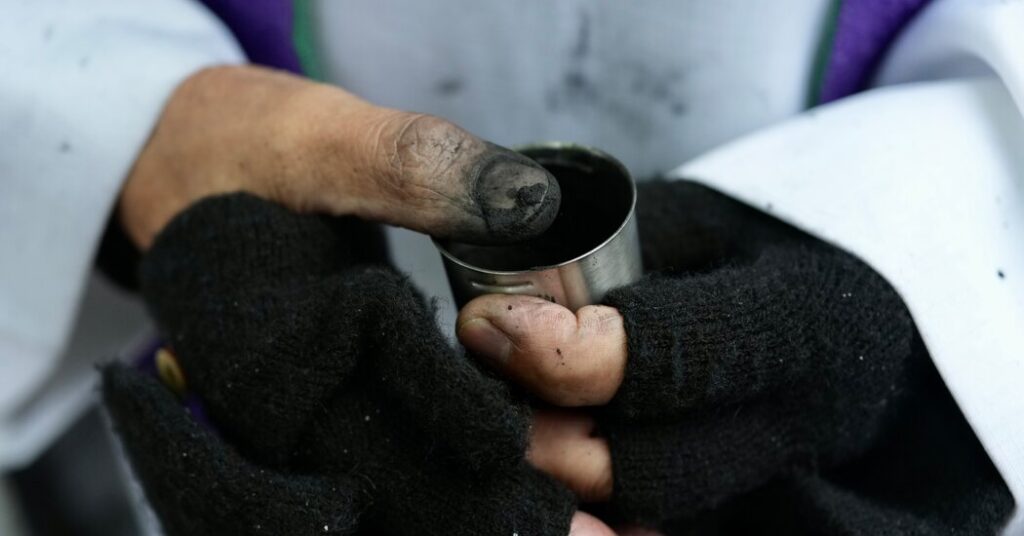
Clergy members entered the facility on Feb. 18 to administer Communion to Catholic detainees and applied a cross of ashes on their foreheads, a traditional sign of penitence.
That evening, more than 3,000 people attended an outdoor, bilingual Ash Wednesday service at a parish nearby, hosted by the Coalition for Spiritual and Public Leadership and celebrated by Cardinal Blase Cupich of Chicago. The cardinal addressed immigrants in particular in his homily. “Your worth does not come from a visa or a permit,” he said. “It comes from the breath of God inside you.”
At other facilities across the country, Ash Wednesday became an opportunity to make visible the spiritual needs of people held in detention. In New Jersey, Cardinal Joseph Tobin celebrated an Ash Wednesday Mass for detainees at the Delaney Hall ICE facility in Newark.
“It’s important for the church to be part of this place, out of respect for the dignity of those women and men,” he told reporters as he exited.
In Los Angeles, clergy formally requested access to bring ashes and provide pastoral care to people detained at the Edward R. Roybal Federal Building on Ash Wednesday. When that access was not granted, they held a prayer service outside.
Fr. Busse compared the lack of access to spiritual care to the denial of medical care in emergencies. “Not allowing the minister access to their flocks, to their communities, to their parishioners and friends, you’re doing similar harm,” he said.
A spokesperson for ICE did not respond to a request for comment.
About 68,000 people are being held in immigration detention centers, compared with about 40,000 people a year ago, according to ICE. Some detainees, including families with children, are held at the centers for months at a time.
ICE’s own standards require that detainees must be permitted to participate in religious practices, as long as they don’t disrupt the “safety, security and orderly operation of the facility.” Detainees requesting a special diet for religious purposes must be accommodated if possible, with the expectation that requests will be granted “unless an articulable reason exists to disqualify someone.”
In practice, access varies widely.
In Texas, advocates for Muslim detainees say that most do not have access to Muslim chaplains, in part because of a broader shortage. But the fast growth of the number of people in detention has brought an urgency to that deficit.
The monthlong observance of Ramadan, which began in mid-February, requires special meal schedules, including a meal right before dawn to begin fasting, and another meal at sunset to break the fast.
“I just listen to people crying, crying all the time,” said Shaimaa Zayan, operations manager of CAIR-Austin, referring to conversations she has had with people in detention and their families. CAIR is a Muslim advocacy group that also works with Muslim inmates in jails and prisons.
CAIR estimates that about 5 percent of detainees in Texas are Muslim. Ms. Zayan said she was not aware of any Muslim chaplains serving in the state’s more than 20 federal detention facilities.
That means they are relying on Christian chaplains and those from other faiths to facilitate their access to halal foods and other religious needs. Those chaplains serve with good intentions, Ms. Zayan said, but sometimes lack the training and time to fully ensure Muslim detainees are able to practice their faith. She said she has heard about detainees giving away their daily portions of meat, since they were not sure it was halal, leaving them without enough calories to stay healthy.
The problem can be further complicated by the fact that many advocates for Muslim detainees are immigrants themselves. Ms. Zavan, who is a U.S. citizen, said she has been advised by immigration lawyers to not visit a detention center without her own immigration lawyer accompanying her, because she wears a hijab and is “not perceived as Christian white.”
In Texas, anxieties are also higher because of escalating rhetoric against the state’s growing Muslim population by Republican officials and candidates. Gov. Greg Abbott recently declared CAIR a foreign terrorist organization.
The overwhelming majority of immigrants without legal status or with only temporary legal protection in the United States are Christians, according to a report last year produced by the United States Conference of Catholic Bishops and several evangelical institutions, including the humanitarian group World Relief.
Just over 60 percent are Catholic, 13 percent are evangelicals, and other Christians and other religious groups represent 7 percent each. The report found that 8 percent of Christians in the United States share a household with someone at risk of deportation, or are at risk themselves.
Catholics, including many priests and bishops, have pushed back against federal immigration tactics. At their annual conference last fall, bishops in the United States mentioned access to pastoral care in detention centers in a statement rebuking the Trump administration’s deportation campaign.
“The thought of holding thousands of families in massive warehouses should challenge the conscience of every American,” the chairman of the U.S. Conference of Catholic Bishops’ committee on migration, Bishop Brendan Cahill of Victoria, Texas, said in a new statement on Feb. 20, responding to the Trump administration’s plans to dramatically expand its detention capacity.
The statement called the moment “a moral inflection point for our country” and compared the scale of the plans to the internment camps used to incarcerate Japanese Americans during World War II.
Ruth Graham is a national reporter, based in Dallas, covering religion, faith and values for The Times.
The post For Immigrants in Detention, Spiritual Care Can Be Hard to Find appeared first on New York Times.