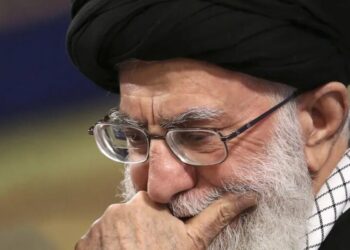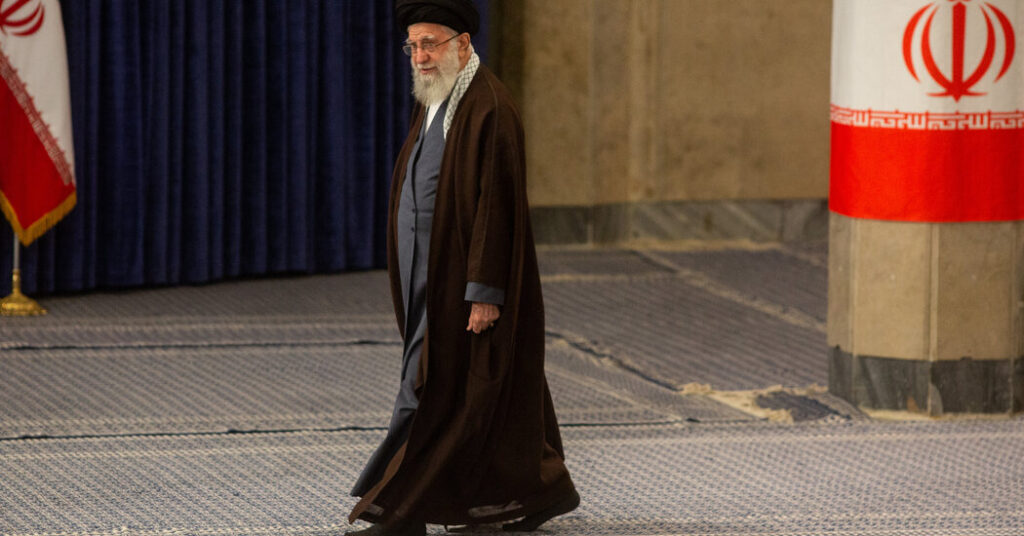
Ayatollah Ali Khamenei, who in more than three decades as Iran’s supreme leader turned the Islamic Republic into a regional power, brutally crushing dissent at home, and maintaining unswerving hostility to the United States and Israel, died on Saturday after U.S. and Israeli military strikes on his country. He was 86.
President Trump announced the death, writing on his Truth Social social-media platform: “Khamenei, one of the most evil people in History, is dead.” Iranian state media later confirmed he had been killed.
Ayatollah Khamenei’s death came amid an extensive attack on Iran by the United States and Israel earlier in the day. Mr. Trump had been building U.S. military forces in the Middle East for weeks and threatening to hit Iran if it did not agree to his demands, which included ending its nuclear program and accepting restrictions on its ballistic missiles. After the attack began, Mr. Trump encouraged Iranians to take over their government.
As the second leader of the Islamic Republic, Ayatollah Khamenei cemented and expanded its hard-line Islamist and anti-Western policies, shaping the nation’s Islamic revolution far more than its founder, Ayatollah Ruhollah Khomeini, who held power for just a decade, most of it during a devastating war with Iraq.
At home, Ayatollah Khamenei ruled with an iron fist, blocking attempts at moderate reforms, labeling public demands for change as Western-orchestrated “sedition” and squelching dissent with arrests and executions. He vastly expanded a loyal military force, the Islamic Revolutionary Guards Corps, whose intelligence wing served as a powerful tool of repression.
Abroad, he trained and armed allied militias in Gaza, Iraq, Lebanon and Yemen, expanding Iran’s influence to menace Israel and challenge Saudi Arabia for regional dominance.
His worldview was shaped by animosity toward the United States, which he called “the great Satan,” and Israel, which he described as “a cancerous tumor that must be removed,” though for the most part he avoided open military confrontation with either.
Such was his rancor toward the United States and its allies that Tehran supplied Russia with suicide drones to attack cities in Ukraine after Moscow invaded in 2022. After the Palestinian militant group Hamas led a devastating attack on Israel in October 2023, he offered full-throated support to anti-Israel militants in the resulting wars in Gaza and Lebanon.
But Iran’s nuclear program, coupled with the ayatollah’s fiery rhetoric toward the West, led to rafts of crippling international economic sanctions and made Iran an international pariah. It also drew a covert, Israeli-led campaign of sabotage and targeted killings aimed at preventing Iran from developing nuclear weapons. This campaign culminated in Israeli strikes across Iran in June 2025 that killed key military leaders and scientists and damaged nuclear sites, and the joint U.S.-Israel assault eight months later.
Ayatollah Khamenei vehemently insisted on what he said was Iran’s sovereign right to pursue its own interests in nuclear fuel enrichment, missile development and regional diplomacy.
“Should the Iranian nation beg for the right of exploitation of nuclear energy from the bullying world powers until they accept that the nation has a nuclear right?” he asked in 2007. “No,” he answered. “This is not the way of a free and independent nation.”
He presided over a state that jailed critics and journalists and enforced draconian restrictions on women. By the end of Ayatollah Khamenei’s life, many Iranians viewed him as the dictator of a corrupt and repressive regime whose policies had killed thousands of Iranians and forced countless others into exile.
During the past decade, as bouts of anti-government protests increased in frequency, Ayatollah Khamenei resorted to ever more brutal tactics. In January 2026, he ordered the security forces to open fire on protesters who had initially taken to the streets peacefully over economic issues.
The government said more than 3,100 people were killed, while human rights organizations estimated the toll at more than 6,000 dead. Ayatollah Khamenei blamed foreign “enemies” for provoking the bloodshed.
Mr. Trump threatened to bomb Iran to halt the killing of protesters and dispatched a naval “armada,” which ostensibly prompted Iran to hold off on executing detainees accused of demonstrating. The ayatollah warned that he would start a regional war if the United States attacked, leading to a flurry of international diplomacy and direct talks between senior U.S. and Iranian officials.
But on Saturday, the U.S. and Israel attacked dozens of sites across the country in an assault Mr. Trump said would eliminate Iran’s nuclear program and change its government.
Frustration with the ayatollah’s rule had also exploded in 2022, when protests erupted over the death in custody of Mahsa Amini, a 22-year-old woman who had been accused of violating a law requiring women to wear head scarves. In a remarkable display of courage, women marched across the country, chanting “Women, life, freedom” and yanking off their scarves in public.
The protests widened into a nationwide uprising demanding an end to clerical rule and the ouster of Ayatollah Khamenei.
The authorities cracked down, killing hundreds of protesters and arresting thousands, sentencing dozens to death. The protests continued for months but ultimately petered out.
Ayatollah Khamenei’s supporters credited him with shrewdly navigating Iran’s complex political landscape and for resolutely deterring international threats and pressures.
Despite his deep mistrust of the West, he agreed to a landmark nuclear deal in 2015 that restricted Iran’s right to enrich uranium in exchange for the lifting of international sanctions. His mistrust was validated three years later, however, when Mr. Trump withdrew from the agreement, restoring the sanctions and piling on new ones.
In 2025, Mr. Trump sought to reach a new nuclear accord with Iran, and Ayatollah Khamenei allowed Iranian negotiators to engage while insisting that Iran would not give up its right to enrich uranium.
Those talks were interrupted by the Israeli strikes that June that damaged nuclear facilities and killed officials linked to the nuclear program.
At his death, Ayatollah Khamenei was the longest-serving head of state in the Middle East and one of Iran’s longest-serving modern rulers, with a tenure that antagonized six American presidents, from George H.W. Bush to Mr. Trump.
“He is one of the most consequential and important leaders of Iran in the modern period,” said Vali Nasr, a professor at the School of Advanced International Studies at Johns Hopkins University. “It’s really under him that the Islamic Republic took form. Khomeini led a revolution. Khamenei led a state.”
Becoming Supreme
In some ways, Ayatollah Khamenei (pronounced HAH-meh-NAY-ee) was an accidental leader, assuming the presidency in 1981 only after the incumbent was assassinated. Nor was his ascension to supreme leader a given. He was a devoted revolutionary and protégé of Ayatollah Khomeini, but he lacked the religious credentials required by Iran’s Constitution for the top job.
But after Ayatollah Khomeini’s death in 1989, he emerged as a consensus candidate. To address the legal requirements, he was designated an ayatollah overnight, and the Constitution was changed to remove the mandate that the supreme leader attain the highest rank in the Shiite hierarchy.
Ayatollah Khamenei inherited a country that was regionally isolated, with a depleted military and a war-torn economy. Though he lacked his predecessor’s charisma and mystique, he moved quickly to expand his power and rebuild Iranian influence.
In terms of raw muscle, his position was underpinned by the Revolutionary Guards, a parallel military force whose military, political and economic power he expanded and that in return offered him its enduring loyalty.
His authority was further buttressed by an extensive network of appointees, informers, commissars and multiple layers of security forces, including morality police and a plainclothes militia known as the Basij.
His black turban denoted a claim of direct descent from the Prophet Muhammad. And his appointment by a council of clerics as the earthly representative of the Imam Mahdi, a messianic figure, vested him with divine authority. The mere charge of being “against” his divine rule risked the death penalty.
With his spectacles, Palestinian kaffiyeh, long robes and silver beard, Ayatollah Khamenei cast himself as a religious scholar as well as a writer and translator of works on Islam. He affected an avuncular and magnanimous aloofness, running the country from a perch above the jousting of daily politics.
That facade of supposed neutrality showed cracks after the hard-line conservative president Mahmoud Ahmadinejad won a second term in a 2009 election widely seen as rigged. The ayatollah endorsed the flawed victory and the brutal crackdown on hundreds of thousands of protesters that followed, damaging his standing among many Iranians, particularly the educated, urban middle class.
The 2009 uprising, known as the Green Revolution, was neither the first nor last to challenge clerical authority. Mass protests broke out again in 2017, 2019 and 2022. Each time, the government responded with violent crackdowns and, each time, the ayatollah praised the security forces for crushing the unrest.
He also began to insert himself more directly into the affairs of the government in televised speeches, dictating the approach if not the details of major policies.
By the 2021 election, he no longer bothered to maintain the appearance of a fair contest, allowing Iran’s top clerical body, the Guardian Council, to disqualify any candidates who posed a real challenge to his conservative protégé, Ebrahim Raisi, who won handily.
In July 2024, his regime appeared to be taken by surprise by the upset presidential victory of Masoud Pezeshkian, a reformist who said he sought to make Iran more prosperous, socially open and engaged with the West. Experts questioned how much leeway the new president would be given, but Ayatollah Khamenei offered his endorsement.
At the same time, he cannily exploited political instabilities in the Middle East to extend Iran’s reach, constructing a so-called axis of resistance from the Persian Gulf to the Mediterranean that sought to threaten Israel and rival the Sunni Muslim powers of the Arab world.
“For many Shiites outside of Iran, he came to symbolize the power of the largest Shiite country, and the Islamic Republic in their minds in large part was summarized in Khamenei,” said Mr. Nasr, the Johns Hopkins professor.
The American-led invasion of Iraq in 2003 provided an opening for Ayatollah Khamenei to exert influence abroad. The war toppled a Sunni dictator, Saddam Hussein, who ruled a Shiite-majority country. Iran developed and armed Shiite militias and backed Shiite political parties, giving Iran significant clout in Iraqi politics.
Foreign military ventures not only gave Iran a clear passage across the region — to ship missile parts to its ally Hezbollah in Lebanon, for instance — but also left it with a sectarian fighting force at its disposal.
In 2014, after a large swath of Iraq was captured by the Islamic State, a Sunni jihadist group, Iran-backed militias helped defeat the terrorist group, paradoxically placing Tehran and Washington on the same side against a common adversary.
When the Arab Spring uprisings erupted in 2011, the ayatollah sent militia forces into Syria to support President Bashar al-Assad against Western-backed rebels and Sunni jihadists. But they ultimately failed, and the rebels who toppled Mr. al-Assad in late 2024 vowed to keep Iran out of their country.
These regional allies posed risks for Iran. When Hamas led its surprise assault on Israel in October 2023, killing 1,200 people and dragging 250 back to Gaza as hostages, he praised it as “a decisive blow to the Zionist regime.”
Israel engaged Hamas in a war that devastated Gaza, drew in Hezbollah in Lebanon and prompted Israeli assassinations of senior figures from both groups, including one inside of Iran.
Twice in 2024, in April and October, Iran fired barrages of drones and missiles toward Israel, but most were shot down and did little damage. Later that year, an Israeli bombing campaign severely degraded Hezbollah’s military abilities and killed dozens of its leaders, ending its run as a regional extension of Iranian power.
Opposing the West
The Islamic Republic’s relations with the United States have been contentious since Iranian revolutionaries took American diplomats hostage at the U.S. Embassy in 1979, an event Ayatollah Khamenei later praised as “a great and valuable service performed for our revolution.”
He said he considered the United States a “vindictive and malevolent” enemy.
The United States and other critics labeled Tehran a sponsor of terrorism and a threat to the regional order, with a record of torture, the jailing of adversaries and persecution of minorities.
Iran’s nuclear enrichment program, which American and Israeli intelligence agencies said was intended to create nuclear weapons, became the most urgent matter of dispute.
Iranian leaders insisted that the program — conducted in secret until its existence was disclosed in 2002 — was for peaceful purposes. Moreover, they said, they had no interest in nuclear arms, which were banned by the ayatollah in a 2003 religious edict.
Western and Israeli analysts, however, said Iran was moving toward nuclear weapons capability, narrowing the so-called breakout time it would take to create a bomb.
Seeking a diplomatic solution in 2009, President Barack Obama wrote two letters to the Iranian leader, eventually leading to the astonishing scene of Iranian and American diplomats at the same negotiating table.
Ayatollah Khamenei voiced reluctant support for the deal reached in 2015, while emphasizing that it did not change Iran’s hostility toward the United States and Israel.
In 2018, Mr. Trump unilaterally withdrew from the agreement, reimposed American sanctions against Iran and added new ones in a so-called “maximum pressure” campaign.
In return, Iran resumed nuclear enrichment. Within a few years, Iran had crossed the threshold of being a nuclear-capable state with enough enriched uranium to make at least one nuclear warhead if it chose to do so.
Tensions between the two countries peaked in January 2020 with the American killing of the commander of the Revolutionary Guards, Maj. Gen. Qassim Suleimani, in a drone strike in Baghdad, pushing the two countries to the brink of war.
Five days later, Ayatollah Khamenei ordered a ballistic missile attack on American troops in Iraq. No Americans were killed, but more than 100 soldiers suffered traumatic brain injuries.
Both countries then stood down, averting a wider conflict, but the tension caused a new disaster.
With Iran on high alert for a possible American counterattack, a Revolutionary Guards officer shot down what turned out to be a Ukrainian Airlines passenger jet near Tehran’s international airport. All 176 passengers, including some of Iran’s best and brightest, were killed.
The ayatollah immediately knew what had happened. But for three days, the government denied that the plane had been shot down, dismissing the accusation as a Western plot to discredit the country, until mounting evidence made the lie untenable.
Personal honor is a sacred virtue in Iranian culture. To many Iranians, the ayatollah’s had sustained permanent damage.
Modest Upbringing
Sayyid Ali Husseini Khamenei was in born in modest circumstances as the second of eight children on April 19, 1939, in Mashhad, in northeastern Iran, the country’s second-largest city.
His father, Sayyid Jawad Khamenei, was a midranking cleric who was regarded as ascetic and devout. His mother, Khadijeh Mirdamadi, also came from a clerical family. In his official autobiography, Ayatollah Khamenei described her as a “very wise, educated and well-versed woman who enjoyed poetic and artistic talents.”
From the age of 4, he was educated at Islamic seminaries. At 13, he said, he felt the first stirrings of revolutionary zeal when he heard a speech by the Islamic militant Navab Safavi. After a year of study in Najaf, Iraq, he returned to Iran and the holy city of Qum, where at 19 he fell under the influence of Ayatollah Khomeini.
He was also influenced by the writings of Sayyid Qutb, an Egyptian fundamentalist ideologue and proponent of Islamic statehood, some of whose work Mr. Khamenei translated to Persian from Arabic.
In 1963, a time of great ferment over the shah’s efforts to modernize Iran, the young Mr. Khamenei served as a secret courier between Ayatollah Khomeini in Qum and clerics in Mashhad. Later that year, he was arrested for the first of six times by the shah’s secret police and spent a night in jail.
A year later, he married Khojasteh Bagherzadeh. Although little is known about her, the couple had six children: four sons, Massoud, Mojtaba, Mostafa and Meysam, and two daughters, Bushra and Hoda. A complete list of survivors was not immediately available.
Ayatollah Khamenei has made much of his six arrests, in effect a tally of revolutionary credentials, culminating in the mid-1970s when he was held in solitary confinement before being banished, first to Iranshahr and then to Jiroft, both in southeastern Iran.
For many of these years, Ayatollah Khomeini was exiled from Iran — until his triumphant homecoming after the shah fled in early 1979 amid an uprising against the monarch’s long, repressive rule.
He declared Iran an Islamic Republic and appointed Mr. Khamenei to lead Friday prayers in Tehran, a major rallying point for the revolution. Mr. Khamenei also served briefly as deputy minister of defense and supervisor of the Revolutionary Guards.
In November 1979, after the United States admitted the exiled shah for cancer treatment, revolutionary students overran the American Embassy, setting off a 444-day hostage crisis.
In June 1981, Mr. Khamenei was badly wounded when a bomb concealed in a tape recorder by opponents of clerical rule exploded at a news conference, crippling his right arm.
Khomeini’s Choice
With Ayatollah Khomeini’s backing, Mr. Khamenei became president in October 1981, serving two terms, until Aug. 3, 1989.
In the jostling to succeed Ayatollah Khomeini after his death in 1989, Mr. Khamenei’s clerical credentials failed to meet the constitutional requirements. But according to accounts from the era, the Parliament speaker, Ali Akbar Hashemi Rafsanjani, and Ayatollah Khomeini’s son, Ahmad, maintained that Ayatollah Khomeini’s dying wish had been for Mr. Khamenei to succeed him.
That blessing won the day, and Mr. Khamenei was elevated to ayatollah and supreme leader. As leader, he adopted a humble posture, calling himself “an individual with many faults and shortcomings, and truly a minor seminarian.”
He appeared to live modestly in a home-office complex where he met with heads of state in a sparsely furnished room with a beige carpet, a sofa and a few wooden chairs. The few photos from his private residence show cushions lined against the wall on the floor.
Many details of his private life and finances remain opaque. In 2013, Reuters reported that he controlled a state-owned business conglomerate worth around $95 billion built on “the systematic seizure of thousands of properties belonging to ordinary Iranians.” While the business gave him huge economic power, Reuters found no evidence that the ayatollah used it to enrich himself.
Ayatollah Khamenei had no qualms about taking stances that were anathema elsewhere.
He dismissed the Holocaust as “the myth of the massacre of Jews.” In 2005, he upheld the religious injunction issued by his predecessor urging Muslims to take the life of the novelist Salman Rushdie over allegations that his book “The Satanic Verses” was blasphemous. In August 2022, a 24-year-old New Jersey man attacked Mr. Rushdie with a knife, stabbing him 10 times.
Iranian state media called it “divine retribution.”
Ayatollah Khamenei’s obstinacy sometimes hurt Iranians, as during the Covid-19 pandemic. On top of chaotic planning, a lack of transparency and a refusal to impose quarantines, the ayatollah banned American- and British-made coronavirus vaccines, insisting that Iran would produce its own.
That decision probably contributed to a toll of well over 100,000 deaths.
“He was arrogant, literate, obdurate, revengeful, unable to accept mistakes, unwilling to make concessions and given to conspiracy theories,” said Abbas Milani, a historian and director of Iranian studies at Stanford University. “He was constantly at war with real and imaginary enemies. His policies led to Iran’s isolation internationally and to sclerotic despotism at home.”
After more than 35 years in power, Ayatollah Khamenei had shaped the Islamic Republic in his own image.
After a long career as a foreign correspondent for The New York Times based in Africa, the Middle East and Europe, Alan Cowell became a freelance contributor in 2015, based in London.
The post Ayatollah Ali Khamenei, Hard-Line Cleric Who Made Iran a Regional Power, Dies at 86 appeared first on New York Times.