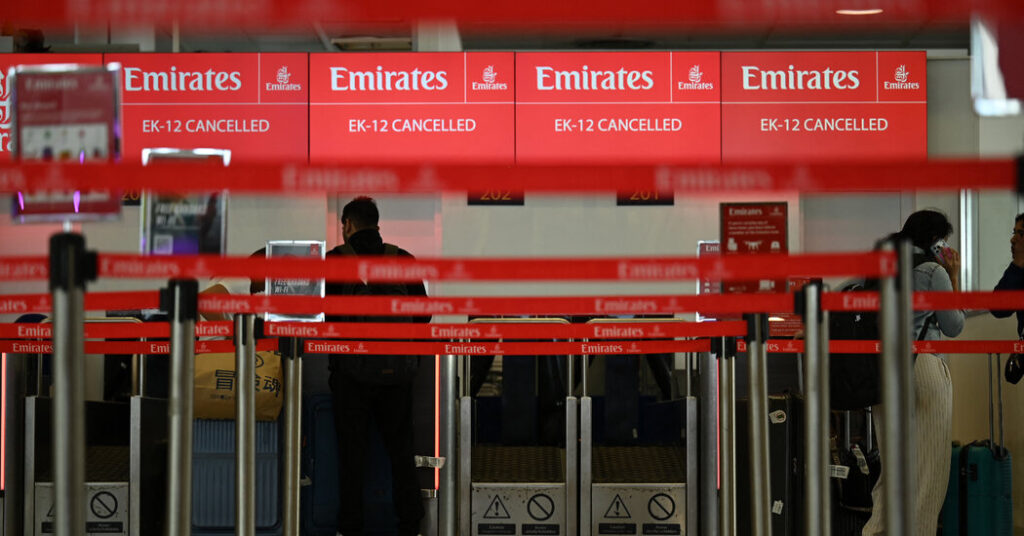
After the U.S.-led attack on Iran, a wide corridor of airspace over the Middle East has been closed, with Israel, Iran, Iraq, Bahrain, Qatar, Kuwait and Jordan shutting down air traffic.
About 1,600 flights to and from the region had been canceled on Saturday, and major airports, including Dubai International in the United Arab Emirates and Ben Gurion in Israel have been closed.
Airlines serving the region, including Emirates, Etihad Airways, Gulf Air, and Oman Air are scrambling to suspend flights and divert them far from affected areas. They are also issuing waivers for passengers to rebook or cancel their flights.
Emirates, the region’s largest airline, announced that all operations to and from Dubai had been paused. The airline’s social media channels were flooded with requests from stranded travelers hoping to be rebooked.
Several dozen Emirates flights bound for Dubai this afternoon were instead landing in scattered European airports, including in Vienna and Rome, according to Flightradar24, a flight-tracking service.
Airports in the Middle East, among the world’s busiest, play a key role in global aviation because of their capacity to handle rapidly-rising numbers of flights as well as their geographic position between Europe, Asia and Africa. The flight disruptions could ripple well beyond the Middle East if the airspace closures persist; airports such as Dubai International Airport and Abu Dhabi International Airport, also in the United Arab Emirates, serve as major connection hubs for international travelers.
Each day, some 90,000 passengers fly from airports in the U.A.E. and Qatar, connecting to the Americas, Europe, Africa and Asia, and using Dubai as the hub, according to Cirium, a firm focused on aviation analytics.
“Dubai, Doha and Abu Dhabi have purpose-built hubs to transit passengers from around the world for long haul flying with the Middle East a short stopover,” said Mike Arnot, a Cirium spokesman. “If you’re a passenger traveling from Rio de Janeiro to Delhi for example, there’s a good chance you’d consider flying with a Middle East airline for your travels. And it’s the same for most far-flung cities around the world.
Christine Chung is a Times reporter covering airlines and consumer travel.
The post Attacks Close Airspace in Middle East, Causing 1,600 Flight cancellations appeared first on New York Times.