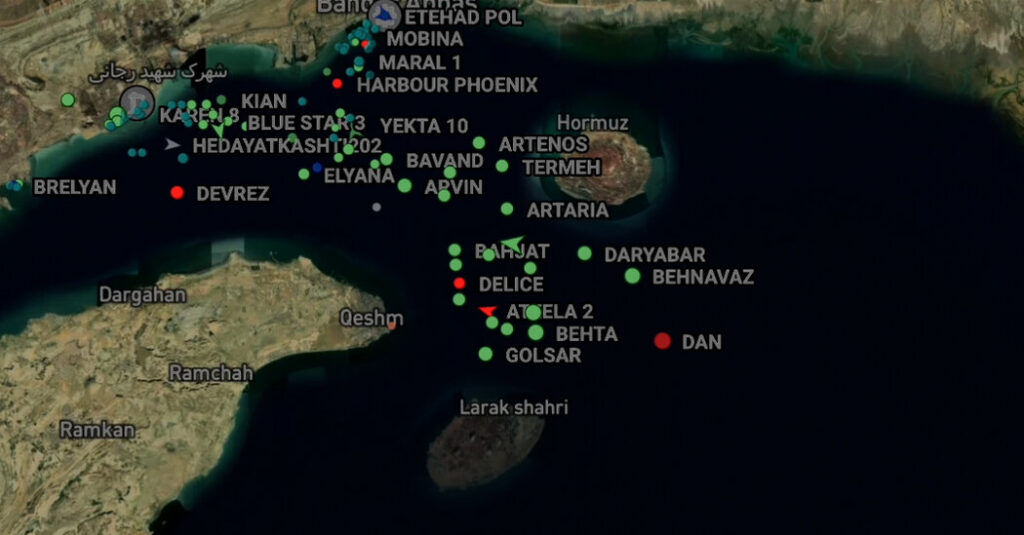
Commercial ship traffic through the Strait of Hormuz, a narrow waterway on Iran’s southern border connecting the Persian Gulf to the Gulf of Oman and one of the world’s most vital maritime arteries, slowed sharply on Saturday after strikes by the United States and Israel on Iran, according to industry experts and maritime data analyzed by The New York Times.
The ship-tracking platform MarineTraffic showed a 70 percent drop in vessel traffic through the Strait of Hormuz, as of late evening in Iran, according to Dimitris Ampatzidis, a senior risk and compliance analyst at Kpler, MarineTraffic’s parent company. The majority of vessels in the area had done U-turns, diverted to alternative routes or begun idling in the Gulf of Oman, he added.
“Saudi Arabia, Iraq, the United Arab Emirates and Qatar are the most exposed,” said Mr. Ampatzidis, “as the majority of their seaborne crude and liquefied natural gas exports pass through Hormuz.”
Some vessels, however, continued to traverse the waterway, according to ship-tracking data from MarineTraffic and Pole Star Global, another data firm.
“My guess is they are trying to get out while there is still a better chance,” said David Tannenbaum, a former sanctions compliance officer with the U.S. Treasury.
The Iranian military cautioned vessels on Saturday to avoid the strait, saying that passage through it was “currently unsafe,” according to Tasnim, a news outlet affiliated with the Islamic Revolutionary Guards.
A U.S. official said there was no evidence Iran was attempting a military blockade of the waterway.
To fully close the Strait of Hormuz would be difficult for Iran, as it would require a continuous military presence. That would reduce Iran’s capacity with other operations, Mr. Ampatzidis said. “Historically, we have more often seen harassment, seizures and selective targeting of vessels rather than a prolonged, absolute shutdown of traffic,” he added.
President Trump signaled that the U.S. would target Iran’s ability to project power at sea. “We’re going to annihilate their navy,” he said in a video address posted to X and Truth Social just after the strikes started.
According to TankerTrackers.com, a company that monitors global oil shipments, 55 oil tankers remain in Iranian waters — 18 laden with crude and 37 sitting empty. The bottleneck in the strait threatens global oil supplies and Iran’s own oil exports.
Reporting was contributed by Rebecca F. Elliott, Peter Eavis and Eric Schmitt.
Christiaan Triebert is a Times reporter working on the Visual Investigations team, a group that combines traditional reporting with digital sleuthing and analysis of visual evidence to verify and source facts from around the world.
The post Shipping Traffic Through Strait of Hormuz Plummets After Attacks on Iran appeared first on New York Times.