When he first ran for president in 2016, Donald J. Trump disavowed the military adventurism of recent years, declaring that “regime change is a proven, absolute failure.” He promised to “stop racing to topple foreign regimes.”
When Mr. Trump ran for president in 2024, he boasted of starting “no new wars,” and asserted that if Kamala Harris won, “she would get us into a World War III guaranteed,” and send the “sons and daughters” of Americans “to go fight for a war in a country that you’ve never heard of.”
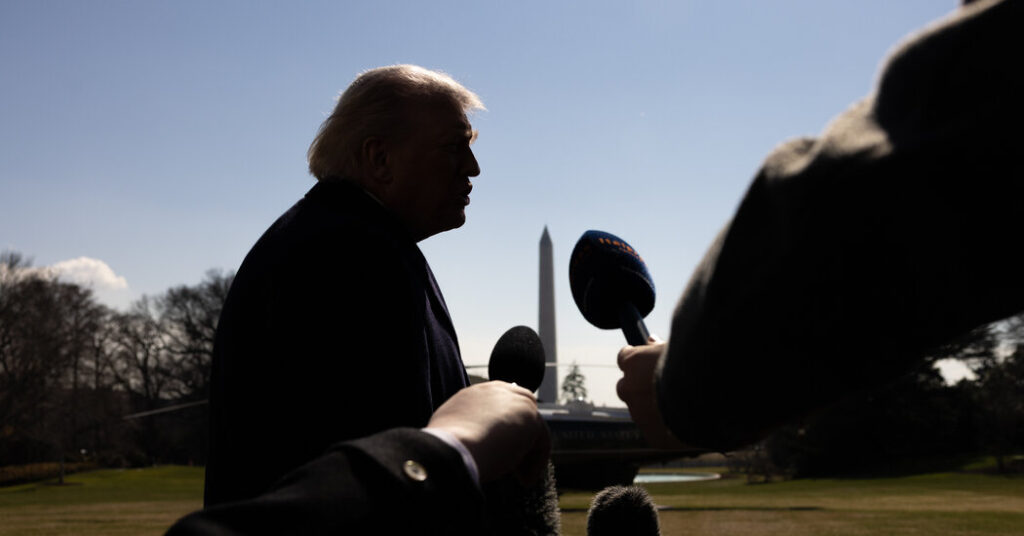
Barely a year later, Mr. Trump is racing to topple foreign regimes, and is sending American sons and daughters to wage another war in the Middle East. The self-declared “president of PEACE” has chosen to become the president of war after all, unleashing the full power of the U.S. military on Iran with the explicit goal of toppling its government.
What the Donald Trump of 2016 would think of the Donald Trump of 2026 will never be known. But they are starkly different figures when it comes to overseas intervention. A decade after propelling himself to the highest office by promising to focus on “America first,” Mr. Trump has become increasingly willing to assert power overseas. The bombardment of Iran on Saturday was the eighth time he had ordered the military into action in his second term, even as he has decapitated the government of Venezuela and threatened to overthrow Cuba’s dictator.
In his middle-of-the-night social media video announcing the opening of this new war, Mr. Trump laid out a bill of particulars against Iran going back nearly half a century, including its pursuit of nuclear weapons and ballistic missiles, its support for terrorist groups that attacked Americans and allies, the 1979 seizure of the U.S. Embassy in Tehran and the recent massacre of Iranian protesters. But he never explained why those aggressions required action now rather than earlier, or why his thinking evidently changed.
Nor did he reconcile his conflicting statements on the status of the Iranian threat. After joining Israel in attacking Iran last summer, he said that he had “obliterated” the country’s nuclear program. He repeated that claim in last Tuesday’s State of the Union address, and again in his early Saturday morning video. But he did not clarify why it was necessary to strike a program that had already been obliterated.
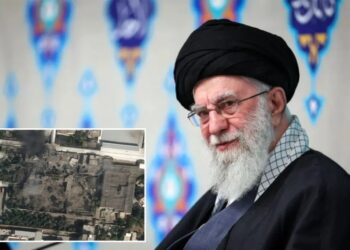
He did, however, go further than ever in making regime change the goal, calling on Iranians to overthrow their leaders. “When we are finished, take over your government,” Mr. Trump said. “It will be yours to take.” He repeated that in a social media post Saturday afternoon announcing that the strike had killed Ayatollah Ali Khamenei, the supreme leader — “one of the most evil people in History,” as he put it.
But how Iranians should go about taking over was left unclear. Mr. Trump wrote that police and revolutionary guard forces should “peacefully merge with the Iranian Patriots, and work together as a unit to bring back the Country to the Greatness it deserves” — a remarkable notion suggesting that Iranian security officials would somehow team up with the same people they were gunning down in the streets just weeks ago.
“His stated goal here, regime change, is the very thing he ran against in 2016,” said Brandan P. Buck, a research fellow in foreign policy studies at the libertarian Cato Institute. “Previously, the president used airstrikes, raids and covert military power when he believed it could achieve discrete ends with good optics at little cost. This attack on Iran has broken that formula and constitutes a leap into the unknown.”
Mr. Trump’s critics quickly resurrected his past statements to accuse him of abandoning his own promises, circulating video clips of his campaign rallies and social media quotes assailing Barack Obama, George W. Bush and Kamala Harris as warmongers.
Mr. Trump, 2012: “Now that Obama’s poll numbers are in tailspin — watch for him to launch a strike in Libya or Iran. He is desperate.”
Mr. Trump, 2013: “Remember that I predicted a long time ago that President Obama will attack Iran because of his inability to negotiate properly — not skilled!”
Mr. Trump, 2016: “We’re going to stop the reckless and costly policy of regime change.”
Mr. Trump, election night 2024: “I’m not going to start wars. I’m going to stop wars.”
And there were plenty of quotes from advisers like Stephen Miller, now the deputy White House chief of staff (“Kamala = WWIII. Trump = Peace,” Nov. 1, 2024), and Defense Secretary Pete Hegseth (“The War Department will not be distracted by democracy-building, interventionism, undefined wars, regime change,” Dec. 6, 2025).
Among those lashing out at Mr. Trump on Saturday were not just liberals but also prominent leaders of the Make America Great movement who complained that he had been captured by the neoconservatives he once spurned, criticism led by the right-wing podcast host Tucker Carlson and former Representative Marjorie Taylor Greene, Republican of Georgia.
“It’s always a lie and it’s always America Last,” Ms. Greene, who resigned her seat last month after breaking with Mr. Trump, wrote on social media. “But it feels like the worst betrayal this time because it comes from the very man and the admin who we all believed was different and said no more.”
Representative Marlin Stutzman, Republican of Indiana, argued that Mr. Trump’s attack on Iran would head off a worse threat down the road and pave the way for a new Middle East that would be friendlier to the United States. “To those who say, ‘Well, President Trump said he wasn’t going to take us into any wars,’ he’s keeping us out of wars in the long run,” he said on CNN.
Advocates of action against Iran said Mr. Trump still had not fully committed to changing the government in Tehran, but instead had left it to the Iranian people. “Trump’s speech wasn’t a regime change speech — and I wish it had been,” said Mark Dubowitz, chief executive of the Foundation for Defense of Democracies, a group that has long pressed for tougher policy on Iran.
The only “durable solution,” he added, is not a military strike that sets the Iranian nuclear weapons program back by months or years, but the end of the regime. “But that’s not exactly what Trump prioritized tonight,” Mr. Dubowitz said, “and we need to be honest about what he did, and didn’t, say.”
Mr. Trump’s increasing willingness to deploy military force underscores the broader change between his first term and second term. He is far more comfortable using the instruments of power than he was the last time around, at home as well as abroad. What he sometimes threatened or considered doing in his first stint in the White House, he more readily acts on now, whether it be sending federal forces into American streets, prosecuting his perceived enemies, purging the government of those deemed disloyal or imposing tariffs on countries around the world.
The team he assembled in the first four years included conventional Republicans or career military officers who often restrained his most radical impulses. But there is no John F. Kelly, Jim Mattis, Mark T. Esper or Mark A. Milley this time around. Instead, he has surrounded himself with more aggressive break-the-china advisers pushing for more ambitious action and with figures like Mr. Hegseth, Secretary of State Marco Rubio and Susie Wiles, the White House chief of staff, who view their jobs as facilitating the president’s desires rather than talking him out of them.
Mr. Trump’s journey as commander in chief has been a fitful one. He had no experience in either the military or public office when he first arrived in the Oval Office in January 2017. He promoted a more aggressive war against the Islamic State, but sometimes hesitated to use force, at one point calling off a retaliatory military strike on Iran with just minutes to go, deeming it not worth the casualties.
He was intent on pulling back from much of the world, seeking to bring U.S. troops home from places like South Korea, Germany and Syria. He negotiated a peace agreement with the Taliban to withdraw all American forces from Afghanistan, a deal then executed by his successor, President Joseph R. Biden Jr., in a disastrous operation.
But he was also emboldened when a U.S. strike in 2020 targeted and killed Iran’s Maj. Gen. Qassim Suleimani without instigating the devastating reprisals or prolonged regional war that some critics had predicted. Likewise, in this second term, the successful commando raid that captured President Nicolás Maduro of Venezuela also energized Mr. Trump.
His public posture, however, has veered wildly over the past year. One moment, he is presenting himself as a historic peacemaker, forming a so-called Board of Peace and griping that he has not won the Nobel Peace Prize while boasting, inaccurately, that he has ended eight wars — including one with Iran. The next moment, he is threatening to seize Greenland, take back the Panama Canal, strangle Cuba and even go after Colombia’s president as he did Venezuela’s.
Charles Kupperman, who was a deputy national security adviser to Mr. Trump in the president’s first term, said he did not think Mr. Trump had evolved in his thinking about foreign threats. But in the case of Iran, Mr. Kupperman said, the president set himself up by investing in a diplomatic effort that was always doomed to fail, leaving little alternative but to take military action.
“It is difficult to determine Trump’s decision-making process given the serious downgrade of the N.S.C. and its policymaking role,” he said of the National Security Council. “What options were developed and presented to Trump and the process for generating them are key questions.” But he added that “the diplomatic effort to engage Iran was never going to yield the results that Trump sought. Pure Kabuki theater.”
The outcome of Mr. Trump’s geopolitical gamble will depend not just on how the military operation proceeds, but what comes next. Success has a way of making voters forget about broken promises. There is little love lost for the Tehran regime, and video showed Iranians in the streets cheering reports of Ayatollah Khamenei’s death. If Mr. Trump manages to push the remaining government from power, he will have something to boast about that none of his predecessors dared try.
Unlike the so-called forever wars in Afghanistan and Iraq that helped fuel his political rise, Mr. Trump has not made any major commitment of ground troops in Iran, and seems determined to stick to air power, avoiding the sort of grinding guerrilla warfare that turned Americans against past wars.
Still, as Mr. Trump himself warned in his overnight video, there could be American casualties. And if the Tehran government does fall, it could result in a replacement that is still hostile to the United States, or in fratricidal chaos, as happened in Libya after Muammar el-Qaddafi was deposed and killed in 2011.
One way or the other, his allies were already talking about it being a legacy moment for Mr. Trump. What kind of legacy is not yet clear. But it will not be the one that he originally promised.
Peter Baker is the chief White House correspondent for The Times. He is covering his sixth presidency and sometimes writes analytical pieces that place presidents and their administrations in a larger context and historical framework.
The post Trump, the Self-Declared Peace President, Goes to War Seeking Regime Change appeared first on New York Times.