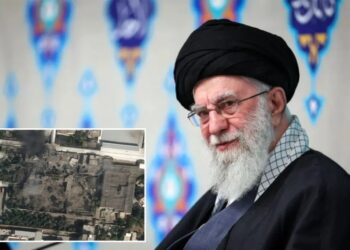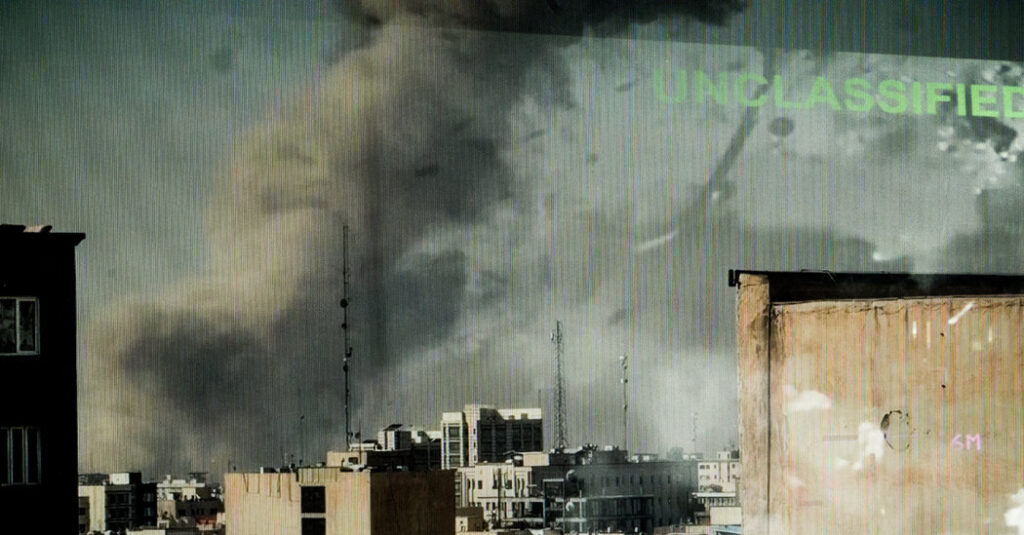
The United States and Israel conducted airstrikes on Iran early on Saturday, and President Trump announced that Ayatollah Ali Khamenei, Iran’s supreme leader, was killed. Stephen Stromberg, an editor in Opinion, convened the Opinion columnists David French, Nicholas Kristof and Bret Stephens and the Opinion contributing writer Megan K. Stack for a written discussion about the attack and its implications.
Stephen Stromberg: Trump says Iran’s supreme leader is dead. How should we feel about the potential for regime change?
Megan K. Stack: I fail to see how creating a political vacuum that could evolve in countless, unpredictable ways is expected to make anyone safer. There’s some vague idea that the Iranian people are all opposed to their government and will come together to create a new government. I don’t think history supports that expectation. Our leaders don’t seem to have learned anything from U.S. interventions in Iraq, Afghanistan and Libya. Sure, the U.S. military can kill all the leadership. And then what?
Nicholas Kristof: One risk is that Iran’s militant Islamic Revolutionary Guards Corps takes over. That might be worse. There’s also some danger that Iran simply fragments; regional leaders worry about this. To me, it feels like an echo of the 2003 Iraq invasion: Once again, we’ve relied on manipulated intelligence to launch a war with vast aims to reshape the Middle East and little assurance of success — but great risks and costs.
Bret Stephens: I urge anyone reading this conversation to spend a few minutes watching this Times Opinion video created by the journalists Roxana Saberi and Fatemeh Jamalpour, who collected images taken by Iranian doctors and medical personnel documenting the unimaginable brutality they experienced last month at the hands of this regime. Right now, there’s a worldwide protest movement against Israel on account of an estimated 70,000 Palestinians, militants and civilians killed in Gaza over more than two years of combat. The Iranian regime killed an estimated 30,000 unarmed civilians in two days — to little apparent outrage among many of the same people protesting Israel. That’s why you read reports of ordinary Iranians looking to the skies and hoping the United States and Israel will strike.
I don’t doubt that this campaign is going to entail grave risks for Iranians, and Megan’s and Nick’s warnings should be taken seriously. But we also need to be mindful that those same Iranians are running grave risks just by living under the current regime.
What happens now depends in part on whether the justified fury that Iran’s public feels against what is left of the regime will exceed the understandable fear they have about its bottomless cruelty.
Stack: I second the recommendation to watch that powerful video. I have no regard whatsoever for the oppressive, violent, theocratic Iranian regime. But I’ve covered wars in which the United States toppled terrible regimes, and I know too well how the violence multiplies. It’s about 25 years and a whole lot of dead friends too late for me to accept the argument that the regime is bad and therefore we had to intervene.
David French: The regime is utterly loathsome, and that video is extraordinary. I will not mourn Khamenei’s death, and I hope that the seeds of democracy can sprout in the heart of Iran.
There is little question that we have many legal and moral justifications for war. When Trump spoke about Americans killed by Iranian-backed militias in Iraq, that struck home for me. We lost men in my own unit to Iranian-backed militias using Iranian-supplied munitions. I knew those men, and I will never forget the terrible days when they fell.
But my own anger at Iran can’t blind me to the very real questions of strategy, prudence and legality presented by Trump’s strike. He absolutely should not have taken us to war on his own command.
Power vacuums have a terrible record in the Middle East. We tend to have a romanticized view of popular uprisings, but harsh experiences in Iraq, Syria, Libya and elsewhere have taught us that chaos is also a breeding ground for terrorism, extremism and destabilizing waves of mass migration as millions flee violence.
This also applies to our 2003 invasion of Iraq. We went in with too few troops, could not secure all the cities and towns, and then watched as anarchy and chaos helped spawn a deadly insurgency. It took years to correct that initial mistake.
We can only hope that this time will be different. There are deep divisions in Iranian society, and even if Khamenei’s apparent death heralds the fall of the regime, we cannot know what will happen next.
Stromberg: Bret, was this decapitation strike prudent? How might a successful popular uprising play out?
Stephens: The short answer to your first question is yes: At a minimum, it significantly disrupts Iran’s command and control capabilities and therefore its ability to wage war. At best, it inspires those Iranians who’ve been chanting “death to the dictator” to rise up, possibly aided by units of the regular Iranian army who lack the ideological fervor of the Revolutionary Guards.
As to your second question, David is right that we’re entering uncharted and difficult territory. The optimist in me thinks that Iran is different from Iraq in a few key respects. First, the protest movement is now decades old, and I don’t think there’s much doubt that the regime is broadly despised by the overwhelming majority of Iranians. There was nothing like that in Iraq in 2002. Second, Trump has explicitly entrusted Iranians with their own liberation: We aren’t going to spend the next decade trying to fix their electric grid while rewriting their laws. Finally, Reza Pahlavi, the son of the last shah, is a modest person who seems to retain legitimacy among Iranian protesters who have been chanting his name, and has been offering himself as a transitional figure. Again, there was nothing like that in Iraq.
Kristof: I think Bret is right that Iran is different in some respects from Iraq; it’s hard to be sure, but I do believe that even more than in Iraq in 2003, many Iranians are so angry at their government that they welcome outside intervention. But they are disorganized, and the government is entrenched.
The Houthi regime in Yemen is, like Iran’s, profoundly unpopular — it’s a bunch of tribal fighters from the north, poorly armed, unable to control their entire country — yet President Joe Biden and Trump both spent $7 billion on bombing campaigns and couldn’t dislodge them. That should remind us of the limitations of air campaigns to overthrow a regime, even an unpopular one.
Stephens: Nick is correct about the hardy Houthis, although we heard a lot less from them after Israel took out a dozen of their top officials, including their prime minister, last August. On the other hand, Iran’s military performance during its war with Israel last year was not impressive. And it is considerably weaker now than it was then.
French: Decapitation strikes can create confusion and disrupt command and control, but they don’t guarantee the end of a regime. This is especially true when dealing with radical religious movements. ISIS, Al Qaeda, Hamas and Hezbollah have all endured decapitation strikes, replaced their leaders and continued to wage war.
My fear is that we create conditions that are similar to those in Iraq immediately after Operation Desert Storm in 1991. We devastated the Iraqi military, Saddam Hussein appeared vulnerable and Iraqis rose up against the regime — only to be slaughtered by the remnants of Saddam’s army. That’s the nightmare scenario. I pray it does not come to pass.
Stromberg: If the regime does survive, how might it retaliate? By closing the Strait of Hormuz? Encouraging the Houthis to snarl ship traffic in the Red Sea?
Stack: I’ve been wondering about the Strait of Hormuz. If Iran moves to close it, it will be a grave escalation. And Iran knows that. I notice this time, unlike when it responded to U.S. and Israeli strikes last summer, Iran hasn’t been giving warnings or making efforts to mitigate the effects of its attacks. So the regime wants to project that it’s ready to go all out into war. But is that really happening? Some reports from the Trump administration talk about days of attacks. I still don’t think it’s clear where we’re headed.
Stromberg: Should the president ask for congressional approval for further strikes? Should Congress give it, if asked?
Stack: He shouldn’t have gone this far without asking Congress. War powers rest with Congress, our elected representatives. And Trump hasn’t done enough to convince the American people that this war is in our interests. A vague speech about how these are terrible people doesn’t cut it.
Stephens: I agree with Megan, at least when it comes to the need to lay out the case to the American people. A brief reference to Iran in this week’s State of the Union, followed by an eight-minute address posted to social media, just isn’t enough. The case for taking on Iran is strong, and Americans deserve to hear it. As for Congress, if this war lasts longer than a couple of months, Trump should either end it or seek a vote. But I doubt it will last that long.
French: The Constitution isn’t some kind of technicality. I’m afraid that too many people will think something like: Well, in a perfect world he should have gone to Congress, but what’s done is done. In reality, the president has committed a grave breach of the Constitution, and he’s taken us to war without expending much effort to justify it, explain it and outline his aims. One consequence is that public support for it is likely to be highly unstable, and that is less than ideal for successfully prosecuting a risky and potentially difficult military campaign.
Stephens: I don’t recall Bill Clinton asking Congress to authorize the war with Serbia over Kosovo.
French: The situations are quite different, but, yes, Clinton should have gone to Congress before he struck Serbia.
Stromberg: Around the president’s strikes on Venezuela last month, the Trump administration appeared to be resurrecting the notion that great powers separate the world into spheres of influence — and the Western Hemisphere is America’s. But now American forces are engaged on the other side of the world. Is a coherent Trump Doctrine detectable in all this?
French: This is one area where I’m going to defend Trump — Iran is just different. It has directly attacked Americans, it has supported direct attacks on Americans, and its quest for a nuclear bomb is extraordinarily threatening to American national security. This is a regime that seethes with hatred for this country. Even in a spheres-of-influence-focused foreign policy, the United States will respond when any nation, no matter its location on the globe, wages war against us, as Iran has been doing for many, many years. He absolutely should not have launched this war without going to Congress, but Iran has been a concern of every American president since Jimmy Carter.
Stack: I’m not sure Trump’s approach qualifies as a doctrine. In Venezuela, he kidnapped a head of state and has started seizing and selling off its oil. In Iran, he’s capriciously launched a war without asking for the backing of Congress or the American people. These are the actions of an all-powerful king, not a U.S. president bound by democratic checks and international law. That seems to be his overarching theory: that he can do whatever he wants.
Kristof: One virtue of Trump’s military intervention in Venezuela was that it was limited. He removed Nicolás Maduro, the country’s president, but didn’t try to overthrow the regime, instead seeing if it could be improved over time. It must have been frustrating to leave a repressive regime in place, but it was practical — and better than starting a prolonged war in Venezuela. Limited interventions like that have a decent record of success; grand, optimistic wars to reshape the world don’t have as good a record, as we’ve seen from Vietnam to Iraq. I wish Trump had shown similar restraint in Iran.
Stephens: I agree with Megan that we can’t easily describe a coherent doctrine. Except perhaps this: Mess around and find out — and I have a stronger word in mind than “mess.” With Venezuela and now, for the second time, with Iran, Trump has sent powerful signals to two gruesome regimes that his administration isn’t to be trifled with. I pray for the success of the effort in Iran, for the safety of American and Israeli pilots, and for freedom for the Iranian people. And I can only hope that Trump will one day send a similar signal to Russia over its criminal war in Ukraine.
The Times is committed to publishing a diversity of letters to the editor. We’d like to hear what you think about this or any of our articles. Here are some tips. And here’s our email: [email protected].
Follow the New York Times Opinion section on Facebook, Instagram, TikTok, Bluesky, WhatsApp and Threads.
The post ‘Mess Around and Find Out’: 4 Opinion Writers on the Khamenei Strike appeared first on New York Times.