In the final hours before U.S. warplanes bombarded Iran on Saturday, President Trump wanted to go over the plan one last time. He called the top U.S. military commander in the Middle East to confirm the final details of the operation, asking about how the regime in Iran was likely to retaliate and how many American casualties he could expect, according to two U.S. officials who were briefed on Trump’s call with Admiral Brad Cooper, head of U.S. Central Command. Trump had sent the largest number of forces to the region since George W. Bush ordered the invasion of Iraq in 2003.
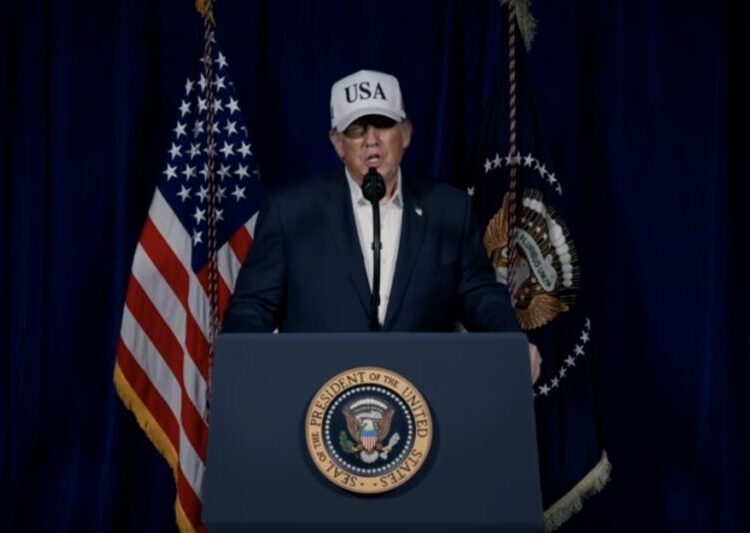
The president hoped that the air campaign, conducted with Israel, would weaken the Iranian regime, and that the people would rise up and “take over your government,” as he said in a video address on Truth Social in the early hours this morning “This will be probably your only chance for generations,” he added.
By day’s end in the Middle East, U.S. officials had concluded that the attacks had accomplished something historic, nearly five decades into the reign of the Islamic Republic’s ayatollahs: They had killed Iran’s Supreme Leader, Ali Khamenei. Khamenei’s compound had been a principal target of the attacks, and satellite images showed that little of it was left standing.
The attacks followed months of deliberation, but little attempt by the administration to sell the logic for striking Iran to the American public. Despite skepticism from some of his closest aides and advisers, Trump was persuaded that now was a rare and fleeting moment for regime change. Getting rid of the government that came to power in the 1979 Iranian Revolution is something Trump—and many others— would consider a crowning legacy achievement, one that had eluded his predecessors. In announcing Khamenei’s death, Trump called him “one of the most evil people in History.”
But even with the Supreme Leader gone, true regime change has not been fulfilled. Trump’s call with Cooper was a reminder of the high stakes and competing pressures that have shaped the president’s decision to launch the war, which is premised on what Iran experts say is an optimistic assessment about the likelihood that the Islamic Republic itself can be brought to an end.
In the days leading up to the attacks, some of Trump’s most senior advisers expressed reservations about the operation, including Vice President J. D. Vance, Chairman of the Joint Chiefs of Staff General Dan Caine, and senior Pentagon official Elbridge Colby. Caine in particular was unsure whether airstrikes alone would be enough to undermine the regime, and privately warned about how complicated any move against Iran would be, according to two U.S. officials, who were among those who spoke on the condition of anonymity about Trump’s decision-making and the debates within the administration.
Trump’s chief of staff, Susie Wiles, the architect of his political comeback in 2024, did not offer a personal position on the wisdom of the strikes, according to a person familiar with the conversations. But in an effort to make sure the president was fully informed, she did present the president with concerns about the unpredictable consequences of an attack. She also organized a conversation about the importance of following through on the promises he made during the campaign about avoiding new foreign wars. Republican midterm strategists, many of whom gathered in Florida for meetings this weekend, have grown anxious about Trump’s foreign military adventures turning off voters who want their leaders to focus on the economy.
A visit by the Omani foreign minister with Vance on Friday was a last-ditch effort to avert strikes and give more time for negotiations between Iran and the U.S., which Oman has mediated, officials said. This week’s talks in Geneva had made progress, but the U.S. side regarded them as relatively superficial because Iran was unwilling to agree to the Trump administration’s demands, which included destruction of Iran’s primary nuclear sites, delivery of all enriched uranium to the United States, and no sunset clauses for the agreement, among other provisions.
Trump’s lead negotiator, Special Envoy Steve Witkoff, believed further talks would be futile because the two sides couldn’t agree on a basic framework for discussions, one U.S. official told us. The Omani foreign minister later said publicly that he was “dismayed” the Americans had not allowed more time for negotiations.
One question looming over the attacks was whether regional U.S. allies, including Israel and the Gulf states, could withstand a retaliatory barrage of Iranian missiles before any civilian uprising takes place, the U.S. official added. Iran fired back at targets across the region today, but many of Iran’s missiles appear to have been intercepted and caused limited damage. One person in the United Arab Emirates was reportedly killed.
The prospects for a popular revolt in Iran seem dim, at least in the short-term. Former U.S. officials told us there is no obvious element within the Iranian regime that could take power and steer Iran toward a more U.S.-friendly approach, as occurred in Venezuela last month. The Iranian people are unarmed, so it’s not clear how they would mount a credible opposition to the security forces that have recently killed as many as 30,000 civilians, according to some estimates, after protesters took to the street starting in late December. The Islamic Revolutionary Guard Corps, one of Iran’s main power centers, has a decentralized hierarchy and has trained to maintain control in the face of strikes.
But Trump was persuaded that the odds of a successful popular revolt were not going to get better over time, so this was the best moment to strike. Israeli Prime Minister Benjamin Netanyahu urged him to act. Netanyahu, like other Trump advisers, including Senator Lindsey Graham, believed that if Khamenei were killed, along with Iran’s president, some of the people lower down in the IRGC who are not zealots but “mid-market businessmen” could be persuaded to work with the Americans, one U.S. official said.
History suggests that, in Iran’s case, that is probably an overly rosy prediction. But Trump was not deterred. The president’s own past success with a limited strike on Iran’s nuclear facilities last summer, as well as last month’s operation that removed Nicolás Maduro from power in Venezuela, may have convinced Trump that the U.S. military is “an almost biblical force that can accomplish anything,” one adviser told us.
The operation in Iran is far bigger and more complicated than anything the president has attempted in his two terms in office. The repercussions are just beginning. “I worry that the lesson he’s taken is he can do this, and that the blowback won’t be that bad,” Jonathan Panikoff, a former U.S. intelligence official and Middle East expert, told us.
Trump has long derided George W. Bush for, as Trump sees it, throwing away his presidency on a years-long war in Iraq, which was premised on eliminating weapons of mass destruction that the country didn’t actually possess. Now, Trump’s own legacy may be determined by his attempt to overthrow a more powerful Middle Eastern regime and stop it from building a nuclear weapon.
This is not the project Trump told his voters they were signing up for. “There’s a lot of concern about the impact on the political landscape for the midterms,” one former administration official told us. Like some of Trump’s other allies, the former official was perplexed why the president didn’t take the opportunity of his State of the Union address on Tuesday to tell the American people why war in Iran is in the nation’s interest and likely to succeed. Iran received only a relatively brief mention in the lengthy speech. “Why not use the State of the Union platform to try to make the real case?” the former official asked. Instead, Trump spent nearly two hours on “the bread-and-butter stuff” that might influence voters in the midterms. “And then days later, it’s this—it just feels off.”
Even as Trump spoke to the nation, he had apparently already made up his mind. He didn’t believe Tehran would make “meaningful long-term progress and the potential for them to have nuclear capacities is too much of a wild card,” the former official said, echoing the assessment of Trump officials involved in the negotiations.
But Trump never made a public case, as Bush did with Iraq, for why negotiating with Iran wasn’t going to yield results. Yesterday afternoon, hours before the first American bombs fell, the Omani foreign minister, Badr Albusaidi, said the U.S. and Iran were close to the “heart” of an agreement on Iran’s nuclear ambitions. Albusaidi told Margaret Brennan, host of CBS News’ Face the Nation, that “if the ultimate objective is to ensure forever that Iran cannot have a nuclear bomb, I think we have cracked that problem through these negotiations by agreeing a very important breakthrough that has never been achieved any time before.”
For years, the U.S. military rehearsed the strike plan carried out today, former defense officials told us. It was considered the “maximalist” option: after an initial bombardment of hundreds of targets, the decisive phase would come in the following few days.
At various points when officials weighed this “maximalist” option, military planners also projected what might happen further out, with the possibility that strikes may continue for weeks. They reasoned that if Iran responded with ballistic missiles—many of those missiles were already positioned for launch at U.S. and Israeli targets—the U.S. would strike launchers, storage sites, and transportation routes. Each Iranian missile launch would not only threaten U.S. bases and Israel but force Washington to expend costly and limited air-defense interceptors and risk an escalatory cycle of attacks.
Officials also anticipated the need to defend economic chokepoints. Within 12 hours of the opening strikes, Iran would move to close the Strait of Hormuz, the planners imagined, through which roughly one-fifth of the world’s oil flows.
But the planners concluded that military strikes alone would not produce regime change, which may help explain why Trump specifically called on Iranians to overthrow the government once the bombing campaign stopped. Now the question is how long the strikes will continue. The U.S. may have to sustain operations until alternative leadership emerges. But that risks exposing protesters to further brutality if the regime doesn’t collapse. Tehran has long prepared for such a challenge, and almost immediately shut down internet access, leaving state media as the primary source of information.
Stopping strikes too soon could leave the current regime intact and foreclose future nuclear negotiations. Continuing until the costs become unbearable—even for the existing leadership—might force Iran to negotiate from a position of weakness. “The next time we sit down with Iran, it must not be as equals,” one former defense official said. “It must be as victor and vanquished.” Achieving that outcome, planners believed, could require weeks of sustained attacks.
A prolonged campaign could also produce a failed state with enriched uranium, destabilize critical oil routes, threaten Gulf allies, trigger a refugee crisis, and disrupt the global economy. “The worst-case outcome is complete chaos,” Dana Stroul, former deputy assistant secretary of defense for the Middle East, told us, warning of regional spillover.
Trump has told confidants that he believes his legacy could be defined by his overthrow of the regimes in Venezuela, Iran, and, potentially, Cuba. He is drawn to the idea of redrawing global maps and doing what his predecessors, both Democrat and Republican, could not. But in his eight-minute address via Truth Social shortly after strikes began, Trump offered no timeline for how long the U.S. would wait for Iranians to overthrow their government. (He later said on Truth Social that the attacks could last for a week or more.) If the ayatollah-led regime does collapse, the Islamic Revolutionary Guard Corps would be best positioned to step in—and could prove even more hostile to Washington. Alternatively, the U.S. could redefine success mid-operation and declare victory after degrading Iran’s defenses. If Iranians haven’t risen up to seize control by then, that could be portrayed as their failing, not Trump’s.
Stroul outlined a more hopeful scenario: Opposition leaders emerge from prison to unify the country, assuming sustained strikes dismantle the regime’s religious and security apparatus. Such a prolonged campaign would run counter to the Trump administration’s recent pledge to pivot toward China and address threats in the Western Hemisphere. But the record of success in regime change initiatives is sparse, especially when the nation seeking a revolution chooses only to engage from a distance. Unlike the decision Bush made when he ordered the invasion of Iraq, no ground troops are expected to be deployed in Iran. Trump wants to avoid a quagmire. But even with the Supreme Leader dead—and with at least 150 aircraft and drones, more than a dozen destroyers, and two aircraft carriers at his disposal—he may find it difficult to achieve his ultimate goals.
The post “The Worst-Case Outcome Is Complete Chaos” appeared first on The Atlantic.