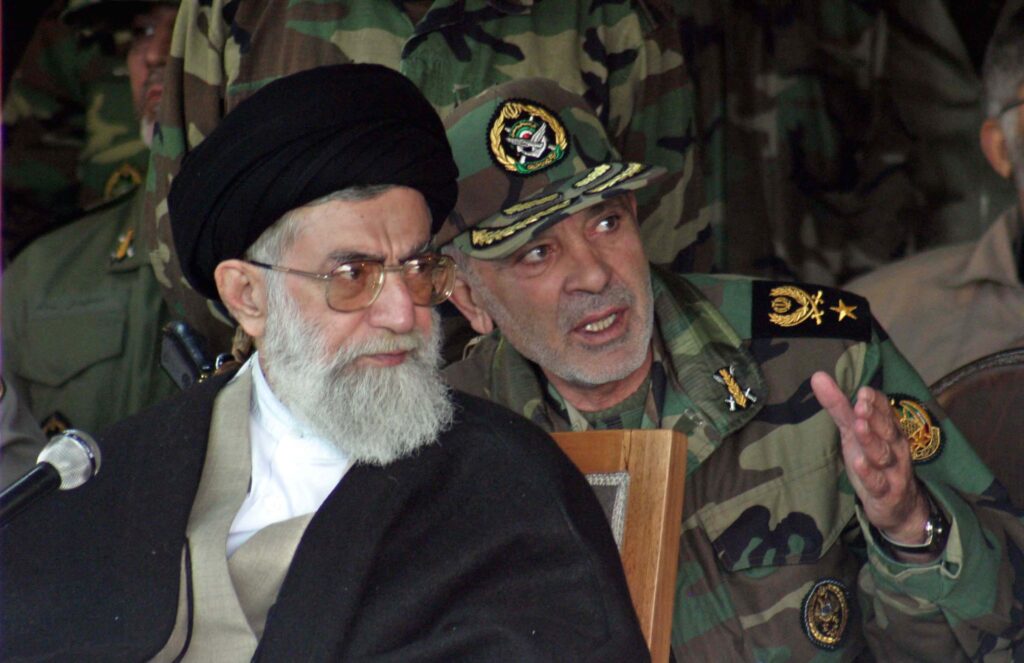
Ayatollah Ali Khamenei, the Shiite Muslim cleric who played a behind-the-scenes role in Iran’s Islamic revolution, served two terms as president in the 1980s and dominated the country for more than three decades as supreme leader, was killed Saturday as Israel and the United States launched a joint attack on Iran. He was 86.
President Donald Trump announced the death in a Truth Social post, calling the ayatollah “one of the most evil people in History.” He did not share additional details, but four Israeli security officials said Ayatollah Khamenei was killed in an Israeli airstrike at his compound in Tehran.
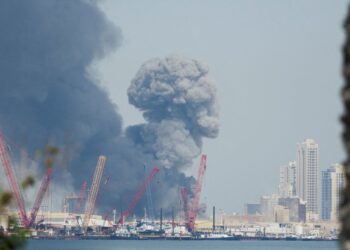
The strike came near the outset of a joint attack aimed at decimating Iran’s nuclear program and military and fueling a change in government. Black smoke billowed over the compound Saturday, although it was not immediately clear whether the supreme leader was there at the time. The strikes were aimed at top military and civilian leaders, including the ayatollah, Israeli sources said.
In announcing the attack, the second by Israeli and U.S. forces since June 2025, Trump publicly urged Iranians to “take over your government” once the operation ended. He had previously called on Iranians to rise up and pledged U.S. backing after widespread anti-government demonstrations broke out in December. Sparked by a severe economic crisis, the protests burgeoned into mass demonstrations against Iran’s entrenched theocratic system. Previously taboo chants of “Death to Khamenei!” were heard in street marches across the country.
Security forces responded by launching a bloody crackdown, killing more than 6,800 protesters and detaining tens of thousands. Ayatollah Khamenei blamed the carnage on Trump, denouncing him as a “criminal” who “openly encouraged” the protesters by promising U.S. military support.
An early follower of Ayatollah Ruhollah Khomeini, the austere cleric who inspired the revolution against Iran’s U.S.-backed monarchy, Ayatollah Khamenei staunchly opposed the United States and Israel, rejected Western “liberalism,” and adhered strictly to fundamentalist social policies.
As supreme leader of Iran since 1989 — when he succeeded Khomeini — Ayatollah Khamenei wielded ultimate political and religious authority in the Islamic republic, outranking the elected president and overseeing the country’s armed forces, internal security apparatus, judiciary, state media and foreign policy.
He had the final say on a landmark July 2015 nuclear accord with six world powers, including the United States, that restricted Iran’s nuclear program in exchange for the easing of crippling economic sanctions. Although deeply distrustful of U.S. motives, and despite the misgivings of fellow hard-liners, he ultimately endorsed the deal, and it was formally implemented in January 2016.
But he appeared to regret it after Trump pulled the United States out of the agreement in 2018 during his first term and reimposed harsh sanctions. (In retaliation, Iran began disregarding some provisions of the nuclear deal, notably limits on quantity and quality of its production of enriched uranium, but did not renounce its pledge never to acquire nuclear weapons.) Ayatollah Khamenei was especially incensed by the Trump-ordered killing of a top Iranian commander, Qasem Soleimani, in a U.S. drone strike in Iraq in January 2020. He called the killing “a cowardly act,” denounced Trump as a “clown” and rejected the U.S. president’s calls for new talks, which he said were intended only to boost Trump’s reelection bid.
After Trump lost the 2020 election, Ayatollah Khamenei said its chaotic aftermath, marked by Trump’s baseless fraud claims, illustrated “the ugly face of liberal democracy” in the United States and made clear the country’s “definite political, civil [and] moral decline.”
When Iran was convulsed by widespread protests after the September 2022 death in custody of a young woman who was arrested by Islamic “morality police” for a dress-code violation, the supreme leader publicly blamed the United States and Israel and backed a deadly crackdown. How, he wondered, could some people “not see the foreign hand” behind the “rioting.”
With his bushy white beard and easy smile, Ayatollah Khamenei cut a more avuncular figure in public than his perpetually scowling but much more revered mentor, and he was known to be fond of Persian poetry and classic Western novels, especially Victor Hugo’s “Les Misérables.” But like the uncompromising Khomeini, he opposed moderates’ efforts to promote political and social reforms domestically and to secure rapprochement with the United States.
Some Iranians who knew Ayatollah Khamenei before he became supreme leader described him as a “closet moderate,” Karim Sadjadpour, a leading researcher on Iran with the Carnegie Endowment for International Peace, wrote in a 2008 study. Others, however, took him at face value, Sadjadpour said: “a deeply religious, ideologically rigid, anti-American cleric whose politics are stuck in the anti-imperialist euphoria of the 1979 revolution.”
In the third decade of his rule, Iran became increasingly repressive, especially after security forces crushed demonstrations against the disputed 2009 reelection of President Mahmoud Ahmadinejad.
Ayatollah Khamenei’s image as “an impartial and magnanimous guide” unraveled, exposing him as “a petty, partisan autocrat” dependent far more on his intelligence, security and military apparatus than on the Muslim clergy, Sadjadpour wrote.
Ayatollah Khamenei first came to prominence as a strong supporter of the militants who seized the U.S. Embassy in Tehran in November 1979 and held 52 Americans hostage for more than 14 months. He was seriously injured in a 1981 assassination attempt but went on to win the first of two terms as Iran’s president less than four months later, becoming the first cleric to hold that post.
Ayatollah Khamenei embraced nuclear energy while insisting that Iran would not seek nuclear weapons, which he declared to be forbidden by Islam. But he adamantly refused to give up Iran’s uranium-enrichment program, which he regarded as a hallmark of scientific prowess, independence and national pride.
The July 2015 nuclear accord allowed Iran to continue enriching uranium, but at a sharply reduced level.
Arrests, torture under the shah
Ali Khamenei was born July 17, 1939, in the northeastern Iranian city of Mashhad, where his father was a Shiite cleric of humble means. He was the second of eight children, and he and his family “had a difficult life,” sometimes with little to eat but bread and raisins, he said in a biography published on his website.
He was sent to Islamic schools from an early age, and in his late teens, he briefly studied in Najaf, a Shiite shrine city and center of learning in neighboring Iraq. He then went to the Shiite holy city of Qom, about 90 miles south of Tehran, where he studied for six years under Khomeini. But he had to cut short his training at Qom’s renowned Islamic seminary in 1964 to return to Mashhad to care for his ailing father, a decision he later said accounted for his failure to attain the highest credentials of Islamic scholarship.
He did, however, learn Arabic, becoming proficient enough to translate several Arabic books into Farsi over the years. They included works of the Egyptian Islamist Sayyid Qutb, an intensely anti-American theorist of Islamic holy war whose writings have also influenced leaders of al-Qaeda.
In the spring of 1963, Khomeini ignited protests against Mohammad Reza Pahlavi, the U.S.-backed shah, that were violently put down by security forces. Ayatollah Khamenei was arrested by the shah’s secret police, known as SAVAK, and “spent 10 days under severe torture,” according to his official biography. In late 1964, his mentor Khomeini was expelled from Iran and spent more than 14 years in exile, most of it in Najaf.
Between 1963 and 1976, Ayatollah Khamenei was arrested seven times and spent a total of three years in prison before being sentenced to a sort of internal exile in Iranshahr in the far southeastern corner of the country.
With the Islamic revolution underway, he returned to Mashhad and took part in street battles that preceded the shah’s departure into exile on Jan. 16, 1979, and Khomeini’s triumphant return to Tehran on Feb. 1. Khomeini named Ayatollah Khamenei to a newly formed Islamic Revolutionary Council, a shadowy group that was instrumental in running the country after the last vestiges of the shah’s regime collapsed on Feb. 11, 1979.
Then a mid-level Shiite cleric, Ayatollah Khamenei won a seat in the Iranian parliament in 1980 as a member of the Islamic Republican Party, which he helped found, and was appointed by Khomeini to the key post of Friday prayers leader in the capital.
He delivered weekly sermons before large crowds, usually with a rifle in his hands, and built a following as he used his oratorical skills to rail against the Islamic revolution’s perceived enemies, notably the United States, “the Great Satan.”
During this period, he also served briefly as a deputy defense minister and supervisor of the Islamic Revolutionary Guard Corps, a military force fiercely loyal to the supreme leader.
Ayatollah Khamenei narrowly escaped death in June 1981 when a bomb concealed in a tape recorder exploded next to him as he addressed a crowd at a Tehran mosque. Severely injured, he lost the use of his right arm and suffered damage to his vocal cords. The assassination attempt was blamed on the Mujahideen-e Khalq, an Iranian militant group that killed President Mohammed Ali Rajai and four other top officials in another bombing two months later.
Path to the presidency
The ruling party then prevailed on Ayatollah Khamenei to run for president in an October 1981 special election, which he won in a landslide with 95 percent of the vote. He declared in his inaugural address that his victory represented a vote for Islam, for the clergy, for independence and “for stamping out deviation, liberalism and American-influenced leftists.”
As president — he was reelected in November 1985 — Ayatollah Khamenei helped guide the country through the brutal Iran-Iraq war of the 1980s. He traveled abroad during that period, flying to Syria to sign a secret economic and military pact, embarking on a six-nation tour of Africa, addressing the U.N. General Assembly in New York and visiting North Korea.
He upset his hosts during a visit to Zimbabwe when he refused to attend a state banquet in his honor because women were at the head table and wine was being served.
Shortly before Khomeini died in June 1989 at age 86 of complications from intestinal surgery, a falling-out with the supreme leader’s designated successor, Grand Ayatollah Hossein Ali Montazeri, came to a head. (Montazeri, who died in 2009, infuriated Khomeini by denouncing the mass execution of political prisoners, calling for “political and ideological reconstruction” and criticizing a Khomeini edict that ordered Muslims to kill author Salman Rushdie for blasphemy.) As a result, Khomeini had the 1979 constitution revised so that a cleric with lower religious credentials could succeed him.
Instead of requiring that the supreme leader be a “marja-e taqlid,” or “source of emulation,” a theological rank associated with grand ayatollahs in Shiite Islam, the revised charter said only that he must be an expert in Islamic jurisprudence and possess “the appropriate political and managerial skills.”
That opened the door for Ayatollah Khamenei, who was suddenly elevated to ayatollah from the mid-level “hojatoleslam” rank he held during his presidency. The day after Khomeini’s death, Iran’s Assembly of Experts, made up of Islamic scholars, elected Ayatollah Khamenei as supreme leader, making him the nation’s preeminent religious and political authority.
In his first speech in the post, he struck a self-deprecatory tone, calling himself a man “with many faults and shortcomings and truly a minor seminarian.” He said later in his biography that he accepted the position reluctantly.
“I always considered my level too low to accept not only this highly significant and crucial post but also much lower posts like the presidency,” Ayatollah Khamenei said. “Even now, I consider myself as a common religious student without any outstanding feature or special advantage.”
A conspiracy-ridden worldview
As supreme leader, Ayatollah Khamenei was responsible for appointing the commanders of the armed forces, including the powerful Revolutionary Guard Corps, as well as the nation’s supreme judicial authority, the director of the state radio and television network, prayer leaders in Iranian cities and — directly and indirectly — the 12 members of the Guardian Council, a top supervisory body that vets candidates for public office and approves legislation.
In international affairs, Ayatollah Khamenei was the driving force behind Tehran’s defiance of demands by major world powers that it halt its uranium-enrichment program. The government insisted that the program’s purpose was only to supply fuel for nuclear power plants and a medical research reactor. But the United States and its allies suspected that it was secretly intended to provide an option to produce fissile material for nuclear weapons.
The dispute epitomized Ayatollah Khamenei’s grievances against the United States and his conspiracy-ridden worldview in which concerns about nuclear proliferation were merely a “pretext” to prevent Iran from achieving scientific advances and real energy independence.
In the hands of Western countries, “knowledge has turned into a means for bullying,” Ayatollah Khamenei told a gathering of Iranian nuclear scientists in February 2012. “They know that we are not after nuclear weapons. … They know this, but they stress the issue in order to stop our movement.”
He maintained that stand after the nuclear agreement was announced, dismissing U.S. assertions that the deal — rather than his own policies — blocked Iran’s path to nuclear arms.
“Years ago, we issued a fatwa, based on Islamic teachings, forbidding the production of nuclear weapons,” Ayatollah Khamenei said in a July 18, 2015, sermon. But Americans “keep lying in their propaganda … and claim that their threat has blocked the production of [a] nuclear weapon by Iran.”
In the same speech, Ayatollah Khamenei said Iran would never stop supporting its allies in the Middle East, including groups labeled terrorists by Washington. He also vowed there would be “no negotiations with America,” apart from the nuclear talks. And he blamed the United States for Sunni-Shiite divisions in the Islamic world, saying that it had “launched such criminal organizations as al-Qaeda and Daesh [the Arabic acronym for the Islamic State, or ISIS] in order to deflect the attention of Islamic nations from the Zionist regime.”
Although implacably hostile to Israel, which he repeatedly described as a “cancerous tumor” in the Middle East, Ayatollah Khamenei insisted that Iran did not seek to destroy the Jewish state militarily, much less annihilate it with a nuclear weapon. Rather, he said, Iran sought the dissolution of Israel and its replacement by a Palestinian state through a “popular referendum.”
But under his leadership, Iran stepped up support for the radical Shiite Hezbollah militia in Lebanon and the Palestinian Islamist group Hamas in the Gaza Strip, apparently in hopes of eventually fomenting a popular uprising that would lead to the collapse of the Israeli government in much the same way that the shah’s regime had crumbled in 1979.
Ayatollah Khamenei shunned foreign travel as supreme leader, declined to meet with representatives of Western powers and rarely passed up an opportunity to express his contempt for the United States, which he routinely described as “the global arrogance” and “the devil incarnate.”
In an October 2008 speech to students, he declared that “the Iranian people’s hatred for America is profound,” ascribing this hostility to “the various plots that the U.S. government has concocted against Iran and the Iranian people in the past 50 years.” He further warned that “anyone who wished to trample the identity and independence of the Iranian nation would have his hand cut off by it.”
He rebuffed overtures from President Barack Obama, including at least two private letters, and he rejected any bilateral negotiations while the United States was “holding a gun” to Iran’s head.
On the domestic front, Khamenei intervened decisively in the dispute over the 2009 reelection of Ahmadinejad, rejecting opposition candidates’ charges of massive electoral fraud, banning protests and resisting calls for a more open society.
When Hassan Rouhani, a relatively moderate Shiite cleric, was elected president in 2013, Ayatollah Khamenei backed his efforts to revive the Iranian economy by negotiating an end to nuclear-related sanctions, even as he sought to assuage skeptical hard-liners. The July 2014 arrestof Washington Post correspondent Jason Rezaian and his subsequent trial on espionage charges reportedly reflected those internal rivalries. Rezaian was freed 18 months later as part of a prisoner deal linked to the Iran nuclear agreement.
Ayatollah Khamenei had six children with his wife, Khojasteh, whom he wed in an arranged marriage in 1964, when she was 17. Information on survivors was not immediately available, but their son Mojtaba, a hard-line cleric who was born in 1969, was said to play a key role in the Basij, a paramilitary force loyal to the supreme leader that has been used to quell protests.
The ayatollah’s siblings included an estranged younger brother, Hadi Khamenei, a reformist cleric who ran afoul of the establishment. He was brutally beaten by Basij members in 1999 after giving a sermon criticizing the supreme leader’s powers.
The post Ayatollah Ali Khamenei, Iran’s supreme leader, is dead at 86 appeared first on Washington Post.