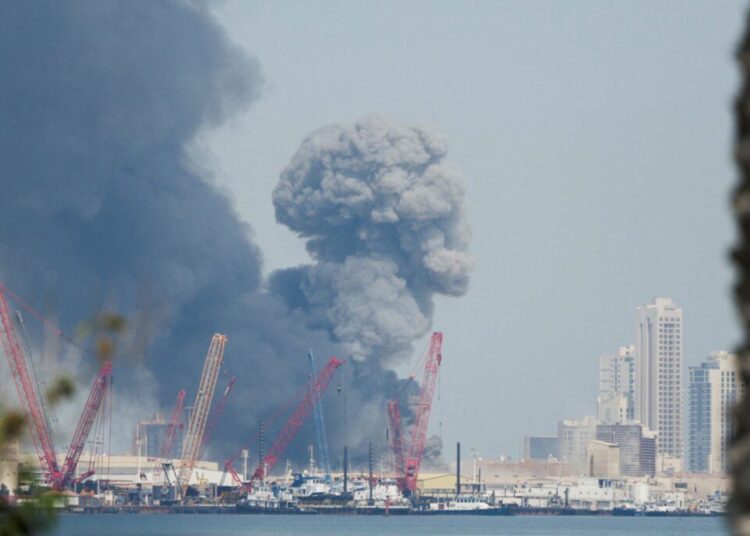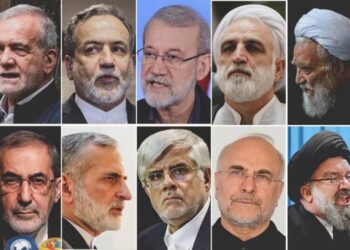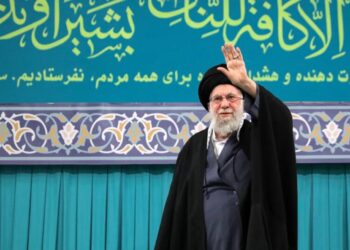
Bombs are falling on Iran. The apparent goals of the strikes that began on Saturday, as pronounced by President Trump, are to overturn the regime, destroy its military and end its nuclear capability. But we have seen enough wars to know that even if the United States and Israel, which joined the attack, achieve those stated objectives, Iranians are unlikely to experience peace and stability in the immediate aftermath.
In a videotaped message, Mr. Trump said to Iranians that the “hour of your freedom is at hand,” and that when the United States is done, the government will be “yours to take.” The outlook for Iran to emerge as a freer society — and a more viable place for tens of millions of Iranians to live — is not good.
What will result from the military campaign is difficult to predict. History, however, offers some guidance. We have a well-documented record of what happens to the invaded countries following military campaigns, and we can draw lessons from them.
In 2019, the RAND Corporation published a comprehensive study that examined hundreds of instances of American military intervention around the world. The authors identified three major factors that determine whether an invaded nation ends up better off as a result.
The first was the pre-existing level of ethnic and religious tension. This was an undeniable factor in Iraq’s descent into chaos after the American invasion, and its absence helped Japan restore social cohesion after World War II. Compared with most Middle Eastern countries, Iran has long been a relatively cohesive society, thanks in part to borders that have remained more or less stable for centuries. But 47 years of state violence against ethnic and religious minorities by the Islamic Republic has awakened long-dormant fault lines, significantly raising the specter of sectarian bloodshed in the chaotic aftermath of an invasion.
Next came the existence of reliable political institutions, especially functioning government agencies capable of stabilizing the country or coordinating humanitarian relief in times of war. In Iran, rampant corruption, the systematic hollowing out of democratic institutions and deep popular distrust of the political elite have rendered those structures largely ineffective.
Finally, economic strength. Iran’s economy today is notoriously fragile. Inflation rose above 70 percent. The currency lost 84 percent of its value in 2025 alone. It is all compounded by a worsening environmental crisis. By all measures, the Iranian economy is on the edge of disaster.
The authors of the RAND report contrasted examples of intervention in places like Germany and Japan against intervention in Libya, Iraq and Syria to illustrate how these factors shaped the eventual outcomes. Iran today could well fall into the second group, which saw chaos, strife and a breakdown of civic structures in the aftermath of U.S. military action. Mr. Trump may well succeed in eliminating key military and political figures at the top of the regime, declare victory and blame the ensuing chaos on Iranians who squander their hour of freedom. He will likely move on to the next item on his agenda, and Iranians will be left to survive in a devastated country.
My pessimistic view of military intervention in Iran, however, should not be mistaken for opposition to all forms of foreign intervention.
Some estimates suggest that the regime may have killed tens of thousands of unarmed civilians in the span of two days during demonstrations in January, and the violence is far from over. Tens of thousands more civilians, many of them children, were arrested during and after those days. Many face lengthy prison sentences. Some face execution.
This violence is not so much a deviation from the foundational norms of the Islamic Republic as a return to them. In the 1980s, when the regime faced existential threats, it responded with a similar iron fist. In 1981, after the ousting of President Abolhassan Banisadr, his supporters and those of the leader of Mujahedeen Khalq, Massoud Rajavi, protested; the regime suppressed them violently, later executing 3,500 people. Toward the end of Ayatollah Ruhollah Khomeini’s life, as the leadership grappled with the question of succession and feared the threat posed by dissident political groups, many of whose influential members were imprisoned at the time, authorities executed as many as 5,000 political prisoners. For almost half a century, Iran’s leaders have responded to threats to their survival by meting out extreme violence against the Iranian people. Should they survive this war, it is unlikely to be any different.
As ordinary citizens, the decision to start or end a war of this magnitude lies beyond our control, and recent history from Iraq to Gaza suggests that in such moments street protests and online posturing do next to nothing to influence decision makers in Washington and elsewhere.
In the face of such despair, Iranians and the world must make the well-being and safety of the Iranian people a priority over ideology, and take collective, concrete steps toward that goal.
Perhaps most urgent is finding a way to keep Iranians connected to the internet. During the recent uprisings, a blackout proved deadly. Stemming the flow of information made it next to impossible for people to organize and coordinate across neighborhoods. In times of war, when community support can mean the difference between life and death and people need to find one another to coordinate and commiserate, maintaining open lines of communication is even more vital.
The technology to circumvent these blackouts exists. Other than use of the satellite network Starlink, advocacy campaigns like Direct2Cell are working to scale and refine communication technologies. Supporting such efforts by donation and applying political pressure to relax the regulations on the operation is far more meaningful than Instagram-tailored expressions of solidarity that no one inside Iran can see.
Opposition parties and groups in exile should organize campaigns of return, in the spirit of what the Palestinian diaspora has carried out. At least four million Iranians live abroad, many driven from their homeland for reasons as absurd as mildly insulting the supreme leader or organizing a student protest. As soon as the bombing stops, we should organize campaigns for exiles to return.
Many exiled Iranians are highly skilled doctors, engineers and other professionals who, in the absence of functioning government agencies, could play a crucial role in stabilizing the country and alleviating suffering. Their return would also make it more difficult for the regime’s surviving security apparatus to reconsolidate its grip on power and carry out arrests and executions. It will also be a great opportunity for the Iranian diaspora, itself divided by algorithm-driven rage and infighting, to find real purpose and make meaningful contributions to our country.
No matter what outcome this war yields, nations must support a global campaign to swiftly lift economic sanctions, which severed Iran from the global economy. The stated intention was to target the regime. But the sanctions net cast over the country always had a gaping hole, controlled by the Revolutionary Guards Corps. Through it, a shadow fleet exports oil and other goods to China and elsewhere. It has used the proceeds to keep its mercenaries paid and fed while forming an oligarchy that pockets significant portions of the revenue and invests it abroad.
The sanctions have not so much weakened the regime as entrenched it further, and they will continue to do so if it somehow remains in power. Lifting them would at least help alleviate the destructive effects of this new war on ordinary Iranians, who will inevitably bear the brunt of it, and assist in rebuilding the critical infrastructure likely to be damaged in the days ahead.
Whatever the outcome of the strikes, sitting back and passively watching the state actors react should not be an option. We need a new form of internationalism: grass-roots activism focused on transnational coordination. Ordinary people must have more of a say in global affairs. Iran is as good a place as any to start.
Amir Ahmadi Arian is an Iranian American writer and journalist. He is an assistant professor of creative writing at the State University of New York, Binghamton.
The Times is committed to publishing a diversity of letters to the editor. We’d like to hear what you think about this or any of our articles. Here are some tips. And here’s our email: [email protected].
Follow the New York Times Opinion section on Facebook, Instagram, TikTok, Bluesky, WhatsApp and Threads.
The post How Iranians Can Take Control of Their Future appeared first on New York Times.