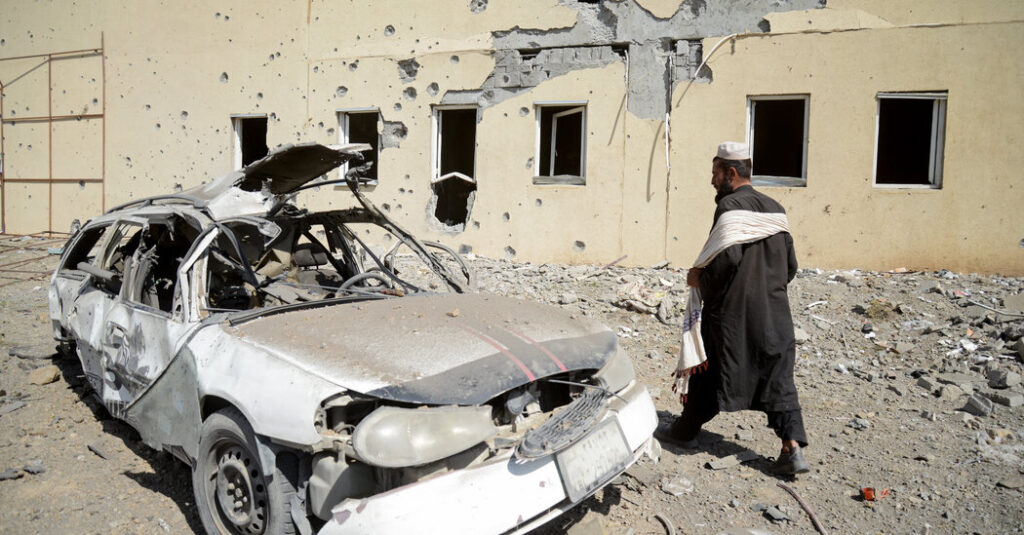
Once again, Afghanistan is fighting a mightier enemy.
After Pakistan declared “open war” on the Taliban government on Friday, two armed forces with wide gaps in weaponry and tactics between them now face each other along a roughly 1,600-mile-long border.
Pakistan has one of the largest militaries in Asia, emboldened by its successes in a conflict with India last year. The Taliban in Afghanistan have honed guerrilla tactics over more than two decades of war with U.S. forces, which abandoned billions of dollars worth of weapons in 2021.
The latest phase of the conflict, which started with border skirmishes last year, is expected to continue flaring up and may escalate. Additional airstrikes threaten to inflict major damage on cities in Afghanistan, which is already reeling from extreme poverty and a humanitarian crisis. Militant groups supporting the Taliban are likely to target deeper in Pakistan’s territory with more attacks, including suicide bombings and assaults on security forces, analysts say.
The Pakistani military carried out a barrage of airstrikes on Afghan military infrastructure on Friday, after accusing the Taliban government of hosting and supporting a militant group that has repeatedly attacked Pakistan’s security forces.
“Pakistan wants to take the war to Afghanistan and no longer in Pakistan,” said Qamar Cheema, the executive director of the Sanober Institute, a research organization based in Islamabad, Pakistan’s capital.
The strikes this week did not target major infrastructure to leave room for escalation, Mr. Cheema noted.
“The Pakistani military knows where to hit and hurt the Taliban the most,” he said.
Pakistan’s military and security apparatus supported the Taliban for decades, including by providing a refuge for the group’s leadership during the U.S.-led war in Afghanistan and supplying the insurgency with weapons.
Its government initially welcomed the Taliban’s return to power in 2021, but the relationship soured shortly after Tehreek-e-Taliban Pakistan, an Islamist militant group that opposes the Pakistani state, intensified its attacks across the border. Pakistan accuses the Taliban government of harboring the group, which is also known as the Pakistani Taliban.
On Friday, the relationship between the two countries reached its lowest point in years.
“Now it is open war between us and you,” Pakistan’s defense minister, Khawaja Asif, said Friday in a post on social media. The comment was a sharp turn from the public support he had once displayed toward Taliban officials.
The Afghan Ministry of Defense says it has 205,000 men in its armed forces. An additional 223,000 men are in the Afghan police, according to the Interior Ministry, though analysts say those figures are difficult to verify.
The Taliban have also inherited Black Hawk helicopters, Humvee vehicles and thousands of weapons from the war against the United States — worth more than $7 billion in total, according to the Department of Defense. Afghan soldiers in the capital, Kabul, and across the country can regularly be seen with M16 and AR-15 rifles, and markets there sell U.S. military uniforms and spare parts for night vision goggles.
Many of those weapons have ended up in the hands of insurgent groups like the Pakistani Taliban.
“The Taliban have definitely capitalized on the stocks of U.S. weapons, but they don’t have the logistical and maintenance capacity,” said Paddy Ginn, a senior expert on Afghanistan at the Global Initiative Against Transnational Organized Crime.
The Afghan military would struggle to hit major Pakistani military bases, Mr. Ginn added.
“Afghanistan has a fledgling air force made of helicopters and drones they’ve weaponized,” he said. “Pakistan is pretty impressive in its air defense counter drones and airstrike capabilities.”
Still, the Taliban fighters who now make up the bulk of the Afghan military have repeatedly broken through Pakistani territory through lethal ground incursions. They struck more than 50 locations on Friday in coordinated attacks, which the Afghan government said were in retaliation for Pakistani strikes earlier in the week.
“The Taliban mastered the art of taking out isolated military checkpoints when they were fighting internationally backed Afghan troops,” said Ibraheem Bahiss, an Afghanistan analyst with the International Crisis Group.
“They’re trying to rely on their tried and tested methods because they don’t have a lot of other options,” he added.
Afghan officials have called for dialogue, and analysts on both sides of the border say the region cannot sustain more volatility.
“It’s tit for tat, and it has to end,” said Abdul Hai Qanit, an expert on international relations who is based in Kabul. “It’s in no one’s interest to have more instability in the region, especially with the conflict now unfolding in Iran.”
Pakistan has refused the call for talks. Although the Taliban publicly deny hosting the Pakistani Taliban, Islamabad says it has run out of patience with the Taliban leadership after several rounds of failed peace negotiations and relentless attacks.
The Pakistani Taliban have killed more than 1,300 people in over 800 attacks since 2021, according to the Pak Institute for Peace Studies, a research center based in Islamabad.
Pakistani aircraft hit military compounds in Kabul and Kandahar — home to Afghanistan’s supreme leader, Sheikh Haibatullah Akhundzada — on Friday as well as various other military facilities and arms depots near the Pakistani border in eastern Afghanistan.
The Pakistani military claims to have destroyed 135 Afghan tanks and carrier vehicles and killed more than 330 Afghan fighters in a single day, although it made no distinction between Afghan soldiers and Pakistani Taliban militants.
Pakistan also struck areas that were full of civilians, according to humanitarian organizations and Afghan officials. They added that it targeted at least two camps hosting Afghans who were recently expelled from Pakistan. Returnees evacuated one of the camps; three Afghan civilians were killed and seven others wounded in a strike near the other camp in southeastern Afghanistan on Saturday, Afghan officials said.
The camps are run by U.N. agencies and international and Afghan organizations.
Allison Hooker, the U.S. under secretary of state for political affairs, said on Friday that she had called Pakistan’s foreign minister and “expressed support for Pakistan’s right to defend itself against Taliban attacks.”
After Pakistan’s airstrikes in Afghanistan, the Pakistani Taliban and two other Islamist militant groups urged their fighters to intensify attacks in Pakistan’s two most populous provinces, Punjab and Sindh, which have largely been spared the brunt of Pakistani Taliban’s assaults.
The attacks would aim to “weaken the enemy” and show solidarity with Afghans, the groups said in statements. The Pakistani Taliban have about 6,000 fighters, according to the United Nations.
The Pakistani government has tightened security nationwide, and the U.S. embassy in Islamabad has advised Americans in Pakistan to avoid large commercial areas.
“A blowback will come,” said Mansoor Ahmad Khan, a former Pakistani ambassador to Afghanistan. “That is the nature of war.”
Pakistan should leave the door open for de-escalation, he added.
“The Afghan Taliban have suffered heavy damage as a result of Pakistani strikes, no doubt,” Mr. Khan said. “But an expansion of the war is not in Pakistan’s interest. Nor is it in Afghanistan’s.”
Zia ur-Rehman and Salman Masood contributed reporting from Islamabad, Christiaan Triebert from New York, Safiullah Padshah and Yaqoob Akbary from Kabul, and Omar Ataullah from Kandahar.
Elian Peltier is The Times’s bureau chief for Pakistan and Afghanistan, based in Islamabad.
The post No Clear Endgame in the Conflict Between Afghanistan and Pakistan appeared first on New York Times.