The theory at the heart of the QAnon conspiracy theory was simple, even if the details were not: A global cabal of elites was running a child sex-trafficking ring.
The latest release of files about Jeffrey Epstein has the QAnon faithful crowing that they were right. The documents revealed that a global group of prominent business and political figures had close personal relationships with a convicted sex offender, and raised questions about how much those people knew about, or participated in, Mr. Epstein’s crimes.
Never mind that those relationships did not seem to prove a widespread deep-state scheme centered on pedophilia. Never mind that the files do not seem to back up other outlandish claims — such as beliefs about cannibalism, cloning or devil worship — in the QAnon canon.
For adherents, there is enough to make them feel vindicated. The drop, experts said, is legitimizing the vein of paranoid thinking that is increasingly prevalent in American politics and, in some cases, further cementing support among QAnon sympathizers for President Trump.
“People like me and MANY others, have known this for almost a DECADE,” trumpeted one Facebook user in a post. “It’s time to admit we were right,” a user on a QAnon channel declared on Telegram. The QAnon faithful gloated online by posting memes, like clips of John Travolta’s confident strut in “Saturday Night Fever” and heavy-metal riffs titled “Q Was Right” with the repeating lyric “wake up.”
Even some who doubted QAnon acknowledged that there might have been some truth to its ideas. Many of the QAnon faithful celebrated an apology of sorts from Bill Maher, the left-leaning commentator with a show on HBO, who said this month about sexual perversion among elites: “I’m big enough to say, QAnon, you were more right about this than I admitted, and than lots of other people admitted.”
“It’s terrible to be right about many of these things,” said Marjorie Taylor Greene, a former congresswoman from Georgia, in a recent interview on YouTube that addressed sex crimes among powerful people and Mr. Epstein’s influence in high society. Ms. Greene was once a vocal QAnon supporter but distanced herself in 2021, saying then she was “allowed to believe things that weren’t true.”
In an emailed statement, a spokeswoman for the White House wrote that Mr. Trump was “totally exonerated on anything relating to Epstein.” Ms. Greene did not respond to a request for comment.
The millions of files posted last month about Mr. Epstein chronicle his efforts to surround himself with young women and solicit sex from them. He was charged in 2019 with running a sex-trafficking operation in the early 2000s that brought dozens of girls as young as 14 to his opulent Upper East Side home. He was found dead in his jail cell that year, and his death was ruled a suicide.
The documents also show Mr. Epstein’s ties to powerful people including a former prince, billionaire businessmen, top officials from multiple White House administrations and academic leaders.
The files do not address many common QAnon assertions. Many prominent figures facing backlash for their proximity to Mr. Epstein were not documented as having supported sex trafficking, but rather as having socialized or dealt financially with him, or shared lewd remarks about women.
So the movement is adjusting its expectations and blind spots to fit the current reality, moving goal posts whenever certain wild predictions fail to happen, as it has frequently done in the past, according to longtime experts.
“Nothing is ever going to validate QAnon,” said Russell Muirhead, a politics professor and conspiracy theory expert at Dartmouth College.
He added, though, that the Epstein files can help make sense of QAnon and other conspiracy theories “as allegorical stories about an elite class that has lost touch with common-sense morality, that regards human beings as things to be used in whatever way is convenient.”
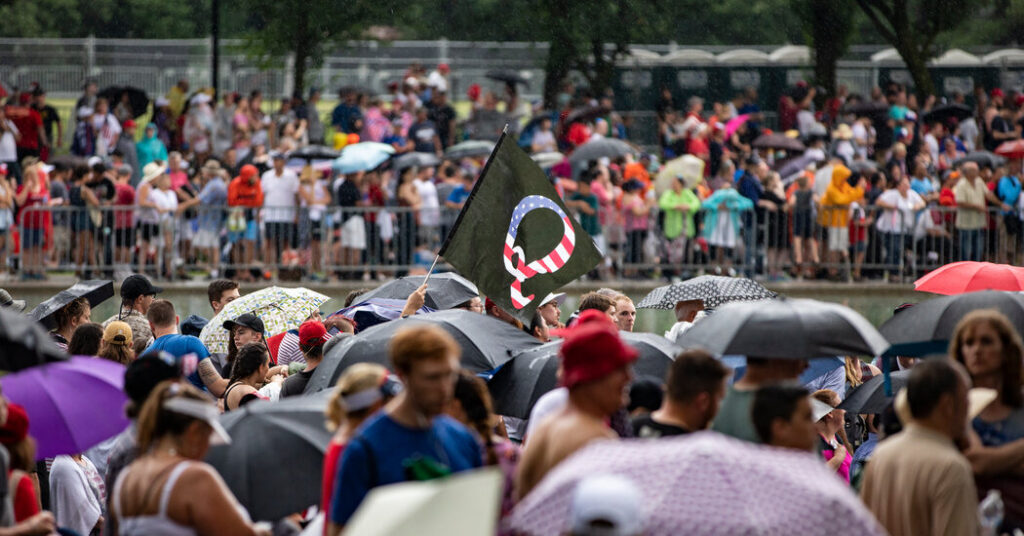
The QAnon movement emerged from the dark corners of the internet in 2017, spawned from cryptic posts attributed to a mysterious figure called Q. At one point, millions of Americans — including many politicians — believed its overarching theories, according to some estimates, though its popularity has faded greatly since 2020. Q hasn’t posted online since 2022.
Now, its adherents are using the massive trove of documents to reignite interest in their theories.
They are resurfacing, for example, a debunked theory from 2016, known as Pizzagate, which suggested that political figures used “pizza” as a code word for abusing children. It also suggested Democrats in Washington were running a child sex-trafficking ring out of the basement of a pizza restaurant.
The newest Epstein files do show the financier and his associates repeatedly discussing “pizza” and other food and drink, sometimes in ways that seem coded. Those documents — which include unverified and fake content, according to the Justice Department — have fueled new conspiratorial thinking, distorting the available evidence and pushing online speculation far beyond what the documents have proved. The files led Tucker Carlson, the conservative pundit, to declare on social media that “it looks like Pizzagate is basically real.”
But the new Epstein files do not appear to explain why Mr. Epstein referred so often to pizza. They do not include any suggestion of a Democrat-led child sex-trafficking ring. The pizza restaurant in question does not have a basement.
“It fits the pattern of conspiratorial thinking, where if you have a conclusion that you already hold on to, anything else can be confirmatory evidence,” said Yini Zhang, an assistant professor at the University at Buffalo who studies social media and emerging communication technologies.
QAnon’s shifting standards are showcased clearly in its relationship with Mr. Trump. In QAnon lore, the president is a nearly messianic figure who was thrust into the political arena to round up and arrest elites involved in satanic, pedophilic activity.
In reality, he has been criticized during his second term for stalling or preventing the release of documents that critics speculate might implicate him or powerful people in his orbit. He has dismissed the inquiry as a Democratic “hoax.” In December, his administration missed a congressionally mandated deadline to release all of its files on Mr. Epstein. Mr. Trump, his properties, his associates and related terms were referred to more than 38,000 times in the files, according to a review by The New York Times.
Now, however, many in the movement have found ways to excuse Mr. Trump’s actions in what experts described as examples of cognitive dissonance or selective memory. Worries that the president was working with the deep state have evolved in recent weeks into a conviction that the documents fully absolve him and expose his enemies.
“Essentially, they’re tying themselves in knots to absolve Trump and play down the idea that Epstein ever really mattered — while still claiming they’re trying to stop trafficking and save children,” said Mike Rothschild, a journalist and expert on conspiracy theories. “We’ve gone from Epstein being the center of a vast interlocking ring of satanic child traffickers to Epstein being a bad guy who Trump exposed, so let’s stop talking about it.”
Tiffany Hsu reports on the information ecosystem, including foreign influence, political speech and disinformation
The post QAnon Faithful See Validation in the Epstein Files appeared first on New York Times.