It was last March.
A graduate student at Columbia University had been detained by immigration enforcement agents in the lobby of his university-owned apartment building. Within 24 hours, the arrest — done without a warrant — became a national story and drew widespread outrage.
But Columbia’s reaction to the detention of the student, Mahmoud Khalil, was restrained.
“There have been reports of ICE around campus,” the university wrote in an unsigned public statement one day after Mr. Khalil’s arrest. “Columbia has and will continue to follow the law.”
Nearly one year later, the university landed on a far different approach after Elmina Aghayeva, a 29-year-old senior from Azerbaijan, was taken by Immigration and Customs Enforcement agents from her university-owned apartment on Thursday.
Before the morning was over, Columbia had sounded the alarm to the campus in an urgent letter. The university’s leaders began dialing up influential elected officials to raise concern. And its acting president, Claire Shipman, later denounced the behavior and conduct of federal agents.
“This was a frightening and fast-moving situation and utterly unacceptable for our students and staff,” she said in a recorded address Thursday night, describing in detail how immigration officers had asked for entry into the building to search for a missing child.
“Let me be clear — misrepresenting identity and other facts to gain access to a residential building is a breach of protocol.”
In the worlds of academia and law, some observers who have closely followed the university’s posture in recent years immediately noticed the shift.
“The response was quite different,” said Michael Thaddeus, a mathematics professor and vice president of the Columbia chapter of the American Association of University Professors.
“It’s not clear whether this reflects the difference in the public stands these students have taken, or a fundamental change in the university’s approach,” Professor Thaddeus said. “I hope it will prove to be the latter.”
In some ways, the contrasting responses provided a vivid illustration of just how much has shifted during the past 12 months, for Columbia, an Ivy League school, and the nation.
The conduct of immigration agents has fallen under scrutiny from New York to Minnesota, where the Trump administration mounted an aggressive operation and federal agents fatally shot two people during the recent protests.
“The context has changed,” Reinhold Martin, the president of Columbia’s chapter of the professors’ association, said. “We thank our friends in Minneapolis, who set an example for others to follow.”
At this time last year, elite universities were entering the cross hairs of the White House. One day before the detention of Mr. Khalil, a leader in a pro-Palestinian campus movement that drew both support and condemnation, the Trump administration had announced the cancellation of $400 million in federal grants to Columbia.
But the dispute was settled over the summer, with Columbia making a deal to receive its funding anew. This school year, the Morningside Heights campus has been comparatively quiet.
At the same time, the Trump administration’s recent immigration crackdown in several U.S. cities is provoking criticism from a broad cast of elected Democrats. Many rank-and-file voters, too, have registered their rage in large-scale protests.
A poll last month from The New York Times and Siena University found that a sizable majority now believes that ICE has gone too far.
To some, it all seemed to inform Columbia’s response to Ms. Aghayeva’s arrest, and to provide cover for the university if it chose to strike a different tone.
“Public opinion has certainly shifted against ICE and their warrantless arrests,” said Brad Hoylman-Sigal, a Democrat and the Manhattan borough president. “I think the university was on firmer ground to protect its student population.”
Columbia officials declined to discuss their strategy publicly.
The university has navigated life under a spotlight since protests erupted on campus after the Hamas-led incursion of Israel on Oct. 7, 2023, and the university’s president at the time, Nemat Shafik, testified before Congress about its response to campus antisemitism.
The cancellation of federal funding and the detention of Mr. Khalil, all within 48 hours last March, thrust the university back into the center of the story.
Katrina Armstrong, the university’s interim president when Mr. Khalil was detained, said in a letter at the time that she empathized with the distress the school community felt over the presence of ICE agents around campus.
But Dr. Armstrong did not name Mr. Khalil — or even mention the arrest — publicly.
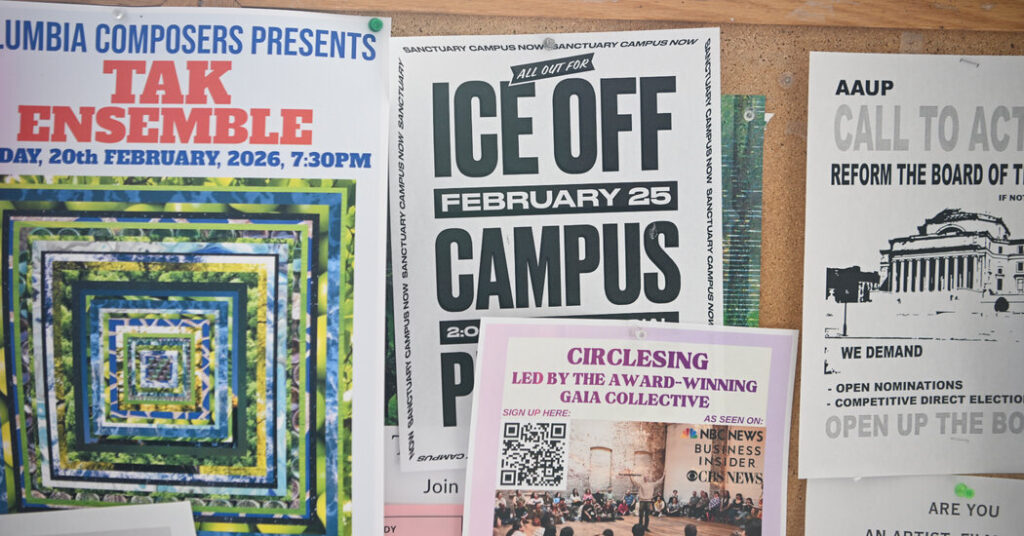
The approach angered some faculty members and others, particularly as the Trump administration’s dragnet expanded to include other Columbia students, including Mohsen Mahdawi, an organizer of pro-Palestinian demonstrations who was arrested at a citizenship interview.
Some pointed to Tufts University’s backing of its graduate student, Rumeysa Ozturk, who was detained on the street, and asked why Columbia hadn’t more forcefully defended its students.
Columbia took a different tack this week when five plainclothes immigration agents demanded to be let inside Ms. Aghayeva’s apartment building on Thursday morning. The Department of Homeland Security said it had arrested Ms. Aghayeva because her student visa had been terminated in 2016 for her failure to attend classes.
University leaders told city officials that the agents had misrepresented themselves as police officers searching for a missing child in order to gain entry. The Department of Homeland Security disputed Columbia’s account, saying its officers had “verbally identified themselves and wore badges around their necks.”
Mr. Mahdawi, one of the students detained last year, said that the release of Ms. Aghayeva “is the right outcome, and Columbia’s response, legal support and public advocacy is exactly what a university should do.”
“When I and other students were detained by ICE for our support of Palestinian rights, Columbia did not respond that way,” he said.
Unlike those arrested last year, Ms. Aghayeva was not openly political. Her large social media presence, with more than 100,000 followers on Instagram, focuses on the stress of trying to be perfect and why it is important to make something of yourself.
After Mayor Zohran Mamdani asked President Trump on Thursday to intervene to secure the student’s release, Ms. Shipman referred to Ms. Aghayeva by name in her recorded address.
And she put it plainly: “The agents took our student.”
The contrast frustrated some of those close to Mr. Khalil, who had criticized the conduct of Columbia’s leadership after his arrest.
Baher Azmy, the legal director at the Center for Constitutional Rights, an advocacy and legal group, said that the university was far more responsive this week “than they were to the equally unlawful arrest of Mahmoud.”
“I think a lasting shame for the university for how they failed to intercede on his behalf or prevent his abduction when they knew it was possible,” Mr. Azmy, who is one of Mr. Khalil’s lawyers, said in a statement.
Some lawyers saw no major distinction between the legal cases of Ms. Aghayeva and some of the other detained Columbia students. “The only thing that I can see different is the politics of it,” Joshua Bardavid, an immigration lawyer in New York, said.
Still, Mr. Bardavid said that the swift release of Ms. Aghayeva offered a valuable lesson.
“When the university was willing to allow the government to have its way with their students, the government did,” he said. “When strong institutions and bodies are willing to fight, that can make the difference.”
For others, the takeaway from Thursday’s episode was different.
Aharon Dardik, a senior and an organizer with the Columbia Student Union, said Ms. Aghayeva’s arrest at her university housing showed Columbia remains unprepared to protect students from ICE.
He pointed to other incidents across the United States in recent months in which immigration agents were accused of using deception and intimidation to gain access to private spaces. Columbia, he said, had not trained its workers to be prepared for a similar scenario.
It has instituted a protocol since Ms. Aghayeva’s arrest.
“If you leave your doors unlocked, and every day on the news there’s talk about how there were more burglaries,” Mr. Dardik said, “you don’t get to say the burglar fooled you.”
Jonah E. Bromwich and Ana Ley contributed reporting.
Troy Closson is a Times education reporter focusing on K-12 schools.
The post A Tale of Two Seasons at Columbia, and Two Responses to Student Arrests appeared first on New York Times.