When Michaeleen Doucleff walked into my apartment, my almost-2-year-old was sitting pantsless on the counter, screaming, while I untangled her hair.
“Just leave it!” Ms. Doucleff advised, before breaking into her expansive laugh. “I left Rosy’s hair knotted for, like, five years.”
Ms. Doucleff, 49, and her daughter, Rosy, now 10, were visiting my apartment in New York City to help me practice what Ms. Doucleff preaches.
To report her first book, “Hunt, Gather, Parent,” Ms. Doucleff took Rosy, then 3, around the world to study the parenting techniques of ancient cultures and make home life less kid-centric and more family-focused. After the book’s publication, she and her family traded San Francisco for West Texas, where they now live with 15 chickens, two-and-a-half hours from the nearest commercial airport.
Ms. Doucleff might be the biggest parenting expert you’ve never heard about. “Hunt, Gather, Parent,” published in 2021, has been translated into 31 languages. It has sold more than one million copies worldwide and has spent 11 weeks on The New York Times’s best-seller list — including this week, fueled by Instagram and TikTok.
Her book’s online popularity is ironic given that Ms. Doucleff doesn’t even have a phone of her own. (The family shares one that lives in a drawer; it can call and text but can’t download apps.) Her new book, “Dopamine Kids,” out Tuesday, promises to ween families from two modern scourges: screens and ultraprocessed foods. Ms. Doucleff promises that, on the other side, readers can discover lives full of authentic pleasure.
But getting there, I soon learned, would require some difficult changes.
An Ancient Way
I discovered “Hunt, Gather, Parent” when my daughter was an infant; Ms. Doucleff’s candor and humility spoke to me. She opened the book by lamenting how she yelled and got mad at her 3-year-old. Ms. Doucleff told me she grew up in a “viciously angry” home. She desperately wanted to raise Rosy differently but didn’t know how.
So Ms. Doucleff, then an NPR correspondent with a Ph.D. in chemistry, took her daughter to the Yucatán Peninsula, the Arctic and Tanzania to visit Mayan, Inuit and Hadzabe communities. Indigenous mothers and fathers instructed her on “an ancient way of parenting,” practiced around the world for millenniums before the West abandoned traditional wisdom in favor of so-called experts (who offer a plethora of contradicting advice, often in fragments and on social media).
Most great-grandparents would consider “Hunt, Gather, Parent” mere common sense. But to me, a clueless millennial, the advice was revolutionary: Be together, encourage autonomy and don’t interfere.
On a more granular level, that means incorporating children into daily tasks instead of entertaining them; serving kids the same food as adults; and talking less. (While some parenting experts suggest narrating your every move, Ms. Doucleff prefers teaching by example. She also believes talking too much makes words less valuable, which is one reason kids don’t listen.)
I was delighted when I learned there would be a follow-up. I assumed the book’s four-week plan to “take back your family” would be as easy as homemade, unprocessed pie: We don’t own a TV! We cook almost every meal from scratch! Besides video calls, my daughter has never consumed even one minute of screen time!
But a few minutes into my chat with Ms. Doucleff and Rosy, my daughter picked up the phone recording our conversation. She held it to her ear. I beamed. “She thinks phones are for calling people!” I bragged. I held my palm to my ear and picked up my end of the conversation.
“You know what you are doing right now?” Ms. Doucleff told me. “You are teaching her to really value phones.”
Ms. Doucleff plucked the device out of my daughter’s hand. My child began to bawl.
“It’s OK,” Ms. Doucleff smiled. “She’ll get over it.”
Drastic Changes
Right after the publication of “Hunt, Gather, Parent,” Ms. Doucleff and her family traded San Francisco for Alpine, Texas. Ms. Doucleff’s mother, who lived in New Mexico, needed end-of-life care, and her husband, burned out and aching for more time with Rosy, quit his stressful job as an engineer at YouTube the day the book came out.
Priced out of the Bay Area, they searched for a town where they could all live on Ms. Doucleff’s NPR salary. They hoped to find a community where children could be more independent, where neighbors looked after one another and where status mattered less.
“We Googled ‘best towns for families in the Southwest,’” Ms. Doucleff said. “Alpine came up as No. 7.” When she visited, she found “a dirty, dusty town that didn’t look like much,” but as soon as she left, she wanted to return. Her husband visited and immediately bought a house.
In Texas, they got hens and a mean rooster. Ms. Doucleff’s mother moved in next door. The Doucleffs built a greenhouse and a shed where, for several years, they ran a home-schooling co-op. In the afternoons, Ms. Doucleff taught local children cooking, animal care and gardening. “Seeing kids really change when they had what they need — it blew me away,” she said.
Ms. Doucleff was already disillusioned with technology. Even on magical days in nature with Rosy, she couldn’t stop thinking about her phone (back when she still had one). It seemed as if Rosy’s favorite hobby was watching “Lego Friends: Girls on a Mission,” but whenever she had to power down the iPad, mother and daughter got into huge fights.
Her desire to understand and change those habits motivated “Dopamine Kids” — in essence, promising a solution to the problems laid out by Jonathan Haidt in “The Anxious Generation.” Dopamine, Ms. Doucleff argues, is a misunderstood molecule: “It fuels desire, not pleasure,” she said.
The book is guided by the distinction that desire and pleasure are two different things. As much as we crave our phones and Oreos, they do not satisfy us. They are designed to be addicting, not fulfilling. Ms. Doucleff makes a bold claim, backed by research: that moderation doesn’t really work. Those who appear to have “willpower” simply avoid the temptation.
Ms. Doucleff’s suggestions will strike some readers as austere. Instead of setting limits, Ms. Doucleff advocates making the home a “sanctuary” where devices are used only in a “rec room,” plugged into a wall. It’s not just about saying no: Parents need to encourage gratifying replacements. For food, Ms. Doucleff recommends high-fiber options like beans; for activities, anything that involves fire or knives.
“In every culture, kids are drawn to powerful tools that have kept us alive for thousands of years,” she said. “There’s a huge drive for kids to learn how to use powerful tools. In every country, parents teach kids how to use these tools.”
In Tanzania, she saw a toddler waddling with a bow and arrow. “It makes kids feel powerful, purposeful and like they can contribute,” she said. In the cultures she studied, the first thing parents did was teach children how to be safe around these things. Then they taught children how to use them.
As for what we eat, Ms. Doucleff calls ultraprocessed food “pood,” a portmanteau, coined by Rosy, of “food” and excrement. “Pood” includes anything made with white flour, added vitamins and minerals, or added natural flavors — wave bye-bye to LaCroix and Vitamin-D-fortified milk.
“I’m not saying we can never have this stuff,” Ms. Doucleff told me. “We just don’t have it at home.”
Ms. Doucleff, who grew up lower-middle class in Virginia, eating fast food almost every day, hates the assumption that whole foods are a “privilege” for the middle and upper classes. “This is a myth in our society: that ultraprocessed foods are cheaper,” Ms. Doucleff said. A box of cereal at her local grocery store costs $7.
“The traditional diet where we live is extremely inexpensive: masa and beans and some fat and lard,” she added. Yes, eating whole foods requires cooking at home, Ms. Doucleff allowed, but if you know how, “it doesn’t take that much time.”
The Doucleffs live in a community that shares their values, but for those who don’t, it can be hard to swim against the tide.
Caroline Clauss-Ehlers, a family therapist in New York City and a professor of psychology at Long Island University in Brooklyn, said that peer pressure is strong, especially for teens. She emphasized that it is far more effective to change norms en masse, pointing, for instance, to the success of New York City’s ban on phones in public schools.
A Trad Life, but Not a Tradwife
In many ways, Ms. Doucleff’s life resembles a tradwife fantasy. Her refrigerator often contains three types of home-cooked beans, and she grows almost all of her own vegetables and grinds her own grain. Her new favorite hobby is cutting up wood with a chain saw and splitting it with an ax. Rosy, who is home-schooled, loves crafting and practices jazz on the living room piano. Their chickens fly into their trees and raise ruckus with the neighbors.
But it comes without traditional gender roles or religious affiliation: Ms. Doucleff’s husband does the home-schooling, while she writes books and contributes to NPR; she lights up her “hedonic hot spots” singing hymns at an inclusive church. And while some of her same so-called “crunchy” practices are shared with the Make America Healthy Again (MAHA) movement, Ms. Doucleff makes it clear that she is absolutely “not MAHA.”
In many ways, her new book is an ode to the old-school notion that parents have power in shaping their children — an idea antithetical to much of the gentle-parenting advice circulating on social media. In an early chapter, Ms. Doucleff instructs readers to make a list of values they want to instill in their children and select corresponding activities. (I want to teach my daughter to enjoy learning, care for others and, like me, love penguins.)
Even though I failed Week 1 of the book’s “take-back-your-family” plan — don’t use your phone outside the house — I made some changes. For instance, I went from getting distracted every 45 seconds (I timed it) to being able to focus for an hour (with the help of a powerful internet blocker). When I lost my phone, I did replace it — but with a really, really small one.
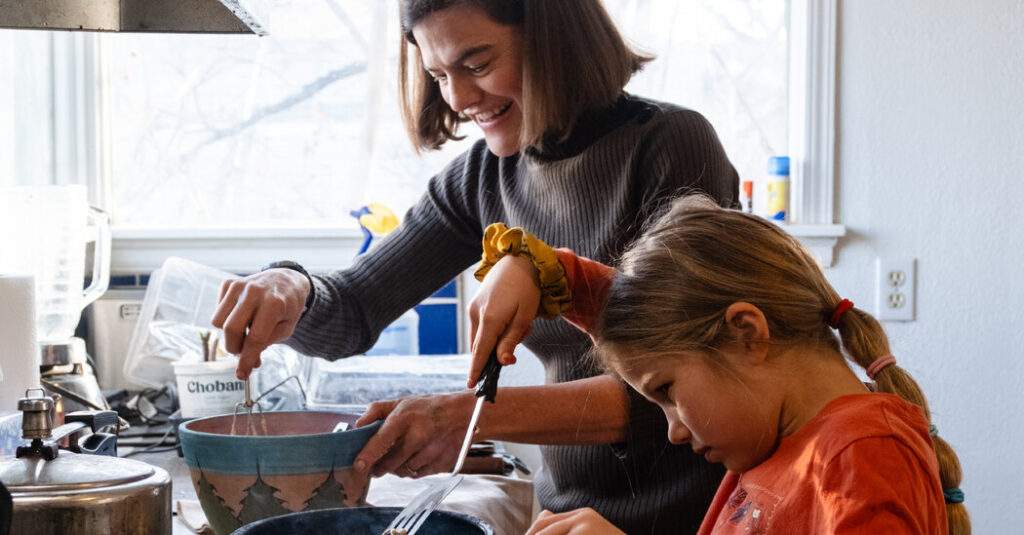
After Ms. Doucleff snatched my phone away from my daughter, we all made lunch. My daughter scooped rice with Ms. Doucleff. Rosy helped her measure the water. Ms. Doucleff sighed, “This is such a perfect moment.” (And while I agreed, I wished I had my phone to take a picture.)
Ms. Doucleff wants the government to do more to protect children, but hopes that “Dopamine Kids” gives parents “agency” in the face of structural failures. “I don’t have the privilege of waiting for regulation,” she said. “I have a child I need to raise today.”
The post This Parenting Expert Thinks Your Kids Need More Fire and Knives appeared first on New York Times.