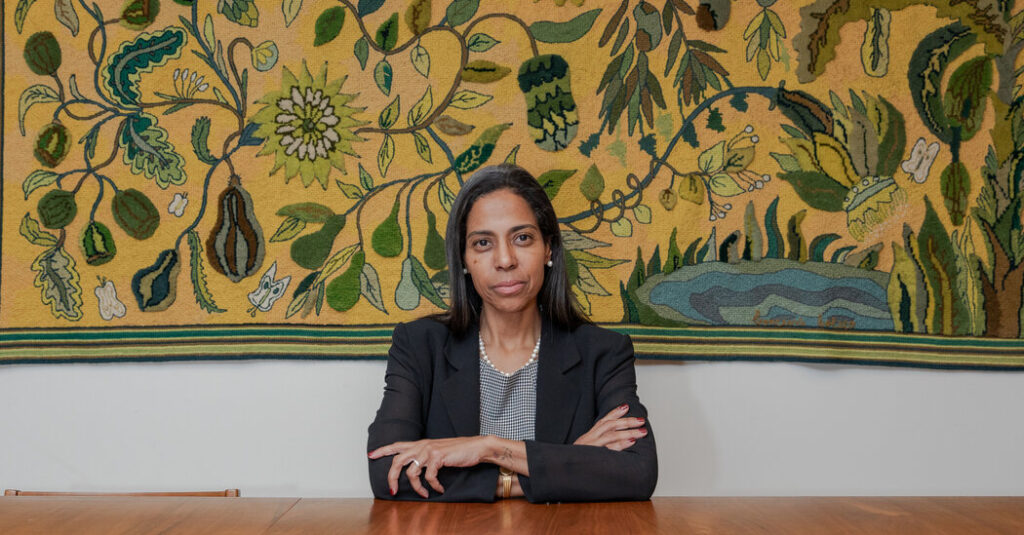
After a decade of debate, by year’s end the world should finally have a rulebook for mining the deep sea, Leticia Carvalho, the head of the International Seabed Authority, said in an interview.
It’s her job to help make it happen. And in the past year, the Trump administration has made the task far more urgent. She called it “absolutely existential” that the 170 nations in the authority now reach an agreement.
That’s because the Trump administration has said it will start unilaterally issuing permits for seabed mining in international waters, the vast stretches of the ocean that are not the domain of any one country. Regulators in the United States are now considering applications from companies that want to mine in these areas for valuable minerals, a practice that is environmentally controversial and has never been done on a commercial scale.
“The world agreed 30 years ago that this is an area that belongs to all of us, and we should go there collectively,” Ms. Carvalho said. In a world without international rules, she said, the oceans could turn into a kind of “Wild West” where each nation makes up its own.
This week, the seabed authority that she leads began its annual meetings in Kingston, Jamaica, to try to end the impasse. The authority was created in 1994 under a global treaty, the United Nations Convention on the Law of the Sea, as an independent body to regulate use of the seafloor in international waters, which cover nearly half the planet.
The United States has not ratified the U.N. convention, but has observer status at the authority’s deliberations and, until recently, followed its standards.
“It was quite extraordinary that such assertive messaging is coming out from the secretariat already, ahead of this meeting,” said Pradeep Singh, an expert on ocean governance at the Oceano Azul Foundation, a Portuguese science and advocacy group, who has attended several years of the authority’s meetings. He is among the experts concerned that rushing to complete the rules this year might lead to sloppy work.
Reaching an agreement on these rules, often called a mining code, would make history. The authority has been locked in debate over what the rules should look like for more than a decade. At the same time, the potential environmental toll of the industry has come under increasing scrutiny.
A completed mining code wouldn’t necessarily give the greenlight for commercial mining. But The Metals Company, which is leading the race to the seafloor, has told investors it will be ready to start mining by the end of 2027 with the assistance of the Trump administration.
Much of the activity would happen in the Pacific Ocean in an area known as the Clarion-Clipperton Zone between Hawaii and Mexico. There, the ocean floor is blanketed with fist-sized nodules of valuable minerals and metals including cobalt, nickel and manganese that have accumulated over millions of years. (Some countries, like Japan, are planning to mine for similar resources in territorial waters rather than international ones)
By some estimates, these deep ocean riches could eclipse all land-based reserves. But accessing such remote areas is technologically complex and costly. Some critics say that the industry may not turn a profit.
Scientists also say mining would damage deep sea ecosystems. There, all manner of animals exist, like tuba-shaped sea sponges and delicate, featherlike corals, that live on the nodules and around them. A scientific study of a Metals Company test run found that collecting nodules could reduce the abundance and biodiversity of seabed life by 30 percent.
Ms. Carvalho was elected to run the authority last year, and, as a trained oceanographer, she is its first secretary-general with a background in science. She is also a former oil industry regulator from Brazil.
United States actions in international waters circumvent the authority, Ms. Carvalho said.
Particularly concerning, she said, is that U.S. regulations were recently modified to combine the permitting process for exploration licenses and commercial ones. As a result, half as many environmental review periods are required before a company’s application can be approved.
Gerard Barron, the chief executive of The Metals Company, said he was doubtful that the International Seabed Authority could finalize its regulations this year. “Unlike the I.S.A., the U.S.A. has a complete and modernized set of regulations,” he said, noting that at least 10 mining applications have been submitted under United States law. “The industry has clearly demonstrated which regime it believes in,” he said.
His company also holds exploration permits from the seabed authority and has spent hundreds of millions of dollars on tests and scientific studies in an allotted area of the Clarion-Clipperton Zone.
Last year, shortly after President Trump ordered federal regulators to prioritize seabed mining, the company applied for new permits from the United States in the same location.
Environmental groups have staunchly opposed seabed mining. “We shouldn’t see deep sea mining as inevitable simply because the front-runner company is now essentially pretending that international law doesn’t exist,” said Louisa Casson, a project leader for Greenpeace International’s campaign against the practice. The organization is among the environmental groups and 40 countries calling for a ban or moratorium on the industry.
The U.N. convention was also designed to protect the interests of small and less wealthy countries, a core promise that Greenpeace argues it is failing to deliver. A recent study, commissioned by Greenpeace International, found that under the seabed authority’s current proposal, developing countries would get a small fraction of the estimated revenue.
In the interview, Ms. Carvalho said she viewed moratoriums as counterproductive. Banning mining outright, she said, takes money away from scientific research into deep sea ecosystems and delays the authority from establishing strict environmental standards.
“Being able to make the rules before activity starts is unique in human history,” she said, adding that the time for ideological debate is over. If the United States acts independently, then other nations may follow, she said. A patchwork of rules could result, which she said would leave the environment less protected and provide fewer benefits for developing countries.
As the authority gets to work this week, Ms. Carvalho said there were 32 specific issues that need to be resolved, some as small as a few words in a sentence, others as hefty as a paragraph. She said she believed the draft could be completed this year without rushing or risking mistakes.
The completed regulations wouldn’t be set in stone, Ms. Carvalho said, and could continue to be perfected over time. “The most important thing that the member states in the council now need to decide is what is desirable versus what is tolerable,” she said. “The perfect is the enemy of the good.”
Ms. Carvalho has not made her goals a secret. Ahead of this year’s meeting, she met with European leaders to urge them to support a mining code.
To some, her current view may come as a surprise. During the 2024 election that elevated her to lead the seabed authority, she had argued that several years of work most likely remained before a code could be finalized. Her predecessor’s tenure ended amid criticism from diplomats who said he was rushing the process to favor The Metals Company.
As the authority’s head, Ms. Carvalho is expected to remain impartial and not take a position on mining itself, but rather to facilitate deliberation among the 170 member states. “My job is not to design these regulations,” she said. “I know my job is to set the table.”
Still, the mission has become personal. “If I am the lucky one, if this agreement can be reached under my watch, then I would say that is the biggest achievement of my career,” she said.
Sachi Kitajima Mulkey covers climate and the environment for The Times.
The post Can Nations Agree How to Mine the Sea? This Is the Year, She Says. appeared first on New York Times.