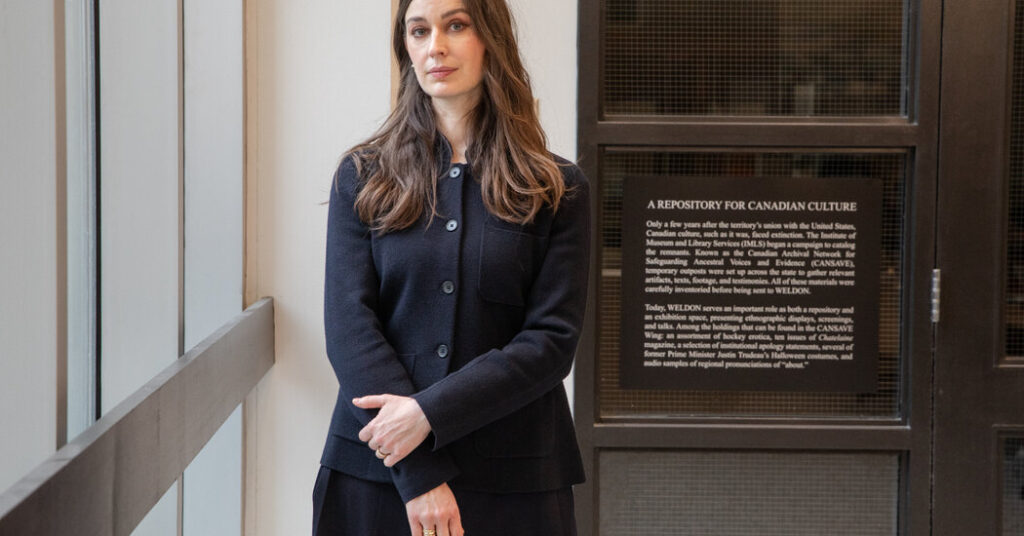
Last winter, as Canada was becoming the persistent target of economic, verbal and social media attacks from President Trump, the Toronto multimedia artist Dara Vandor got to work imagining a nightmarish scenario — the annexation of Canada by the United States.
She hung the result — an aluminum plaque, 18 by 24 inches, memorializing a fictitious surrender on Aug. 11, 2031 — in an alley near her home. She did not expect to be continuing the narrative in the continuing series “Pax Americana” a year later.
For nine months Ms. Vandor produced and posted 18 historical plaques in stairwells and a forest, and on buildings, telephone poles and chain-link fences in Toronto, Ottawa, Montreal and Tofino, British Columbia. The signs recounted disturbing scenarios: an invasion by U.S. troops, a Canadian resistance and then a quick surrender in straightforward, chronological detail. Each plaque can stand alone, but taken together they tell a whole story.
People who stumbled on the signs had big feelings — confusion, anxiety and even fury, Ms. Vandor says. People also stole them, which was fine with her. On Tuesday, “Pax Americana” opens at the D.B. Weldon Library at Western University in London, Ontario. (Unlike those in the wild, these are meant to stay put.)
Alongside 20 new plaques will be a collection of books, also hypothetical. Many nod to Canada’s literary past, inside jokes only we would understand — “The Log Driver’s Waltz: Clearcutting a Northern Passage” and “Selected Canadian Apologies”. One volume, “The Lives of The Presidents 1789-2045,” highlights a five-term Trump dynasty.
“I want the show to jump out at you,” Ms. Vandor says. “To be a little surprising and shocking, which is how the series worked in the wild. You weren’t expecting to come across it.”
The plaques depict Canada’s vulnerability to America’s power, evoking uneasiness and fear in the way of “The Handmaid’s Tale,” the 1985 dystopian novel by Margaret Atwood, a Canadian, if the Republic of Gilead had breached the Northern border. Alberta is liberated in 2027, the U.S. takes over the Arctic a year later, and unification day is Aug. 27, 2035.
“Pax Americana” envisions a future where Ivanka Trump is president, Parliament Hill has been razed, and French has been reclassified as a heritage language. Robert F. Kennedy Jr. is now in charge of the education system. And the classic novel “Anne of Green Gables” has been rewritten and set in New England instead of Prince Edward Island.
Frank Schumacher, a professor of history and director of the international relations program at Western, focuses on the role of the United States in world affairs and invited Ms. Vandor to bring “Pax Americana” to the university.
The collection, he says, allows viewers to step back from a relentless news cycle and to consider possibilities, especially ones that seem improbable.
“When we’re not entirely sure where things are going, it has a liberating effect,” Mr. Schumacher says. “You need ways of contextualizing the barrage of noise with some reflection.”
Reaction to the earlier run of plaques has ranged from “you’re giving the Americans ideas to giving people who found it scary a way to talk about it and share their emotions,” Ms. Vandor says. “Some thought it was pro-American. Once they learn it’s an art project, it’s like, OK. People are bringing their own baggage and feelings to it.”
The most Canadian response: A few people expressed dismay that she was posting signs without permits.
“Pax Americana” raises questions about Canada’s relationship with the United States, and Ms. Vandor says her frustrations extend to both countries.
“The series started looking at the U.S. and then turned inward to our own problems and our own sins, one of which is complacency,” she says. “Another has been allowing someone else to steer the ship, and losing a sense of pride in what we’ve accomplished. And I think that has come back to get us. How can we be united against an external threat?”
Mr. Schumacher is hoping to give the exhibit a wider audience and position it alongside what has often become real-time teaching on global affairs. Because nearly all of the original plaques had been taken, Ms. Vandor created 20 new ones, etched in a heavy-duty aluminum used by the U.S. military.
“There’s a realism that is partly her execution of the plaques themselves and also the moment that we are in and the anxiety we are feeling,” Mr. Schumacher says. “It creates this perfect storm. When you look at them you get a chill.”
[Read: Trump Threatens Canada With Tariffs as Post-Davos Fallout Continues]
Mr. Trump, who talked about making Canada the 51st state before the inauguration and for months after, continues to threaten and apply tariffs, and patronize Prime Minister Mark Carney.
Mr. Schumacher notes there are undertones when the president talks about wanting to control Greenland. “The part he’s not saying out loud is: If we have it, Canada is sandwiched between Alaska and Greenland and will be ours.”
Ms. Vandor isn’t sure when she will be done adding to “Pax Americana.” The political climate that inspired the work is lingering.
“It is amazing that we’re still here, that we are still talking about it,” she says. “I would rather this all went away. It would be nice if we were just left in peace.”
Pax Americana
March 2-April 30, D.B. Weldon Library, Western University, 1151 Richmond St., London, Ontario.
Trans Canada
This section was compiled by Vjosa Isai, a reporter at The Times.
-
Norimitsu Onishi traveled to Stettler, Alberta, to report on what one rural community is doing to attract physicians amid a national shortage.
-
Ian Austen is traveling with Prime Minister Mark Carney, who is visiting India, Australia and Japan seeking deals to strengthen links to Indo-Pacific middle powers and break Canada’s dependence on the United States.
-
Bars across Canada opened early on Sunday for the Canadian men’s hockey team Olympic gold medal match against the United States, but the good feelings were short-lived.
-
The Canadian government and police are pressing for answers on what OpenAI knew about the Tumbler Ridge shooter’s online account activity.
-
Rachel Reid, the Halifax-based author of the series that inspired the hit television show “Heated Rivalry,” said the next book would be delayed as her Parkinson’s symptoms worsen. One of the Canadian filming locations, the “cottage,” will be available for short-term rental through Airbnb.
-
After 50 years of ghostwriting and telling other people’s stories, this Vancouver author will at last tell her own.
-
From Travel: How an airline pilot spends a 48-hour layover in Montreal.
-
Violence in the wake of the killing of Mexico’s most wanted cartel boss upended travel plans there, a popular sun destination for Canadians.
-
In the last 20 years, this man bought up a string of department stores — including Hudson’s Bay, Saks and Neiman Marcus — that closed or filed for bankruptcy after passing through his hands.
-
Christopher Wren, a longtime foreign correspondent who covered Canada during his career at The New York Times, has died. He was 89.
Shawna Richer is an editor on the International Desk at The Times. A native of Ancaster, Ontario, she lives in Toronto.
How are we doing? We’re eager to have your thoughts about this newsletter and events in Canada in general. Please send them to [email protected].
Like this email? Forward it to your friends, and let them know they can sign up here.
Shawna Richer is an editor working on coverage of sports in America.
The post America Has Occupied Canada, in the Creative Mind of a Toronto Artist appeared first on New York Times.