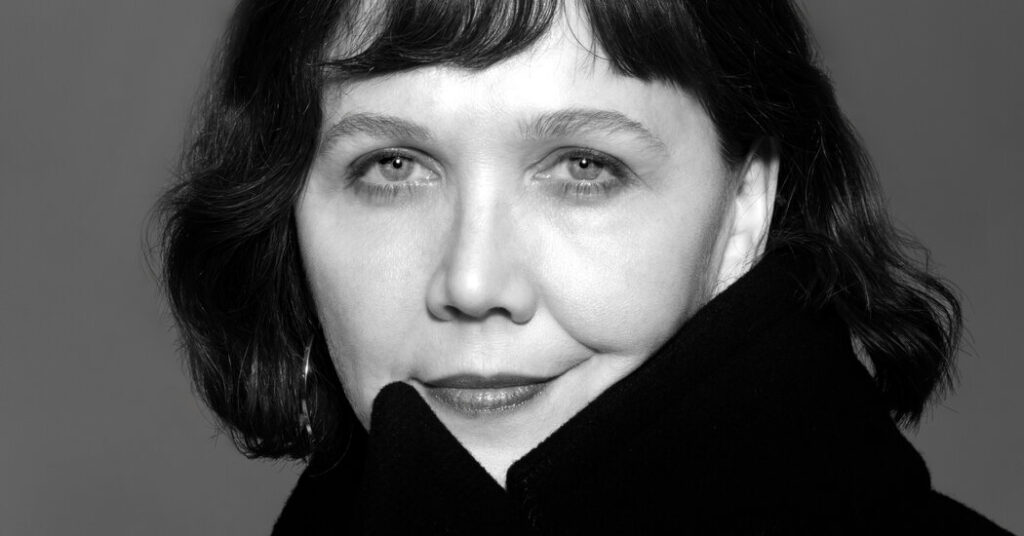
Maggie Gyllenhaal has always been fascinated with the darker side of sex and love. Her breakout role as an actor was in the 2002 film “Secretary,” in which she played a troubled young woman who embarks on a sadomasochistic relationship with her boss (James Spader). In “Crazy Heart,” she played a young mother who falls in love with an older, alcoholic country singer; that role earned her an Oscar nomination. And then in the HBO series “The Deuce,” she starred as a sex worker who becomes a porn director. That role made Gyllenhaal want to be a director in real life, too, and in 2021, she won acclaim with her feature directorial debut, “The Lost Daughter,” about the taboo feelings that some women experience in motherhood.
For me, the through line in all this work is the focus on women who live outside conventional boundaries. And that theme definitely extends to “The Bride!” — an imaginative retelling of the “Bride of Frankenstein” story that Gyllenhaal wrote and directed, in which the titular character, created to be a partner for Frankenstein’s monster, rebels against the path laid out for her. The film, with its big studio budget and high-wattage cast, including Jessie Buckley, Christian Bale and two of Gyllenhaal’s loved ones (her brother, Jake, and her husband, Peter Sarsgaard), is part love story, part crime caper — with some surreal musical numbers thrown in. But Gyllenhaal’s signature themes of sexual violence, female power and transgression undergird it all.
I wanted to understand why Gyllenhaal returns to those themes over and over again in her work, and also what it’s like to be the rare female director helming a big studio film — especially as reports surfaced that the making of the movie, which comes out March 6, was not always smooth. But we began by talking about a blue scarab necklace that Gyllenhaal wore to our interview, which immediately caught my eye.
Subscribe: Apple Podcasts | Spotify | YouTube | Amazon | iHeart
How did you get this necklace, and what does it mean? I’ve never really been into tarot, but I met this woman who has been pulling tarot cards for me. I started cynical, and my cynicism has been falling away. And recently, when I was feeling vulnerable about sharing this movie with the world, she pulled a card that was the Empress.
The Empress is a very powerful card. It’s a female figure who is able to really feel her power. Hearing the word “empress” — I would love to get on that train. And she said, “Lapis lazuli will help you stay in touch with the Empress.” Then, just randomly, I’m doing a short film that happened very quickly, very off the cuff, and Dakota Johnson is in it. I shot it last week. And she shows up for her fitting with this gift for me, which is a scarab made of lapis lazuli, not knowing anything about that story. I was really touched. I do believe that sometimes the unconscious leads you to a place that means something very tangible and clear.
I interviewed you in 2019 for “The Deuce,” and in that interview, you said that playing that role, where your character becomes a director of pornography, made you realize that you would also be a director. Now, sitting here with this big-budget movie, where are you in that evolution? I’m deeply in process. I knew I was going on a major journey starting “The Bride!” and I was terrified. I remember being at the Venice Film Festival with my husband, Peter, who had a movie there, and feeling so scared about the prospect of directing “The Bride!” We went to a lovely restaurant that we’d booked and were excited for, and I remember feeling so anxious and going to the bathroom, looking at myself in the mirror and thinking: Oh, I don’t have to direct this. I can let someone else direct it. I’ve written it. I’ve cast it. I’ve conceived of it. I don’t have to do this. And I came back to the table, and I said to Peter: “I don’t know if I’m going to do it. I feel so relieved.” And he was like: “You don’t have to do it. But that doesn’t mean that you shouldn’t.” Having come out the other side, and only really having finished it in October, I feel like I went on a trip. And now I’m on the trip of putting it out into the world.
This is quite a violent film. It’s visceral. It’s bloody. What were you tapping into? Yes, there’s sexual violence. There’s violence. Because it’s a big studio movie, we tested and tested it. We had big screenings in malls, where people came to see it, which I had never been a part of as an actress or a director before. So fascinating. And one of the things that they brought up was the violence: Is it too violent? And I was talking about it with a girlfriend of mine, who said — and she wasn’t being reductive — “I wonder if you had been a man making this movie, if you would have had the same response.”
I can think of a lot of directors off the top of my head whose signature is that kind of violence. I was asked to take some of it out, and I did. So what you’re seeing is even a little bit pulled back from what was originally in the movie. One of the things that was important to me is that everybody who is killed, is hurt — we, at least for a moment, get to know them. There’s the storm-trooper version of killing people, where they have white masks on and you don’t know who they are. And then there’s the version where every single death has a consequence and a cost — every single one. But I want to talk about the sexual violence, because that’s another thing that I have been taken to task for.
Taken to task by whom? Just by the things in the test screenings. I had a couple of women say, “I don’t want to see a woman being violated.” And I think, I also don’t want to see that. And yet that is a major reality in the culture that we’re living in — just in the time I was cutting this movie, how much wildly disturbing brutality against women there has been in the world. And so if we’re going to see it, we need to see it in a way that is very hard to watch, because it is very awful. And if you know anything about me, if you looked at any of my work, even starting with “Secretary” when I was 22, this is something that I’ve spent a lot of time thinking about. I am sure that I have been thoughtful about this particular subject, and yet it will be hard to watch. I think we can take it.
You just articulated something: Violence toward women has been a persistent theme in your work. I want to understand why. What is it that has drawn you over and over again to that subject? Think about “The Deuce.” Sex worker turned director of porn. But really, she’s a woman with a mind. Like all of these movies really — they are about women with minds. Even “Secretary,” which is a very complicated one.
To me, in some ways, the violence is beside the point. It’s not the violence; it’s the rage. Oh, the rage!
That’s what I connect to. And this is coming from someone who’s very rageful. [Laughs] This teacher I had, Penny Allen, used to say that rage is an umbrella emotion. What she meant was: What’s underneath it? Let’s not skip rage. We have a right to it. But I am also really curious about what’s underneath it. I do feel angry about all sorts of things, and feel a lot of vulnerability underneath that, and just a need and desire to be heard.
There was reporting around “The Bride!” being a difficult process with Warner Bros. because of some of the things you talked about, the way it tested. Were there a lot of changes? Was it difficult to work through the big-budget studio system? Yeah, it was difficult, but not in a bad way. It was just very new for me. I loved working with Pam Abdy, who runs Warner Bros. with Mike De Luca. She understood me and understood what I was saying. And there would be times where she would be like: “Maggie, you cannot have Frankenstein lick black vomit off the Bride’s neck. It’s just too much. You can’t do it.” But she understood why I wanted it.
Do you think it can dilute the vision though? The places where Pam really pushed me to let go of things, I do think that they served the movie ultimately. My goal from the very beginning was to try to open a bigger vein, to tell the truth about something that could be heard by many people. Pam helped me to do that.
Your brother, Jake, is in the film. This is the first time you directed him. How did that feel? I waited until I was absolutely sure that asking him to do this part was the right thing to do. I remember asking him and tearing up alone in this hotel room I was in, because it meant so much to me. It meant so much for me to interact with him.
Why? What did it mean? In the past, I’ve had to be separate from my family, from my brother. Like, cool, I’ve got my own thing going. We both started so young. I think it was just a really honest, vulnerable, what’s underneath rage, reaching out. Just basically saying, I want to interact, and I know that this is a place where we can do it. I’m not asking him to do something that he can’t do. I’m making an offer, which is a generous thing to do.
An invitation? Yeah, and with love.
Have you two been estranged? No, no. We’ve never been estranged, but we’ve never been as close as we are now. We’re finally, maybe in the last five years, more and more and more, even each day, really interacting, which is hard for people to do.
The other thing I was thinking about, in terms of the family dynamics, is with your husband, whom you have worked with before. Your parents were filmmakers — your mother is a screenwriter, your father is a director — and you’ve said that their working together might have caused their ultimate separation, because it’s hard to work with family members. When you are working with Peter, is that in your mind? I don’t think that them working together caused their separation, but I don’t think it was good for them. It was a bad idea. And they did it a few times. It is complicated working with my husband. We’ve done it in all sorts of ways. We did it as actors together onstage in two Chekhov plays, and it was hard and awesome. I remember playing Masha, which is one of the parts I’m most proud of, with Peter playing Vershinin. I was young, like 33, and I had the fantasy that Masha and Vershinin in “Three Sisters” were the love affair of all time. That is not what my husband thought. I was like, “Why are you so withholding?” I was hurt personally by the artistic choice he was making. But Penny, our mutual teacher that I was mentioning before, she said to me: “You may wish that that’s the relationship that you had. Masha wishes that. But that is not the relationship that you’re actually having to contend with onstage. So contend with that relationship.” Then we did “The Last Daughter,” where he has a really hot love affair with Jessie Buckley.
Yes, he does. Which was very complicated, and I almost didn’t give him the part.
Because of that? I was like, I don’t need that along with directing a movie for the first time. I actually offered it to somebody else first. And I knew he was hurt. I remember speaking to both my best girlfriend and to this teacher, and both of them were like: “You can’t manage this? Can you really not?” And I was like, “I think I can, and I really want Peter to play this part.”
And what was it actually like? Oh, my God, it was so many things. He was so good, and so was Jessie. And watching them together and egging them each on from a very unconnected, emotionally, place and pushing them and watching them create the love, as real actors have to — I watched them do that. When I get a second to stop, it’s a little hard, but we have to keep going. Then we get to the sexy stuff. We shoot the scene on the steps where they’re kissing, and I was just looking at it like: Is the light on her leg in the right way? And maybe if we just pan this way, very removed, and we got it. Then my cinematographer, Hélène, says: “Oh, no, this will not do. There is a wine glass on the steps. We have to do it again.” And I was like, “We do?” So it was a little hard. It was also so full of life.
We touched a little bit on “Secretary.” I loved that film when it came out. At the time, you said it was a feminist film. Would you say it’s a feminist film now? I mean, what is a feminist film? The thing about “Secretary,” at least as I intended it, was that it was consensual. She wanted that erotic relationship with her boss. And so who is anyone to tell her that that is not allowed? Then the movie asks: Can you make that true even in this situation?
With a boss who’s older and a young woman who is coming out of a mental institution? Can you allow her to want what she wants, if that’s what she says she wants, even in those circumstances? That’s the question. I haven’t seen it recently enough to say whether I can, but I think that’s what I was trying to stir up at the time. Can she have what she wants, even if it’s not what you would want?
You were seen as this sort of cool-girl young actress who was willing to push boundaries. Having that sense of wanting to stir something up, what was going on there? In my work, at least looking back on it from here, I think I wanted similar things: I wanted to make people think — and not just think, but feel into thinking. “Secretary” was the first time I really expressed my artistic self. Also, I met Peter when that movie came out. So it was like falling in love, finding some voice as an artist, which obviously shifted and changed throughout my career, but that was the first time. It was like a little explosion. And I wasn’t well known at that point. Jake was.
I imagine there was sibling rivalry, to see your brother have success and you trying to make your way? In general, I am very interested in envy. I think there’s a reason it’s a seven deadly sin. I’m interested in it in terms of watching other people’s movies come out. Admiration versus envy. What creates it? I think it’s usually feeling starving, like you don’t have enough. I know Emerald Fennell, whose movie “Wuthering Heights” is about to come out, a little. I reached out to her, and I said: “How are you doing? How are you with all of this?” And just the act of reaching out to her — and she’s great — frees the competition up and you realize: No, no. We’re actually 100 percent on the same team. There absolutely is enough to go around. But I don’t think I knew that at first, when I was young and Jake was a movie star right away. I don’t think I was in touch with the envy, but it was there.
So we’ve been talking about being a female director, and on the one hand, we’ve had all these interesting films come out: Chloé Zhao with “Hamnet,” Lynne Ramsay with “Die My Love,” Kristen Stewart with “The Chronology of Water.” On the other hand, only 8 percent of films [last year] were made by women, and that’s a seven-year low. What do you think that says? I’m thinking about whether to say this.
Say it. It’s fine when we make little movies. “Cute,” you know, “go make your little movie.” It starts to get dangerous when women have their hands on a lot of money. It still doesn’t entirely answer your question about how few women are given the space to express ourselves. And look what you’re saying! You’re saying it’s a tiny percentage, but look at how many of those movies made an impact. If you’ve had your mouth shut for so long, almost like a geyser, when it bursts, it’s going to come out really powerfully and with a lot of energy. And I wonder if what’s happening culturally is going to bring an unstoppable response, especially from women. I don’t know if I’ve said this out loud before. Again, maybe I’ll get in trouble, but I actually think that when I really became a director was the morning that Trump was first elected. I was like, I have a lot more to say than I’ve been saying.
Tell me what that means. Well, actually, I was thinking about Kristen Stewart’s interview on this show. It made an impact in my community. I was thinking about her idea that being an actor is submissive — a very interesting idea. And I was also thinking about something that she said, which is that she hadn’t heard of a method actor who’s a woman. I know she didn’t quite mean that. I want to talk to her. I don’t know her very well. But in fact, I just worked with Ellen Burstyn, who’s 93, studied with Lee Strasberg and is absolutely a method actress. I think being a method actor is about bringing yourself into your work. That’s not exactly submissive. And in my experience, as an actress, I really had to learn to convince everyone I was being submissive just to get myself expressed. And I came to a certain point where I was like, I can’t keep playing that game. Something about that time made me say, OK, I am terrified, and I’m going to do it anyway.
I rewatched “The Dark Knight.” That movie had to have been the biggest-budget film you were ever a part of. What did that experience teach you about how to harness all those resources from inside the studio system? Acting in a huge-budget movie is very different from directing one. It’s hard to be free in a movie of that size because, as an actor, there are so many other aspects that can feel like they take precedence. VFX [visual effects], the massive day, the 400 extras, whatever it is. And Heath Ledger really, really managed to find that humanity and freedom inside that big movie. And I will say that one of the most important things to me on “The Bride!” was to create real freedom for all the artists who were working on it.
I’m curious about your own experience, where that wasn’t what happened to you. As an actress, to be honest, it is way more rare to find an environment where you feel seen, respected and loved than one where you don’t. I had to learn how to do without it. And I see so many actors walk on set with that mind-set. I feel like many actors walk on set like, OK, I’m probably going to get nothing here. I have such a wish and a hope for interaction and connection. I often had to let go of having that in a really deep way with a director. There are exceptions. I worked with Mike Nichols for one day in a reading of a play that we did onstage in New York, and he gave me probably one of the best directions I’ve ever received. I was playing Marie Curie, and he took me aside after the first read-through, and he said, “Just one thing: She’s feral.” It’s a great direction because it has no particular end in mind. He’s basically saying: The wildest secret stuff in you? I want it. What an incredible thing.
When we started this conversation, I got a really strong sense of someone who’s on the cusp of this big adventure. You’re just about to go on the press tour, and “The Bride!” is going to get released into the world. And the critics are going to see it. I’m always so interested in that moment, the in-between time before the world comes in. And I’m just wondering where you’re at. I feel simultaneously like somebody who just had a baby and someone who is about to have a baby. I have delivered my baby, right? I’m finished with the movie, and I have been coming back into myself. At the same time, the world hasn’t seen it. So I’m kind of in both places at once. But I want to say one other thing about this, which is that when I started this process, even though I’ve put a lot of movies out into the world at this point, I naïvely believed that if I was honest enough and excellent enough, everybody would love it. And that is just not ever going to be true. It’s late in life to learn that or to be in the process of learning that. But I guess I’m interested in how to embrace, tolerate, even be proud of the ways in which some people will light up and love this — and some people won’t.
This interview has been edited and condensed from two conversations. Listen to and follow “The Interview” on Apple Podcasts, Spotify, YouTube, iHeartRadio or Amazon Music. Follow us on Instagram and TikTok.
Director of photography (video): Tre Cassetta
Lulu Garcia-Navarro is a writer and co-host of The Interview, a series focused on interviewing the world’s most fascinating people.
The post Maggie Gyllenhaal Thinks Hollywood Likes Women to Direct ‘Little Movies’ appeared first on New York Times.