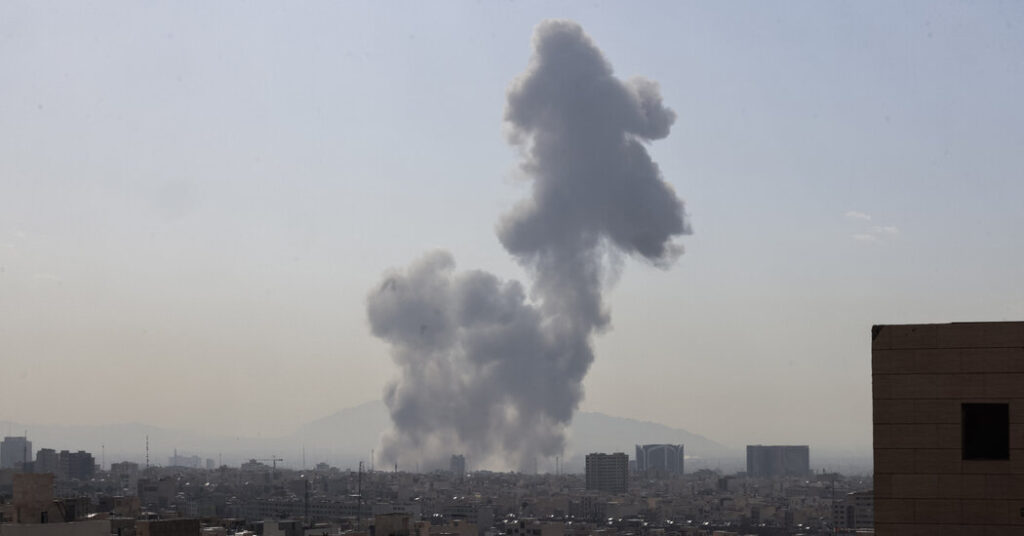
Leaders in Europe and around the world on Saturday urged all sides to exercise restraint after the United States and Israel launched a major attack on Iran, although some officials backed the American-led campaign.
President Trump said the attack was intended to eliminate Iran’s nuclear program and lead to a change in government, after several rounds of nuclear talks involving the two sides failed to reach a deal. Iran’s foreign ministry asked the United Nations Security Council “to take immediate action to confront the violation of international peace and security.”
Here’s what other governments are saying:
-
Britain: The British government said it had not participated in the strikes and did “not want to see further escalation into a wider regional conflict.” It added that it had recently enhanced its defensive capabilities in the Middle East and that its immediate priority was the safety of British citizens in the region. “Iran must never be allowed to develop a nuclear weapon and that is why we have continually supported efforts to reach a negotiated solution,” the government said in a statement.
-
Germany: A government spokesman said in a statement that Germany had been informed by Israel in advance of the strikes. Chancellor Friedrich Merz “is monitoring the development closely and is in close coordination with European partners,” the statement said. Mr. Merz is scheduled to meet Mr. Trump in Washington next week.
-
France: President Emmanuel Macron called for the attacks and asked for a meeting of the Security Council. He also wrote that the Iranian leadership “must understand that it now has no other option than to engage in good-faith negotiations” over its nuclear program, and added that the Iranian people “must also be able to build their future freely.”
-
Australia: Prime Minister Anthony Albanese was among the few leaders who did not publicly urge restraint. “We support the United States acting to prevent Iran from obtaining a nuclear weapon and to prevent Iran continuing to threaten international peace and security,” he said in a statement. He said Iran has been a “destabilizing force” for decades, and cited two recent terrorist attacks in Australia that the government said were directed by an arm of the Iranian military.
-
Canada: Prime Minister Mark Carney and his foreign minister, Anita Anand, backed the American action. “Canada supports the United States acting to prevent Iran from obtaining a nuclear weapon and to prevent its regime from further threatening international peace and security,” they said in a statement.
-
European Union: Kaja Kallas, the top E.U. diplomat, said that she had spoken to Israel’s foreign minister and to other officials in the region, and was “coordinating closely with Arab partners to explore diplomatic paths.” The E.U.’s top executive, Ursula von der Leyen, and its top political leader, Antonio Costa, wrote in a joint statement that it was crucial to prevent “any actions that could further escalate tensions or undermine the global nonproliferation regime.”
-
Spain: Prime Minister Pedro Sánchez condemned the attacks by the United States and Israel, calling them “an escalation.” He also condemned the Iranian regime. “We cannot afford another prolonged and devastating war in the Middle East,” he wrote.
-
Sweden: Prime Minister Ulf Kristersson called for restraint but also condemned Iran for killing its own citizens, in an apparent reference to recent protests in January which were violently crushed by the government. He said Iran’s support for terrorist groups has long been “destabilizing,” and said it should never be allowed to develop nuclear weapons.
-
Lebanon: Top leaders called on all parties to prioritize the welfare of Iranian citizens. The remarks appeared directed at the Lebanese militant group Hezbollah, amid questions over whether the weakened, Iran-backed organization might attempt to enter the conflict in support of Iran.
-
Saudi Arabia: Saudi Arabia called the reports of retaliatory Iranian strikes on Arab nations, including Bahrain, Kuwait and the United Arab Emirates, “a blatant violation” of their national sovereignty. “Saudi Arabia affirms its full solidarity and support for these brotherly nations, pledging all its resources to assist them in any measures they take,” the foreign ministry said in a statement posted on social media.
-
Switzerland: The government said it was “deeply alarmed” by the strikes. It called for “full respect of international law” and urged all parties “to exercise maximum restraint” and to protect civilians.
-
Malaysia: Prime Minister Anwar Ibrahim said on social media that the attacks had brought the Middle East to the brink of catastrophe. “I urge the United States and Iran to pursue a diplomatic off-ramp rather than further escalation, and the international community to act with urgency and without double standards,” he said.
Reporting was contributed by Michael D. Shear, Jim Tankersley, Abdi Latif Dahir, Rawan Sheikh Ahmad, Jeanna Smialek, Edward Wong and Zunaira Saieed.
Jonathan Wolfe is a Times reporter based in London, covering breaking news.
The post Here’s What World Leaders Are Saying About the U.S.-Led Attack on Iran appeared first on New York Times.