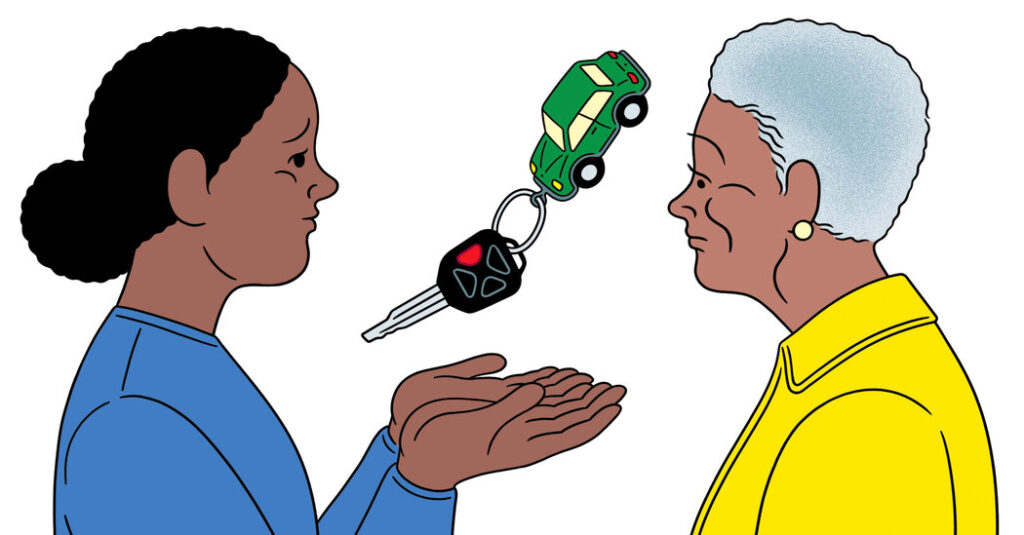
About a year ago, my mother, who is in her late 80s, was diagnosed with mild cognitive impairment. Since then, she has been dealing with health challenges that have increased her frailty and memory issues. She has always been a very proud, strong woman, and until recently she had no trouble living independently. But her neurologist told her, in my and my sibling’s presence, that she should no longer be driving. Our mother argued with him. (“How do you know? You’ve never driven with me.”) Later he told us that her tests alone weren’t conclusive and that his decision was informed by what my sibling and I reported as well as another doctor’s indication on her chart that she shouldn’t be driving.
The D.M.V. has suspended her license, and my mother is irate, blaming us for instigating this and saying she never wants to see us again. She also keeps saying she is going to fight to get her license back, either by taking a driver’s test or getting another doctor to dispute the decision.
Meanwhile, we are concerned that she is continuing to drive, despite the known consequences. For example, if she gets into an accident, she could lose her house, her life savings, etc., even if it’s not her fault. But we have not yet gone so far as to take away her keys or put a lock on the steering wheel. My hesitation stems from the fact that she’s basically said that her life would not be worth living if she couldn’t drive. I advised her to seek help for depression, but that is not something she will do.
I have empathy for my mother being confronted with her deteriorating health, and I try to discuss it with her, but she is from a different generation and didn’t grow up talking about her feelings. Unfortunately she won’t acknowledge that she’s at an increased risk of harming someone else by driving. My question is: How do we know when it’s time to take a drastic step? — Name Withheld
From the Ethicist:
One of the ordinary sorrows of life is to watch a parent, in whose arms we were once so small, grow smaller in ours. But yes, most us will experience some diminishment of freedom and control with age. And though your mother’s language may be hyperbolic, she no doubt takes the loss of that license as a judgment on her adulthood. At the same time, you and your sibling clearly have specific reasons for doubting that your mother is safe on the road, and you’ve made all the pertinent points about the harms she may pose to others and to herself (including her legal and financial exposure). Her safety matters. So does the safety of strangers.
Taking her keys or putting on a steering-wheel lock may be an effective stopgap measure. But even though your aim is to stop her from doing something illegal, these steps could put you in a legally ambiguous area yourself. And you’ll be treating your mother like a child when she already fears the loss of her grown-up autonomy.
You’ll do better, I suspect, if you treat her as the adult she still is. If she thinks she can get the D.M.V. to reverse itself, tell her why you want to hold her keys in the meantime. “Persuasion,” the narrator of Katie Kitamura’s novel “Audition” remarks, “is only one step removed from coercion.” If so, it’s an important step. Offer practical suggestions for preserving her mobility. Perhaps she could sell the car, cancel her insurance and use the money to cover ride-hailing services. Perhaps you and your sibling could also volunteer to drive her for, say, weekly shopping excursions. Perhaps she has friends who would take her to some of her appointments, or perhaps she could hire a home health aide to drive her around a few times a week. In other words, rather than focusing on what you don’t want her to do, come up with proposals that leave her with at least some of the freedom she dreads losing.
Readers Respond
The previous question was from a reader who wondered if she should make public the shocking information she recently learned about her former principal. She wrote:
At my 55th high school reunion a few years ago, I talked with a classmate I barely knew — she had been a shy, reserved girl who came to our school as a transfer student. She told me that our principal would visit her home while her mother was at work and assault her. I don’t remember the specifics of the abuse, but he was clearly a sexual predator. He died more than a decade ago, his obituary celebrating him as a beloved principal and volunteer. … I haven’t been in contact with her since. I don’t know if she told me in confidence or how many others might know, but I’m unsure what to do with this information. I hate what happened to her and don’t want him to get away with it. Yet he’s not here to defend himself, and this may not be my story to tell. What to do? — Name Withheld
In his response, the Ethicist noted:
I once asked my father why, in his autobiography, he had so little to say about the failings of Kwame Nkrumah, who was Ghana’s first president and someone he had known well. Dad’s reply was an old Latin tag: De mortuis nil nisi bonum (“One should not speak ill of the dead”). … The maxim isn’t entirely meritless. For one thing, post-mortem accusations can’t be rebutted by the accused. Still, if you have evidence of misconduct by a person who is now dead, bringing it to public notice can be useful. … In this case, there are complications. To start with, the survivor of these assaults is a living person who could have made her story public had she wanted to. … Second, because the offender is no longer around to prey on young people, public disclosure wouldn’t protect others from him. … It would be very different if the survivor herself, having weighed the consequences, chose to make her story public on her own terms. If she did want to come forward — perhaps through posting on social media or contacting journalists — she might appreciate your support in that. You’d be standing with her, not speaking for her.
(Reread the full question and answer here.)
⬥
I disagree that the letter writer shouldn’t make this public. She doesn’t have to name the person who told her this (in fact I believe she absolutely should not, unless she gets her permission). But the benefit of disclosure, as the Ethicist points out, is that others who suffered at the hands of this predator may find some comfort in knowing they are not alone. Predators like this rarely have only one victim — odds are there are many others who might feel less isolation and shame if this story came to light. — Guinevere
⬥
In this instance, I think it would be inappropriate to make public what the letter writer was told because they do not have firsthand knowledge of the facts, and their acquaintance’s report may have been inaccurate. However, if the facts were known firsthand, I think publicizing them would serve the important purpose of reminding living people that if you choose to treat another person badly, you should expect that choice to tarnish your reputation until the end of time. Speaking ill of the dead, when it is deserved, should be respected if not encouraged. — Neil
⬥
Presumably, the letter writer will attend their 60th class reunion, and if so, she can talk to the classmate about her wishes. If she doesn’t want to speak publicly about it, that choice must be honored. If she doesn’t attend, do nothing. If the woman wants to go public, that’s her right and her right only. The friend could offer support, but without witnesses, there’s no proof, and my instincts tell me that this woman just finally felt like she needed to tell someone. The letter writer should feel honored by that trust. — Emme
⬥
I agree with the Ethicist’s response, but there might be a place for discreetly reaching out to current school leadership (e.g. the board) without revealing the name of the person who told you. It’s possible what you heard could represent a larger issue, with other victims involved or a pattern of lack of accountability for abuse. — Kelly
⬥
I recently dealt with a similar scenario involving a sexual predator who had interacted with multiple female friends of mine back in the ’90s. When he died recently, a friend called me out for not saying anything as the tributes poured in. I was spurred into telling the truth of what he was like (without naming any victims). Subsequently, an acquaintance came up to thank me because, unbeknown to me, they were also one of his victims and were still suffering to this day. It made me realize that sometimes you have to stand up and tell the hideous truth, because saying nothing allows offenders to get away with it. — Paul
The post My Aging Mother Won’t Stop Driving. Should I Take Away Her Keys? appeared first on New York Times.