The fashion industry can look, from the outside, like an irresistibly glamorous, but impenetrable, business. Because I’ve spent years reporting on it, I’m often approached by bewildered parents who confide: “My child wants to be a model. What should I do?”
My advice? Talk her out of it.
I write this as Paris Fashion Week is about to begin. The most successful models in the world will be walking those runways. But failure is not only common; it can also wreak havoc on body and soul. An aspiring W.N.B.A. player may fall short of her dreams, but it won’t be because her face is almost imperceptibly asymmetrical or she didn’t fit into a uniform that was sized for a 12-year-old. Her disappointment won’t be because the league already had its allotment of redheads. Or because it already had a Black girl and there’s only room for one brown-skinned girl at a time.
I admire those models who have the controlled physicality of dancers. I’m impressed by those who can communicate complex emotions in a still photograph, like a 21st-century version of a silent film star. I give props to models who know how to “smize.”
That word entered the popular vernacular in 2009 thanks to Tyra Banks and the juggernaut of a reality show she created and hosted, “America’s Next Top Model.” The competition, which ran from 2003 to 2018, promised to transform one aspiring young woman into a star if she managed to survive a series of increasingly outlandish and demoralizing challenges that had everything to do with tantalizing a television audience and little to do with her ability to help a designer get the fit right on a pair of pants.
“Top Model” today is an artifact of what was once, apparently, acceptable. And, I might add, what was expected.
Eight years after the show went off the air, it’s exhumed and re-examined in the Netflix documentary “Reality Check: Inside America’s Next Top Model.” Ms. Banks sits for an interrogation, which is more than what many would do under similarly fraught, revisionist circumstances. As she settles into her seat, assorted hands tend to her chestnut-colored locks and press a powder puff to her face. She’s wrapped in a beige trench coat with its high, tight belt corseting her cleavage. As someone well versed in the messaging power of fashion, she dressed herself against an incoming storm. She looks prepared to evacuate on short notice but is also determined to look fierce, one of her favorite adjectives, while doing so.
Ms. Banks defends the show for its lofty goals. She explains away its meanspirited theatrics as simply catering to the demands of viewers. She dodges questions about the show’s worst offenses. And she thanks her questioners for highlighting her failures with the unctuous gratitude of a politician thanking her voters for pointing out that she’s full of crap.
The show debuted with a kernel of good intent. “I had a feeling I was going to change the beauty world,” Ms. Banks says in the documentary.
She created the show in response to certain truths about the fashion industry. Watching “Reality Check” is a reminder of how the fashion industry in that era could be a poisonous stew of self-importance, irresponsibility, cruelty and, yes, extraordinary creativity. While I never encountered anyone with quite as gleefully hateful a tongue as the former model and judge Janice Dickinson, many could be callow and spiteful.
By 2007, four years into the show’s run, concern about the health of models had become a subject of town halls and panel discussions. While the heyday of waifs had passed, models were still extremely thin. The average sample size had plummeted from a 6 in the early ’90s to a size 2. There were reports of underweight models dying. That year, the Council of Fashion Designers of America started a health initiative aimed at protecting young women, many of whom were still teenagers.
Models of color struggled to secure work on the runway and to win lucrative cosmetics contracts. It was only in 2003 — the first year of “Top Model” — that Estée Lauder hired Liya Kebede, who was the first Black woman to represent the cosmetic giant’s flagship brand in its then-57-year history.
Ms. Banks, with her curves and brown skin, had fought through all those obstacles — and more — to claim success for herself, including becoming the first Black woman on the cover of Sports Illustrated’s swimsuit issue in 1996. She aimed to take viewers behind the scenes of the industry as she cultivated a more diverse generation of models. But instead of directing our attention to the people with the power to change the industry — bookers, designers, agents, photographers, corporate honchos — she focused on the most vulnerable, those who were willing to go hungry for a chance at fame.
The show was discovered during the Covid-19 pandemic by a new generation of viewers. Quarantined at home, they began binge-watching this artifact from a not too distant past. Many of those who bellied up for a gluttonous “Top Model” session were horrified by the buffet of humiliations. As my colleague Jessica Grose, who watched the show as a young person, wrote recently, “Now that my frontal lobe is fully developed, I can see how unnecessarily humiliating the show was toward its uniformly beautiful castmates and how ugly it was for me to be enjoying their torment.”
Our culture has gone through the consciousness-raising of the #MeToo movement, the Black Lives Matter movement and the size inclusivity movement. Bullying, generally, is no longer quite tolerated as it once was. Watchdogs on social media are on high alert for cultural appropriation, gender inclusivity, beauty diversity, safe spaces and triggering events.
In one memorable episode, Ms. Banks screamed at a young contestant who disappointed her, “I was rooting for you! We were all rooting for you!”
Ms. Banks continued: “You have no idea what I’ve been through! But I’m not a victim. I grow from it and I learn!”
As one viewer later shouted into the TikTok void: “She’s a victim of you and your production team, Tyra Banks!”
On “America’s Next Top Model,” young women who were already insecure about their appearance were told they were fat — which they clearly were not — or that they needed cosmetic dental procedures — which they then got, despite their clear reluctance to do so. They had their hair cut, dyed and shaved. They were asked to pose with pigeons, reptiles and arachnids. In photo shoots, they were instructed to pretend to be homeless, murdered and drugged out. They were insulted, badgered and gaslit.
The show was at its worst during the weekly elimination challenges, which revolved around often ludicrous photo shoots. At least two of them centered on blackface — one of which was in collaboration with a Got Milk? campaign — and other variations of racial and ethnic mimicry. Ms. Banks says her goal was to underscore the universality of beauty and the artifice of race. Take her at her word. Or don’t.
The fashion industry often treated ethnicity like a paint chip. In 2009, the model Lara Stone was photographed in blackface for French Vogue. In 2012, Karlie Kloss issued an apology after walking in the Victoria’s Secret Fashion Show wearing a Native American-style headdress. And in 2017, Ms. Kloss apologized again for dressing like a geisha in American Vogue.
While it’s understandable to look back at “Top Model” with disgust, the nagging question remains: Why did young women continue competing? Even as the show failed to produce the sort of supermodel that its title intimated, the contestants continued to line up. Even after the show broadcast an alleged sexual assault in the models’ apartment, still auditioned for the next cycle.
Self-transformation can be Faustian, the subject of morality tales and nightmares, such as Ryan Murphy’s “The Beauty.” The fascination isn’t unique to a particular generation or demographic, nor is it confined to a few callow outliers. One generation’s corset is another’s girdles, is another’s Spanx, is another’s Skims.
The fashion industry continues to tempt us, toy with us and frustrate us. It doesn’t create weaknesses and failures in our self-esteem or confidence, as much as it exploits the ones that are already there — from the obvious cracks to the hairline fractures.
It’s no surprise that Dolce & Gabbana caused controversy in January with a Milan menswear show woefully lacking in diversity, or that we are seeing, yet again, a distressing shrinkage in the physique of runway models. “America’s Next Top Model” reflected the worst of its times. The times have changed. But fashion ultimately has not.
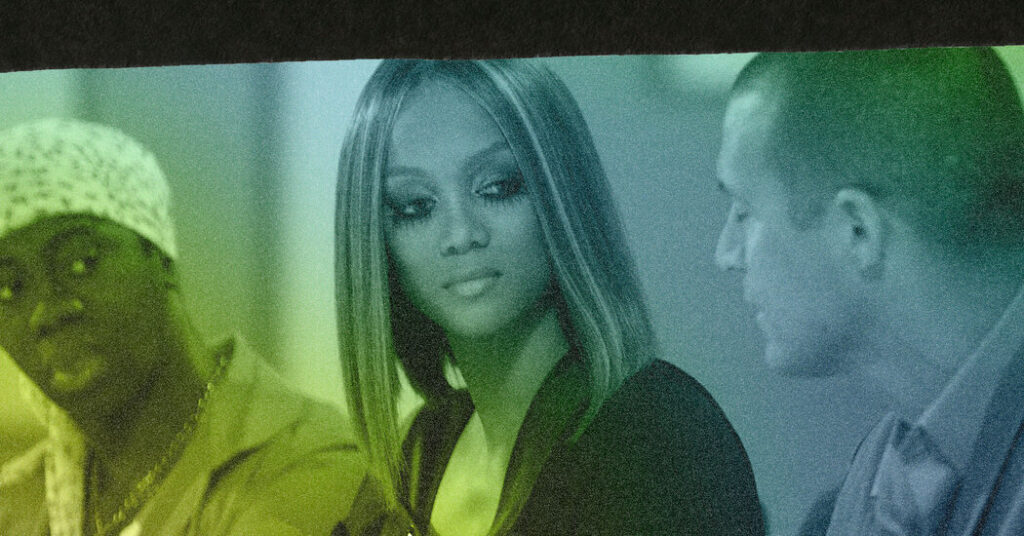
Source photograph by Danny Moloshok/CW.
Robin Givhan is a Pulitzer Prize-winning fashion critic and a former senior critic at large for The Washington Post.
The Times is committed to publishing a diversity of letters to the editor. We’d like to hear what you think about this or any of our articles. Here are some tips. And here’s our email: [email protected].
Follow the New York Times Opinion section on Facebook, Instagram, TikTok, Bluesky, WhatsApp and Threads.
The post Don’t Let Your Children Grow Up to Be Fashion Models appeared first on New York Times.