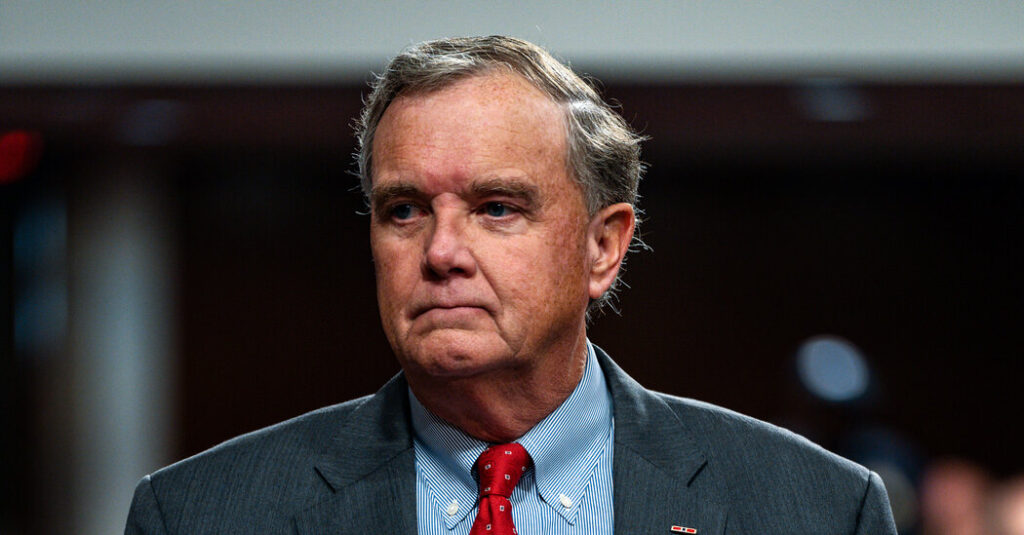
The Pentagon’s new inspector general has frozen a proposal to evaluate military targeting in the Trump administration’s strikes on boats suspected of smuggling cocaine from South America, telling his staff he wanted to consult department leadership before deciding whether the review should go forward, The New York Times has learned.
The inspector general, Platte B. Moring III, also said to staff members at a Feb. 11 meeting that the proposed project sounded as if it could become highly political, according to a person briefed on the exchange. Since then, the project has remained in limbo, with Mr. Moring neither approving nor rejecting it.
The proposal, developed by a unit of the office that assesses compliance, would examine whether the U.S. Southern Command has established and followed targeting practices and procedures in attacking boats in the Caribbean and eastern Pacific Ocean. Since September, the military has carried out 44 strikes on boats it says were suspected of smuggling drugs, killing 150 people.
The project’s fate has emerged as an early test of Mr. Moring’s tenure and of the independence of the watchdog system. Congress created the inspectors general in the post-Watergate era, charging them with hunting for waste, fraud, abuse and illegality inside the executive branch, even at the risk of embarrassing or irritating agency leaders.
Days after taking office last year, President Trump fired at least 17 inspectors general, including the Pentagon’s watchdog, Robert Storch. The mass purge raised a pointed question: whether the replacement inspectors general would act independently or see themselves as part of his administration’s political team.
Mr. Trump later nominated Mr. Moring, who had worked as a Pentagon lawyer for the first Trump administration and has no previous inspector general experience, for the Defense Department role. The Senate confirmed him in a party-line vote on a large slate of Trump nominees in late December, putting him in charge of the 1,600-employee watchdog operation for the nation’s largest employer.
Mark Greenblatt, the former chairman of the inspectors general council and the Interior Department watchdog who was among those Mr. Trump fired, said that under normal circumstances it could be appropriate to give department leaders a heads-up about a planned evaluation and seek their perspective while deciding its scope. But seeking approval or considering the political ramifications, he said, would not be.
“It depends on the inspector general’s mind-set — whether he is an independent watchdog or a lap dog for the agency leadership,” he said. “We won’t know until he either kills the idea or, if he does decide to move forward, how strong the work is.”
Mr. Greenblatt said the report from any evaluation of the boat strikes was likely to be classified, but congressional oversight committees would normally have access to it.
In written answers to questions, Mr. Moring’s office acknowledged that he had sought additional information before deciding whether to approve the project, while insisting that he “has no intention of asking for permission.” It also said he believed in “the conduct of impartial, objective and independent investigations and audit consistent with the law.”
The proposal remains open, Mr. Moring’s office added, and he “will make an independent decision on whether to proceed with the project in accordance with the I.G. Act.”
Sean Parnell, the chief Pentagon spokesman, said in a statement, “No one in the department is interfering with the independence of the I.G.”
There appear to be substantive precedents for the type of study the unit of the office, known as the evaluations component, has proposed, although they did not raise the same political ramifications.
In 2021, the office completed a report about targeting decisions in the U.S. Central Command’s area of responsibility, which includes Afghanistan, Iraq and Syria. It examined, among other questions, whether the military followed established procedures on matters like pre-strike vetting and validation and post-strike assessments, including of any civilian casualties.
Similarly, in 2020, the inspector general indicated it would evaluate targeting in the U.S. Africa Command, which includes Somalia, where there has been a yearslong campaign of drone strikes. That study appears to remain classified.
Mr. Moring’s office said those studies were “not equivalent to this project, which may involve ongoing, sensitive operational plans.” Central Command and Africa Command continued to carry out strikes that involved sensitive operational plans during those evaluations. The office did not respond to a follow-up question seeking more explanation of its basis for distinguishing them.
The office disputed one aspect of a description initially submitted by The Times, which stated that Mr. Moring had indicated that he would consult Defense Secretary Pete Hegseth and asked whether anything about the account was inaccurate. The office said Mr. Moring never stated he wanted to discuss the matter with Mr. Hegseth and had no intention of doing so.
However, asked whether Mr. Moring’s plan to discuss the matter with department leadership instead meant Stephen A. Feinberg, the deputy defense secretary, to whom Mr. Hegseth by statute can delegate supervisory authority, the office declined to answer further.
Mr. Moring’s office also did not deny the account that he had explicitly raised political considerations at the Feb. 11 meeting, even after The Times pressed the point directly.
Military strikes in the Middle East and Africa have largely consisted of counterterrorism operations conducted under Congress’s authorization for the use of military force against Al Qaeda. The boat strikes operation has drawn significantly greater legal and political controversy.
There is no congressional authorization to wage war against drug smugglers, and the military is not allowed to deliberately kill civilians who pose no imminent threat of violence, even if they are suspected of crimes. In peacetime, that is murder; in an armed conflict, it is considered a war crime.
The administration maintains the strikes are lawful because Mr. Trump has “determined” that the United States is engaged in a formal armed conflict with a secret list of 24 drug trafficking organizations he deemed terrorists. Accepting that as a premise, the Justice Department has issued a secret memo asserting that the strikes are legal, including reasoning that the purported war makes the presumed drugs aboard the vessels lawful military targets.
The first boat strike, on Sept. 2, has attracted particular scrutiny from Congress because it raised questions about whether it complied with the laws of war — questions that would arise only if one accepts the administration’s premise that a legal state of armed conflict exists. Relatives of two Trinidadian men who were apparently killed in an Oct. 14 strike have also filed a wrongful-death lawsuit.
A close study of command directives and procedures could be politically embarrassing to the administration. The Times has reported that Mr. Hegseth kept many career uniformed military officials and lawyers from the drafting of the “execute order” that guides the boat strikes. As a result, early versions of the order had holes, including a lack of language on how to deal with survivors.
At a Senate Armed Services Committee confirmation hearing in September, Senator Tim Kaine, Democrat of Virginia, brought up Mr. Trump’s firings of inspectors general and asked Mr. Moring to reassure the committee that he would be independent.
“You have my personal pledge to be independent and objective,” Mr. Moring said, adding, “I pledge to you to follow the letter and tenor” of the Inspector General Act.
But Mr. Moring has suggested that he may have a narrow view of his office’s authority under the statute.
Asked at another confirmation hearing about whether a hypothetical Pentagon action would be illegal, he demurred. Watchdog officials could play a role in “determining whether or not those agencies followed their own policy,” he said, even as he suggested it was up to general counsel, and “not within the remit of the inspector general,” to examine potential lawbreaking by an agency.
That answer struck former inspectors general as a significant misreading because investigating potential crimes is a core part of their mission. A provision of the Inspector General Act empowers such officials to investigate information “concerning the possible existence of an activity constituting a violation of law” and requires them to report such matters to Congress.
The written answers from Mr. Moring’s office also appeared to overstate Mr. Hegseth’s authority to block projects under a provision in the Inspector General Act.
The office wrote that the law authorizes the secretary to quash any inquiry that “implicates” criteria listed in that section of the law, like operational plans and intelligence matters. It added that “a major factor” in Mr. Moring’s consideration of the boat strikes proposal was “ensuring that the proposed project would not implicate one or more of the criteria.”
But the text of the statute sets a higher standard. It is not enough for a project to implicate one of the listed criteria; to prohibit an inquiry, it says, the secretary must determine “that such prohibition is necessary to preserve the national security interests of the United States.”
The Pentagon inspector general’s office has frequently scrutinized classified military operations, and there appears to be no precedent for a secretary blocking a project in the name of national security. The stakes for doing so would be significant: Mr. Hegseth and Mr. Moring would each be required within 30 days to explain what happened to Congress.
If Mr. Moring were instead to decide to shelve the project on his own, no such notice would be required.
Charlie Savage writes about national security and legal policy for The Times.
The post Pentagon Watchdog Stalls Proposal to Review Targeting in Trump’s Boat Strikes appeared first on New York Times.